Work and Leisure: Two Halves of a Good Life
Every day is shared between two kinds of time. There is the time we spend working: studying, farming, teaching, cooking, running a shop or an office. And there is the time that belongs to us, when nobody is asking us to produce anything. A healthy life needs both kinds, and it needs them in the right amounts.
Work: effort of body or mind done to produce something, to earn a living or to serve other people.
Leisure: free time, when a person is not working and can choose to rest, play, travel or follow a hobby.
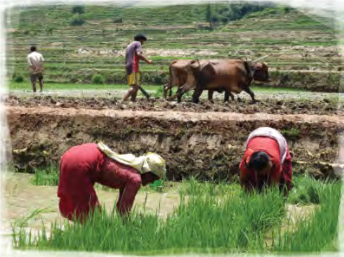



The four scenes above fall into two pairs. Farmers transplanting rice seedlings and a teacher at the blackboard are working. One feeds a country and the other educates it, and without either of them society would stop. Children splashing in a water park and two trekkers gazing at the mountains are at leisure. They produce nothing to sell, yet their time matters just as much, because play and travel rest the body, clear the mind and send people back to work with fresh energy.
Why keep the two in balance? A person who only works grows tired and stressed, falls ill more often, and usually does worse work, not better. A person who only relaxes earns nothing, learns nothing and ends up depending on others. An old English proverb puts it neatly: "All work and no play makes Jack a dull boy." A proverb is not a report about a real boy called Jack. It states a general truth: without rest and enjoyment, people become tired, bored and boring.
Work gives life its purpose and its bread. Leisure gives it energy and joy. Kept in balance, each makes the other better.
Cabbage White: A Story of a Job Gone Wrong
Sarah, who is twelve, and her brother Jamie, who is eleven, are on holiday from school. They want to earn some money and help their parents, so they walk into a large farm and hand the tall man behind the counter a card from their school. They have to stand on tiptoe to reach him, and they hardly look like farm workers. The man frowns. Farm work is tough, he tells them, and he needs somebody big and strong.
Sarah pleads with him, and the farmer decides to test them. Does she know what a Cabbage White is? She does. It is a white butterfly that lays its eggs on cabbages, and the eggs hatch into caterpillars. Jamie shouts that the caterpillars eat the cabbage leaves. When the children insist they are not afraid of caterpillars, the man gives them a job: check every single cabbage and eliminate all the caterpillars by picking them off and collecting them in pails. On the question of pay he promises only this: if he is happy with their work, he will not disappoint them. Then he leaves for his greenhouse.

The cabbage patch is enormous. "There must be a million cabbages here!" says Jamie. "At least!" replies Sarah, and if every cabbage carries ten caterpillars, she announces, that makes a billion. Jamie doubts her arithmetic but knows better than to argue. The work is hideous. The caterpillars wriggle as they are picked up, and it takes the two of them ages to finish a single row. All around them the air is full of Cabbage White butterflies, which seem to be mocking them: kill as many caterpillars as you like, we can lay millions more eggs.

Desperate, Sarah swipes at a butterfly, misses, and watches it fly gaily away. Then she has an idea that seems to her as brilliant as Einstein arriving at e=mc². Caterpillars come from eggs, and eggs come from butterflies. So if they get rid of the butterflies, there will be no more eggs and no more caterpillars. She pulls two bamboo poles out of a row of beans, which kills two bean plants, hands one pole to Jamie and charges into the cabbages swinging hers round and round. To Jamie this looks like a fine game, so he follows her.
A butterfly in flight is hard to hit, but a butterfly resting on a cabbage is easy. The trouble is that nobody can hit a butterfly on a cabbage without hitting the cabbage too. The children fight on until they are exhausted, then stand back to admire their work. There are hardly any butterflies left. There are hardly any cabbages left, either. The patch looks like a battlefield, and not one cabbage is still standing. Without a word, the two of them put down their poles and tiptoe out of the garden. "He knows our names," says Jamie. "But he does not know where we live," says Sarah. "Thank goodness," they say together.
The story is adapted from the short stories of Jake Allsop, who writes lively fiction for learners of English.
Reading Between the Lines
Cabbage White is a comic story, and most of its humour comes from the gap between what the children intend and what actually happens. They are hired to protect the cabbages and they end up destroying every one of them. A reversal like this has a name.
Irony of situation: when the result of an action is the opposite of what was intended or expected. Two children hired to save a crop flatten the whole crop.
The children also exaggerate. Nobody counted a million cabbages, and nobody counted a billion caterpillars. The numbers simply mean "far more than we can ever deal with". Sarah's sum does not even work: ten caterpillars on each of a million cabbages would make ten million, not a billion. That is part of the joke, and Jamie's silence shows he has learnt when not to argue with his sister.
Hyperbole: deliberate exaggeration used for emphasis or humour, not meant to be taken literally. "There must be a million cabbages here!" is hyperbole.
The butterflies "seemed to be mocking" the children and even seemed to speak to them. Insects cannot mock anybody, but describing them this way lets the reader feel how teased and hopeless the children felt.
Personification: giving human actions or feelings to animals, objects or ideas, as when the butterflies seem to laugh at the children.
Behind the laughter there is a serious point about work. Sarah's idea attacks the cause of the problem instead of its symptoms, which is clever thinking, but she never asks what her method will do to the crop. Good work means solving the problem you were given without creating a bigger one. And when the job goes wrong, the children run away instead of owning up. Their relief at the end is funny precisely because we know it is not the honest response.
In a True, False or Not Given question, False means the text says the opposite, and Not Given means the text says nothing either way. The children say they want to support their parents, but nothing says their parents cannot work. A statement that the parents were unable to work is therefore Not Given, not True.
Vowel Sounds: Short, Long and Combined
English has only five vowel letters, a, e, i, o and u, but it has around twenty vowel sounds. Spelling is therefore a poor guide to pronunciation, so each sound is written with its own symbol. English vowel sounds fall into two types.
Monophthong: a single vowel sound, made with the mouth held in one position. It can be short, as in sit, or long, as in seat.
Diphthong: a combination of two vowel sounds in one syllable. The mouth starts in one position and glides to another, as in boy, which moves from ɔ to ɪ.
A long vowel is marked with the sign ː after its symbol. Compare ship (ɪ) with sheep (iː), and full (ʊ) with fool (uː). The difference is not only length. The tongue and lips take a tighter position for the long sound, and changing the sound changes the word.
| Type | Sound | Spellings | Examples |
| short | ə | a, e, o, u | alive, the, today, supply |
| short | ɪ | i | thin, sit, rich |
| short | ʊ | u, oo, ou | put, look, should |
| short | e | e, ea, ie | went, bread, friend |
| short | ʌ | u, o | fun, love, money |
| short | æ | a | cat, hand, fan |
| short | ɒ | o, a | rob, top, watch |
| long | iː | ee, ea | need, beat, team |
| long | uː | ew, oo, oe | few, boot, lose |
| long | ɜː | ir, ur, wor | third, turn, worse |
| long | ɔː | al, aw, or, our, oor | talk, law, port |
| long | ɑː | a, al, ar | glass, half, car |
| diphthong | eɪ | ay, ea, ae, ai | pay, great, maid |
| diphthong | ɔɪ | oi, oy | noise, toy, choice |
| diphthong | aɪ | ie, i, ei, y | fine, like, might |
| diphthong | əʊ | o, oe, oa | no, stone, road |
| diphthong | aʊ | ou, ow | round, how, brown |
| diphthong | ɪə | eer, ear | beer, hear, steer |
| diphthong | eə | are, ere, ea, ai | care, there, bear |
Short and long sounds are both monophthongs: the mouth holds one position. A diphthong needs two mouth positions. Now try the chart on words from the story. Say each one aloud and listen to the vowel in the letters shown in brackets.
| Word | Sound | Type |
| stood (oo) | ʊ | short |
| support (u) | ə | short |
| beautiful (u in -ful) | ʊ or ə | short |
| plead (ea) | iː | long |
| seemed (ee) | iː | long |
| exhausted (au) | ɔː | long |
| bamboo (oo) | uː | long |
| their (ei) | eə | vowel combination |
| afraid (ai) | eɪ | vowel combination |
| lay (ay) | eɪ | vowel combination |
| gaily (ai) | eɪ | vowel combination |
| pail (ai) | eɪ | vowel combination |
| ground (ou) | aʊ | vowel combination |
| tiptoe (oe) | əʊ | vowel combination |
| hideous (eou) | iə | vowel combination |
The same letters can stand for different sounds. The letters ea are a short e in bread, a long iː in plead and the diphthong eɪ in great. Decide by listening, never by looking.
Asking for Permission
When we want to do something that affects another person, such as using their things, taking a seat beside them or changing the room they are in, we ask for permission. How we ask depends on who we are speaking to and how big the favour is. A small favour from a friend needs a short question. A bigger favour, or any request to a stranger or someone senior, needs a longer and more careful one. In English, the longer the question, the more polite it usually sounds.
- I wonder if I could possibly sit next to you? (the most careful, for a stranger)
- Would you mind if I opened the window? (formal)
- Would it be alright if I used your computer? (polite)
- Do you mind if I switch on the fan? (polite, a little less formal)
- Is it alright if I go out with my friends? (friendly)
- Can I ask a question? Could I borrow your pen? (everyday)
After "Would you mind if I" and "Would it be alright if I", use the past simple: "Would you mind if I sat here?", not "Would you mind if I sit here?" The past form does not mean past time. It makes the request sound more distant and so more polite. After "Do you mind if I", use the present: "Do you mind if I sit here?"
A reply either grants permission or refuses it. A refusal should still be polite, and it sounds kinder when it gives a reason.
| Granting permission | Refusing permission |
| Yes, sure. Here is the key. | I'm sorry, but this seat has been booked for my friend. |
| Yes, please feel free. | I'm afraid the battery has gone down. |
| Oh well, alright. | I'd rather you didn't, if you don't mind. |
| Go ahead. | No, please don't. It's time to go to bed. |
| OK, but don't make it late. | I'm sorry, but this is a No Smoking zone. |
"Do you mind...?" and "Would you mind...?" ask whether the listener objects. So "No, not at all" gives permission, and "Yes, I do mind" refuses it. A careless "Yes" says the opposite of what you mean.

Reporting a Request for Permission
Sometimes a third person tells others what was asked and how it was answered. This is reported speech, and two patterns cover almost every case.
- Pattern one: A asked for B's permission to do something, and B granted it or refused it.
- Pattern two: A asked B if he or she could do something, and B said he or she could or could not.
Reported, this becomes: "Pema asked for Suman's permission to borrow his bicycle, but he refused it." Or: "Pema asked Suman if she could borrow his bicycle, and he said she couldn't because he needed it that day." Notice what shifts. Can becomes could, I and your become she and his, and today becomes that day. The words move back because the conversation is now being reported rather than spoken.
Modal Verbs
Modal verb: a helping verb such as can, could, may, might, must, should, would or shall, placed before a main verb to show ability, possibility, permission, necessity, advice or willingness. A modal is followed by the base form of the verb: she must go, never she must goes or she must to go.
A short fable shows modals doing different jobs. A heron walks calmly along a riverbank looking for breakfast. All he could see in the clear water was a little fish. "This might be a good breakfast," he thinks. Then a big octopus drifts past. "A heron like me should not be happy with such a tiny fish," he tells himself. "I wouldn't even open my beak for it when I may have a lovely dinner. But I must play a trick on the octopus or it will escape." The fish and the octopus are smarter than he is. Both slip into the deep water, and the heron has to be content with a tiny snail.

| Modal | What it shows | Example |
| could | ability in the past; a polite request | All he could see was a little fish. Could you tell me the way to the airport? |
| might | a weak possibility | This might be a good breakfast. It might rain this afternoon. |
| may | possibility; formal permission | I may have a lovely dinner. May I come in? |
| should | advice, or what is right or expected | You should see that film at least once. |
| would | polite offers and invitations; willingness, and wouldn't for refusal | Would you like to stay with us? I wouldn't open my beak for that. |
| must | strong necessity; a confident conclusion | I must play a trick. She has worked all day, so she must be tired. |
| had to | necessity in the past, since must has no past form | The heron had to be content with a snail. |
| can't | impossibility; a confident negative conclusion | This can't be Safal's coat. It is too small for him. |
Deduction with must and can't: when the evidence makes us almost sure something is true, we use must. When it makes us almost sure something is not true, we use can't. For the present, use must or can't with the base verb. For the past, use must have or can't have with the past participle.
- The man keeps looking at the street signs. He must be lost.
- He has never studied medicine. He can't be a doctor.
- The fan is making a strange noise. There must be something wrong with it.
- There is a library stamp inside. This must be the library's copy.
- She is a clever student but she failed. She can't have prepared well this time.
- The food in that restaurant is always excellent. They must have hired fine chefs.
The opposite of must in a deduction is can't, not mustn't. "He mustn't be a doctor" is wrong here. Mustn't means something is not allowed, as in "You mustn't smoke in the hospital."
May and might show that something is possible but uncertain: "Jack might be in his office" means perhaps he is, perhaps he isn't. Must is far stronger. It is what you say when all the evidence points one way.
Writing a Job Application Letter
A job application letter introduces you to an employer and argues, politely, that you are the right person for a post. It is a formal letter, so its layout is fixed and its language is careful. The employer may read a hundred of them, so yours must be clear, well ordered and short enough to read in a minute.
- Your address and the date, at the top.
- The receiver's title and address, such as The Headteacher and the school's name and place.
- A subject line naming the post.
- The salutation: Dear Sir, Dear Madam or Dear Sir/Madam.
- The opening: the post you are applying for and where you saw it advertised.
- The middle: who you are, your qualifications, your experience and your skills.
- The closing: what you can offer, the documents you have enclosed and your hope to hear from them.
- The complimentary close, Sincerely or Yours sincerely, followed by your name.
The body follows a logic the reader can feel: why I am writing, who I am, what I have done, what I can do, why you should choose me, what I have attached, and a polite goodbye. Shuffle those sentences and the letter still contains the same facts, but it stops building a case.
Avoid contractions such as I'm and I've, slang, and emotional begging. Write complete sentences, keep to one page, and mention only experience that suits the post.
Before replying to an advertisement, read it like a checklist. Note the exact name of the post, every requirement (degree, years of experience, computer skills, languages, licence), the documents to send, where to send them and the deadline. A strong letter answers each requirement in turn.

Leave this Chanting and Singing


Two people may both claim to be serving God. One bows in prayer with folded hands. The other walks behind a plough in the mud. Rabindranath Tagore, the Bengali poet who in 1913 became the first Asian to win the Nobel Prize in Literature, gave a firm answer about which of them is nearer to God. The poem below comes from Gitanjali, his collection of song offerings, which he translated into English himself.
Leave this chanting and singing and telling of beads!Whom dost thou worship in this lonely dark corner of a temple with doors all shut?Open thine eyes and see thy God is not before thee!He is there where the tiller is tilling the hard groundand where the pathmaker is breaking stones.He is with them in sun and in shower,and his garment is covered with dust.Put off thy holy mantle and even like him come down on the dusty soil!Deliverance?Where is this deliverance to be found?Our master himself has joyfully taken upon him the bonds of creation;he is bound with us all forever.Come out of thy meditations and leave aside thy flowers and incense!What harm is there if thy clothes become tattered and stained?Meet him and stand by him in toil and in sweat of thy brow.
The poem is written in free verse. It has no rhyme and no regular beat, and its long lines sound like speech or prayer. It is built from commands (Leave, Open, Put off, Come out, Meet) and exclamations, which give it the urgency of someone shaking a sleeper awake. The old forms thou, thy and thine lend it the solemn tone of scripture, which is fitting, because the poem uses the language of religion to challenge the way religion is practised.
What the Poem Says
In the first stanza the speaker turns on a worshipper sitting in a dark, lonely corner of a temple with all the doors shut, chanting, singing and counting prayer beads. Who are you worshipping in here? Open your eyes, the speaker says: your God is not in front of you.
The second stanza says where God really is: out with the farmer tilling hard ground and the labourer breaking stones to build a path. He stays with them through sun and rain, and his clothes are covered in dust like theirs. So the worshipper is told to take off the holy robe and come down onto the dusty soil too.
The third stanza answers people who pray for deliverance, meaning escape from the troubles of the world. Where would such escape be found? God himself has gladly accepted the bonds of creation and is tied to the world and to us forever. If even God does not escape the world, there is no deliverance in running away from it.
The last stanza gathers everything into one instruction. Leave your meditation, your flowers and your incense. What does it matter if your clothes get torn and stained? Meet God and stand beside him in hard labour and in the sweat of your brow.
Speaker of a poem: the voice that talks in the poem. Here the speaker addresses a worshipper directly, using commands such as Leave, Open and Come out.
Archaic word: an old form no longer used in everyday English, kept in poetry, prayer or old texts to give a solemn or old-fashioned tone.
| Archaic form | Modern form | In the poem | In modern English |
| dost | do | Whom dost thou worship? | Whom do you worship? |
| thou | you (as subject) | dost thou worship | do you worship |
| thine | your (before a vowel sound) | Open thine eyes | Open your eyes |
| thy | your | thy God | your God |
| thee | you (as object) | not before thee | not in front of you |
Work is worship. Honest labour done alongside ordinary people is a truer service to God than ritual performed in a closed room.
Listening: Working Hours and Holidays
The listening task on this theme is a talk comparing working life in several countries. The questions ask how many hours a year people work in France, why employees stay at work beyond their hours, how people in Japan, Germany, Great Britain and the United States feel about their holidays, how long those holidays are, and what a well-known proverb about work and play means. The aim is not to catch every word. It is to catch particular facts.
- Read every question and every choice before the recording starts.
- Underline the key word in each question: a country, a number, a reason.
- Predict the kind of answer: a number of hours, a length of time in weeks, a country's name.
- Listen for signal words such as but, however, only, more than, less than, on average and the shortest.
- Write short notes while listening. Complete sentences can wait.
- On the second listening, check the answers you are least sure of.
Numbers are the easiest thing to mishear. 1646 and 1664 sound alike at speed, and thirteen and thirty differ only in stress. Check the unit as well: hours in a year are very different from hours in a week.
True, False and Not Given: True means the recording states the same information. False means it states the opposite. Not Given means the recording says nothing either way. Never fill a gap with your own general knowledge.
Some questions ask which idea is NOT mentioned. Here most choices will be heard and one will not, so tick each idea as you hear it and the unticked one is your answer. One statement also tests a proverb. When a speaker quotes "All work and no play makes Jack a dull boy", the proverb states a general truth about balance. It says nothing about how many dull boys there are, so do not read a figure of speech as a fact.
Imperative Sentences and What They Do
Imperative sentence: a sentence that tells or asks someone to do something. It begins with the base form of the verb and usually has no written subject, because the subject, you, is understood: "Close the door."
The same grammatical form can do very different jobs. Tone, situation and a few small words such as please, kindly and let's decide whether an imperative sounds like a harsh order or a warm invitation.
| Function | Example | What gives it away |
| making a request | Kindly lend me your notes for a day. | please or kindly |
| giving direction | Walk past the temple and turn left at the crossroads. | route and turns |
| giving instruction | Soak the lentils overnight before cooking them. | steps in a process |
| making an invitation | Please come to my sister's wedding on Saturday. | offers something pleasant |
| warning | Don't touch that wire! | danger, often an exclamation mark |
| giving advice | Drink plenty of water in the heat. | for the listener's own good |
| making a command | Hands up! | short, firm, from someone in authority |
| making an order | Leave this room at once. | authority and urgency |
| suggesting | Let's take a short break. | let's includes the speaker |
Command and order are close. Both come from someone with power over the listener. A command is a short, sharp instruction to act this moment, the kind a police officer or a drill instructor gives. An order tells someone to carry out an action and often carries anger or urgency, as in "Get out of here at once."
Making Imperatives Negative
- Put don't (do not) before the verb: Turn left at the junction. becomes Don't turn left at the junction.
- Keep please at the front: Please open the door. becomes Please don't open the door.
- With let's, put not after it: Let's play a match. becomes Let's not play a match.
- With let and a person, put don't before let: Let him tell a story. becomes Don't let him tell a story.
- For a strong, lasting ban, never can replace don't: Never leave the gas on.
Do not write "Not turn left" or "Don't turned left". The verb after don't stays in its base form. And the standard negative of let's is let's not. Forms such as "Let's don't" are informal and best kept out of written English.
Writing Rules and Regulations
Public places such as parks, libraries, hospitals and museums display notices telling visitors what they must and must not do. A notice of rules is short, clear and firm. It is not a letter and it is not an essay.
Notice: a short written announcement, displayed in public, that gives information or instructions to a particular group of people.
- The name of the body issuing it at the top, sometimes with the government office above it.
- The place.
- A title, such as Rules and Regulations for the Visitors.
- Numbered rules, one idea to each rule.
- A polite close: Thank you!
A national park notice, for instance, might set an entry fee with different rates for foreigners, SAARC citizens and Nepalis; state that the plants and animals are fully protected; forbid buying illegal animal or plant products; ask visitors to respect religious and cultural sites; require rubbish to go in the bins; and prohibit walking in the park between sunset and sunrise. Each rule is one sentence, and each is clear about who must do what.
- ... is/are (not) allowed to ...
- ... is/are strictly prohibited/forbidden to ...
- ... can/cannot ...
- ... is/are required/expected to ...
- ... must/must not ...
- Do not ... (an imperative)
Vary these expressions so the notice does not repeat one pattern, and add a short reason where a rule might otherwise seem unfair. A reason turns an order into something visitors understand and are more willing to follow.
Speaking to an Audience: Work is Worship
"Work is worship" is the belief at the heart of Tagore's poem, and it makes a strong subject for a class speech contest. The teacher acts as judge, and students from other classes can be invited as the audience. A speech is heard, not read, so it needs a clearer shape than an essay: listeners cannot turn back a page.
- Fix a date, a time limit for each speaker (three minutes works well) and the order of speakers.
- Agree with the teacher how the speeches will be marked: content, organisation, language and delivery.
- Invite another class to be the audience, and arrange the room so everyone can see the speaker.
- Prepare your speech, rehearse it aloud and time yourself.
- Greeting: address the judge, the teachers and the audience.
- Opening: a striking fact, question or picture that makes people listen.
- Body: three clear points, each with one example.
- Conclusion: repeat the main idea in one memorable sentence.
- Thanks: thank the audience for listening.
A strong opening might sound like this: "Respected judge, teachers and friends, good morning. Every grain of rice on your plate today passed through a farmer's hands in the mud. Every road you walked on this morning was built by someone breaking stones in the sun. They were not in a temple, yet I believe they were closer to God than many of us who only pray. That is what I mean by work is worship." From there, three points might be the dignity of all honest work, work as service to others, and the need to balance work with rest so that it stays a joy rather than a burden.
The full lesson is waiting for you
The notes are free to read in full. A free account opens the rest of the practice, and tracks your progress and confidence score for every subject. Presentations and videos need approval from Learn Yeti.