Wellness and Its Eight Dimensions
Ask most people what it means to be healthy and they will say it means not being ill: no fever, no pain, no visit to the doctor. Health workers and psychologists use a wider word for this, wellness. Wellness is not something you reach once and then keep. You work at it every day through ordinary choices about what you eat, how long you sleep, how you treat the people around you, how you spend your money and what you learn.
Wellness: the active, lifelong process of making choices that lead to a healthy and fulfilling life. It covers the body, the mind, relationships and surroundings. Being free of disease is only one part of it.
Wellness is usually drawn as a wheel with eight parts called dimensions. Each dimension is one area of life. When one area is neglected, the others suffer too. A student who stays up studying until three in the morning is feeding the intellectual dimension, but the body pays in tiredness, and the mood pays in irritability the next day.
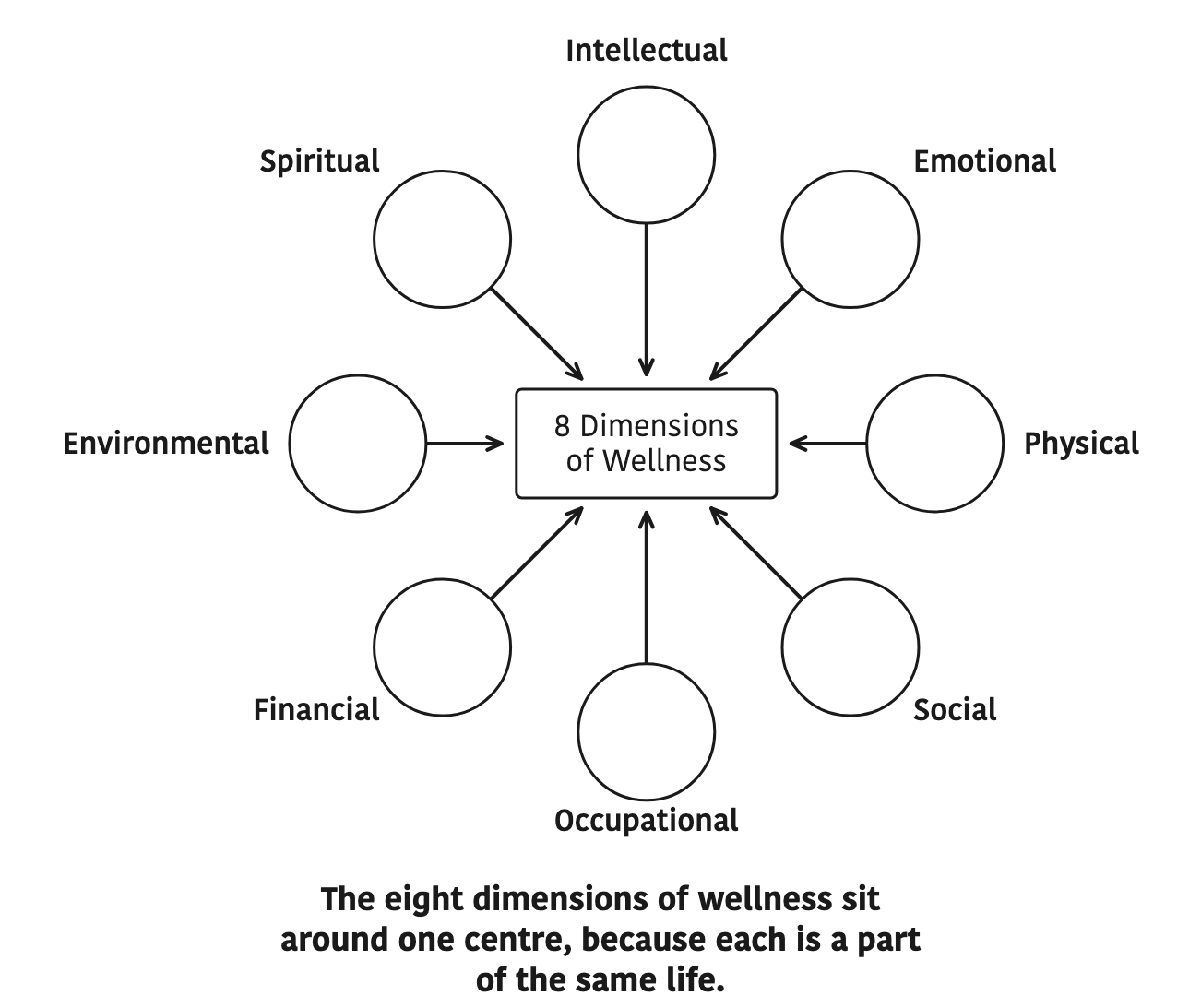
| Dimension | What it is about | An example from a student's life |
| Physical | looking after the body through exercise, food and sleep | walking to school, eating vegetables, sleeping eight hours |
| Emotional | understanding your feelings and coping with stress | talking to a friend after a disappointing result |
| Intellectual | keeping the mind curious and learning new things | reading beyond the syllabus, learning to code or play an instrument |
| Social | building good relationships and a sense of belonging | joining a club, helping a classmate who is struggling |
| Spiritual | having values and a sense of purpose | meditation, prayer, thinking about what matters to you |
| Environmental | living in clean, safe and pleasant surroundings | keeping your room tidy, planting trees, not littering |
| Financial | managing money wisely | saving part of your pocket money |
| Occupational | finding satisfaction in your work or study | choosing subjects and a career that suit your interests |
Wellness means balance. A strong body with no friends is not wellness, and neither are top marks earned with no sleep.
Reading I: A Letter from a Patient

The first reading is a letter from a mother. It is addressed to "Dear health care worker", which means it is written to every health worker who will read it rather than to one person. Letters like this are often published so that a whole profession can learn from one family's experience.
The writer calls what happened to her a parent's worst nightmare. One evening her nine-week-old baby developed an extremely high fever. The family rushed to their local community hospital, where the baby was admitted through the emergency department to the pediatric unit. Three days later they were discharged. The baby recovered, and the mother is clear that the doctors and nurses were skilled and the health outcome was fantastic. Even so, she says the family's experience was less than satisfactory. That contrast drives the whole letter: the medicine was good, but the way the staff behaved was not.
What the Letter Complains About
The mother does not complain in general terms. She gives specific examples, and each one shows staff putting something else ahead of the sick child.
- Staff bad-mouthed each other. The emergency nurses complained about the doctors' orders and about how slowly the pediatric nurses responded. The pediatric nurses complained that the emergency nurses could not get an intravenous line in. The pediatrician complained about the emergency doctor's orders. The pediatric nurse complained about the pediatrician's approach, and the pediatrician complained that the nurse could not obtain a urine sample.
- Egos came before care. From where she sat, everyone seemed so focused on their own needs and skills that they were insensible to the sick baby who needed them. She wanted to scream, "Can everyone stop complaining about each other and look after my sick baby?"
- "I am so busy today." Nurses said this again and again. Perhaps they were excusing late medications, or perhaps they wanted sympathy. In her tired head it became "your daughter is not a priority." She asks staff not to use patients and families as their personal confidante.
- Nobody read the chart. At every visit from a physician and their students she was asked the same questions: "Was she premature?" and "Was your delivery normal?" The answers must already have been written down.
- Her daughter was called a boy. Most of the staff referred to the baby as male. The baby wore only a diaper, so nothing showed her gender, but her paperwork surely said she was female. Tired and stressed, the mother began to wonder what other mistakes were in the paperwork. The error left her with a sense of sloppiness and lack of focus.
Her requests follow from these complaints. Make patients and families your priority, because your job is to restore health. Share positive news as though you are happy too. Use the chart: read it, write on it and refer to it. Be careful about what you say and how you say it. When you make a mistake, apologise genuinely and make a sincere effort not to repeat it. Patients need to know that you are listening and that you care.
Near the end comes a twist. "I am a health care worker just like you," she writes. She admits that she has said some of these same things herself, and promises to be more careful with patients and families after her daughter's stay. She reminds her colleagues that healthcare is not a glamorous career and that people trust them with their loved ones at their most vulnerable. Her final line puts the responsibility on each reader: you alone have the power to positively shape the patient's experience. She signs herself "An appreciative mother".
How the Letter Works as Writing
This letter criticises strongly and still persuades, and that is worth studying. The writer begins with thanks before she complains. She uses exact examples and quotes people's words instead of making vague accusations. She tells the reader how she felt, so a reader can imagine being in that hospital room. Then she turns complaints into advice, mostly in the form of imperative sentences: "Do not use patients or their families as your personal confidante." "Use the chart, read it, write on it and refer to it." "Please be careful of what you say to patients."
Most importantly, she includes herself. By saying "I am not innocent" and "this is our job", she writes as a colleague rather than an enemy. Readers accept criticism far more easily from someone who admits the same fault. That is also why the signature "An appreciative mother" is not a contradiction. She is grateful for the care, and she complains because she wants the care to be better.
A complaint persuades best when it is specific, fair and ends by showing a better way.
Reading II: A Healthy Diet for a Healthy Life
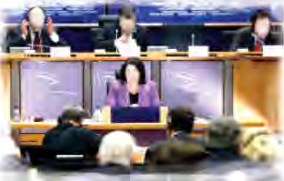
The second reading is a formal speech. It is an adapted version of the opening address given by Maire Geoghegan-Quinn, European Commissioner for Research, Innovation and Science, in Brussels on 28 March 2014. She was opening an international conference on the Joint Programming Initiative (JPI) called "A Healthy Diet for a Healthy Life". Her audience were researchers and officials from the member states of the European Union (EU).
Joint Programming Initiative (JPI): an arrangement in which EU member states plan and fund research on a shared problem together instead of each country working alone. In the speaker's words, they pool their knowledge.
The Argument of the Speech
The speech moves step by step from a problem to a call for action. Following the steps in order is the easiest way to understand and remember it.
- A familiar topic. Diet is never out of the media. There are endless arguments about whether carbs, fat, sugar or protein are good or bad, and endless reports of some new wonderfood that will stop cancer or help us live longer.
- The problem. Diet and lifestyle-related diseases such as overweight and obesity are sometimes described as the greatest public health challenge of our times. Every member state faces it to some degree, so it makes sense, both scientifically and economically, to pool knowledge.
- The evidence. When the initiative was launched, the Council of the European Union noted that over the previous three decades levels of overweight and obesity in the EU had risen dramatically, particularly among children. The trend of poor diet and low physical activity was getting worse.
- The hope. Many chronic conditions, such as cancer, neurological and mental disorders, cardiovascular diseases, obesity and type 2 diabetes, can be prevented or modified through better lifestyles and healthier diets. Research projects are showing how diabetes and obesity can be prevented, how they progress, how early diagnosis improves quality of life and how to choose the best treatments. Much more is still needed because obesity and diabetes have trans-generational effects.
- The tool. Horizon 2020 is Europe's 80-billion-euro research and innovation programme, designed to tackle society's biggest challenges. Two of its challenges matter most here: food safety and the bioeconomy, and health, demographic change and wellbeing. For seven years they will fund the best research on nutrition, health, diet-related disease and ageing, and turn it into products, treatments, services and strategies.
- Cooperation. This will need an unprecedented level of cooperation along the healthcare innovation chain.
- A new approach. Campaigns for healthier eating have not yet changed how people buy and consume food. So research must be multidisciplinary and include the social sciences, because understanding people's behaviour and their relationship with food and exercise is vital to helping them choose better.
- Action. Good intentions are pointless unless they become concrete action. Implementation will start by coordinating national research programmes. She encourages the audience to explore other avenues, such as linking with other JPIs and using shared European research infrastructure. Above all, she urges the member states to unlock national funding and to align their research programmes and innovation policies.
- The close. She wishes them an excellent conference, full of innovative ideas and interesting discussions, and says she looks forward to hearing the results.
The healthcare innovation chain is called a chain because each link depends on the one before it. Researchers first characterise a disease, which means working out what it is and how it behaves. Others use that knowledge to develop biomarkers, diagnostics and medicines. Finally, regulators evaluate these and approve them for use.

How a Formal Speech Is Built
A speech is written for listeners, not readers. A listener cannot turn back a page, so the speaker has to signpost clearly and keep each idea short. This speech follows the pattern most formal speeches use.
- Salutation: a greeting to the audience, here "Ladies and gentlemen".
- Opening: the speaker names the occasion and her pleasure at being there: "I'm delighted to have the honour of opening this international conference."
- The problem: a clear statement of what is wrong, with evidence.
- The solution: what is being done and what could be done.
- The appeal: a direct call to the audience to act, with verbs like urge and encourage.
- Closing: the salutation again, good wishes and "Thank you".
Listen for the signposts that hold the speech together: "That's why", "But despite the improvements", "Unfortunately", "That's where", "So", "Above all". The speaker also says "we" and "our" to make the audience partners in the task, and addresses them directly as "you" when she asks them to act.
Greet, open, state the problem, offer the solution, appeal and thank. That is the skeleton of any formal speech, including the one you will write on exercise or obesity.
Pronunciation: Short /ʊ/ and Long /uː/
English spells two different vowel sounds with the same letters, oo. Say book and then food slowly, and you will feel the difference in your lips and in the length of the sound.
Short /ʊ/: a short, relaxed vowel. The lips are only slightly rounded and the sound is cut off quickly, as in book, good and foot.
Long /uː/: a long vowel. The lips are tightly rounded and pushed forward, and the sound is held, as in food, school and moon. The mark ː after a phonetic symbol means the sound is long.
Pairs of words that differ only in this sound are the best practice: full and fool, pull and pool, look and Luke. If you say them the same way, a listener cannot tell which one you mean. Here are nineteen common oo words sorted by their sound.
| Short /ʊ/ as in book | Long /uː/ as in food |
| book | food |
| cook | moon |
| foot | noon |
| good | roof |
| look | school |
| hook | too |
| stood | zoo |
| took | zoom |
| wood | mood |
| wool |
The spelling oo does not tell you the sound, so learn each word with its sound. The same two sounds also come in other spellings: /ʊ/ in put, full, could and woman; /uː/ in blue, rule, shoe and fruit. Roof is said with a short sound by some speakers, but /ruːf/ with the long sound is the standard form to learn.
Speaking: Reporting What Someone Told You
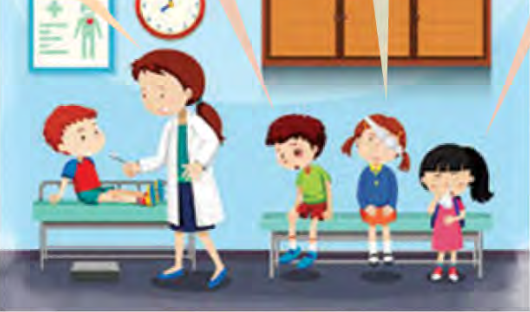
The doctor speaks in commands. The children do not repeat her exact words. They report them, and the words change shape: "Don't eat" becomes "forbade him to eat", and "Get plenty of rest" becomes "told him to get plenty of rest". In everyday speaking this often happens in three steps. Someone gives an instruction, a second person asks what was said, and a third person reports it.
Reporting a whole set of instructions, such as how to fold a paper boat, uses the same pattern again and again. To keep it from sounding repetitive, link the steps with sequencing words and vary the verb: "First, she told me to fold the paper in half on the longest side. Then she asked me to fold it in half again and open it out once. After that, she told me to fold the top two corners to the middle line."
Grammar: Imperative Sentences in Indirect Speech
There are two ways to tell someone what another person said. You can quote the exact words, or you can report their meaning in your own sentence. This unit teaches how to report one kind of sentence: commands, requests and advice.
Direct speech: the speaker's exact words, written inside quotation marks. The teacher said, "Close the window."
Indirect speech (reported speech): the speaker's meaning reported in the reporter's own sentence, without quotation marks. The teacher asked me to close the window.
Imperative sentence: a sentence that gives a command, makes a request or offers advice. It usually begins with the base form of a verb and has no subject: Sit down. Please help me. Drink more water.
Reporting verb: the verb that introduces reported speech and shows what kind of speech it was, such as told, ordered, requested, advised or warned.
To-infinitive: to followed by the base form of a verb: to go, to eat, to close.
Five rules turn any imperative into indirect speech.
Rule 1: Replace said or said to with a reporting verb that shows whether the speaker was commanding, requesting or advising.
She said, "Keep quiet!" becomes "She instructed me to keep quiet." "Please close the window," the teacher said becomes "The teacher asked me to close the window."
Rule 2: Put the person spoken to directly after the reporting verb, with no preposition.
The guide said to the visitors, "Stay together." becomes "The guide told the visitors to stay together." You write told the visitors, never told to the visitors.
Rule 3: The verb of the imperative changes into the to-infinitive.
I said to my friend, "Please explain this lesson to me." becomes "I requested my friend to explain that lesson to me."
Rule 4: If the imperative is negative, put not before the to-infinitive. Don't becomes not to.
The doctor said, "Don't overeat." becomes "The doctor urged me not to overeat." The teacher said to the boys, "Don't make noise." becomes "The teacher asked the boys not to make noise."
Rule 5: Leave out the words of address. Please disappears because the reporting verb already shows the request, and a name used to call someone (a nominative of address, or vocative) becomes the person after the reporting verb.
The teacher said, "Muna, come to the office." becomes "The teacher told Muna to go to the office." Notice that come has become go. Pronouns, and words of time and place, also change to suit the reporter's point of view: me becomes her or him, this becomes that, here becomes there. He said to me, "Please wait here till I return." becomes "He requested me to wait there till he returned."
Here is one sentence taken through every step: "Please lend me your pen," Sita said to Hari.
- Step 1: Decide what kind of imperative it is. The word please shows it is a request.
- Step 2: Choose a reporting verb for a request: requested.
- Step 3: Put the person spoken to after the verb: Sita requested Hari.
- Step 4: Change lend into the to-infinitive: to lend.
- Step 5: Drop please, the comma and the quotation marks.
- Step 6: Change the pronouns to fit the reporter: me becomes her, and your becomes his.
- Result: Sita requested Hari to lend her his pen.
Do not keep the imperative form or add a subject after the reporting verb. "The doctor told me do exercise" and "He ordered us we got out of his way" are both wrong. Write "The doctor told me to do exercise" and "He ordered us to get out of his way." Do not write "said me to" either. Use told me to.
Choosing the Reporting Verb
An imperative always carries one of three meanings: a command, a request or a piece of advice. The reporting verb you choose shows the listener which one it was, and a good choice also shows tone. Ordered sounds stern, begged sounds desperate, and advised sounds caring.
| Verbs of command | Verbs of request | Verbs of advice |
| tell, order, command, bid, require, forbid | ask, request, desire, beg, solicit, beseech, pray, entreat, implore | advise, exhort, urge, persuade |
Other useful verbs are warn, remind, instruct, encourage and invite. They all take the same pattern: verb, then the person, then the to-infinitive.
| Direct speech | Indirect speech |
| The officer said, "Stand in a line!" | The officer ordered us to stand in a line. |
| "Please pass the salt," Grandma said to me. | Grandma requested me to pass the salt. |
| The dentist said, "Brush twice a day." | The dentist advised me to brush twice a day. |
| "Remember your umbrella, Anu," he said. | He reminded Anu to take her umbrella. |
| She said, "Don't touch the wire!" | She warned me not to touch the wire. |
| The guard said, "Don't enter." | The guard forbade us to enter. |
Forbid already means tell not to, so it never takes not. "The doctor forbade me to eat junk food" is right, and "forbade me not to eat" says the opposite. Also keep advise, the verb with an s, apart from advice, the noun with a c: "She advised me to rest" but "Her advice was to rest."
Special Cases: Let's, Let Me and Modal Verbs
Rule: When let's in direct speech makes a proposal or suggestion, report it with suggest or propose followed by that and should.
He said, "Let's play outside." becomes "He suggested that they should play outside." Pranik said, "Let's go out." becomes "Pranik suggested that we should go out." The coach said, "Let's play a friendly football match." becomes "The coach proposed that they should play a friendly football match."
Let me is different. It is a request for permission, so it is reported with request and let: He said to me, "Let me do my work." becomes "He requested me to let him do his work."
Some instructions are not written as imperatives at all. "You must submit your assignment soon" is a command, and "You should see a doctor" is advice. Report them by their meaning: "The teacher told us to submit our assignment soon." "He advised Mrs Tamang to see a doctor." An old-fashioned imperative such as "Be not afraid, noble prince" follows the same rules: "The Guru told the noble prince not to be afraid."
Suggest cannot be followed by a person and a to-infinitive. "He suggested us to go out" is wrong. Write "He suggested that we should go out" or "He suggested going out."
Listening: Lactose Intolerance

The listening task is an interview in which a doctor, Dr Carla Shapiro, is asked about lactose intolerance. Some background knowledge will help you follow it. Milk contains a natural sugar called lactose. To digest it, the small intestine produces an enzyme called lactase, which splits lactose into simpler sugars the body can absorb. A person who makes too little lactase cannot digest lactose properly, and after eating dairy food they may get bloating, gas, stomach cramps or diarrhoea.
Lactose intolerance: difficulty in digesting lactose, the sugar in milk, because the body makes too little of the enzyme that breaks it down. It is a digestive problem, not an allergy.
Enzyme: a substance made by living cells that speeds up a chemical change in the body, such as breaking down food.
The task asks you to complete sentences and answer questions while you listen. You are not listening for every word. You are listening for particular pieces of information, so decide before the recording starts exactly what each gap needs.
- The topic the doctor talks about, which is named near the start.
- What all babies have that helps them break down the sugar in milk.
- The people or places where lactose intolerance is generally not a problem.
- The food culture that developed the ability to break down lactose.
- The kind of products food industries have made for people with the problem.
- What the doctor calls a big problem for many people, two digestive problems, a percentage of the world's population, why people began to depend on milk, and an alternative for people who are lactose intolerant.
Use these three habits every time you do a listening task.
- Before listening: read every gap and question, and predict the kind of word needed. "All babies have ______ that helps to break the sugar in milk" needs a noun, and the word helps tells you it is something that does a job.
- While listening: listen for key words from the question, then catch the words just after them. Write short notes, not full sentences, and note every number exactly.
- After listening: check that each completed sentence is grammatical and that the spelling is right.
Most listening marks are lost before the recording starts, when the gaps have not been read. Predict first, then listen.
Writing I: An Email of Apology
Imagine you work at the hospital in the patient's letter and you have read the mother's complaints. The task is to write her an email that apologises and assures her that the hospital's services will improve. An apology is only believed if it is specific. "Sorry for any inconvenience" admits nothing. "We discussed our colleagues in front of you" admits the real fault.
- To and Subject: the address, and a short subject line that says what the email is about.
- Greeting: a polite, formal greeting such as Dear Madam.
- Opening: who you are and why you are writing.
- The apology: name each mistake plainly and take responsibility for it. Do not make excuses.
- The assurance: say exactly what will change, so she can see that her letter made a difference.
- Closing: thank her, offer further contact, and sign off with Yours sincerely, your name and your position.
An apology loses its value when it turns into an excuse. "We were very busy that week" is exactly what upset the mother. Explain what you will change, not why it happened.
Writing II: A Speech on Obesity
Obesity has become a growing concern in recent years, including among young people in Nepal. A speech on it can be built from three guiding questions, and each question gives you one part of the body of the speech.
- What are the primary causes of obesity? Think of diet high in fat, sugar and salt, junk food and sugary drinks, too little physical activity, long hours at screens, poor sleep and stress.
- What are its consequences? Think of type 2 diabetes, high blood pressure, heart disease, joint pain, low confidence and teasing.
- What should an individual do to avoid it? Think of balanced home-cooked meals, water instead of sugary drinks, daily exercise, less screen time and enough sleep.
Wrap those three parts in the frame of a formal speech: a salutation, an opening that introduces the problem, the three parts in order, a short appeal to the audience and a closing thank you. Use short sentences and signposts such as "First", "What are the consequences?" and "So what can we do?" so that listeners always know where they are.
Project Work: Your Own Wellness Wheel
The project brings the unit back to where it started. You design a wellness wheel of your own, showing what you actually do to stay healthy, and present it to the class.
- Draw a large circle and divide it into eight equal parts, one for each dimension of wellness.
- In each part, write two or three real activities you do: morning walks under Physical, keeping a diary under Emotional, saving money under Financial.
- Colour each part according to how well you look after it, dark for strong and pale for weak.
- Choose one weak dimension and write one change you will make.
- Present your wheel. Speak from notes, explain your strongest and weakest dimensions, and end with your plan.
The full lesson is waiting for you
The notes are free to read in full. A free account opens the rest of the practice, and tracks your progress and confidence score for every subject. Presentations and videos need approval from Learn Yeti.