Festivals Around Us
Every community sets aside certain days as special. On those days people put their ordinary work aside, wear new or bright clothes, cook food they do not eat every day, visit relatives and worship together. Such an occasion is a festival. Some festivals are religious, some mark the harvest or the start of a new year, and many are a mixture of all of these. Nepal alone keeps festivals from many faiths and communities, and each one tells you something about the people who celebrate it: what they believe, what they grow and what they choose to remember.
Festival: a day or a period of celebration, usually religious, cultural or seasonal, that a community keeps every year with special customs, food and gatherings.
Four celebrations show how varied festivals can be.
- Holi is the festival of colours. People smear coloured powder on one another and throw coloured water, and by the end of the day faces, hair and clothes are streaked with pink, yellow and green.
- Eid is the great festival of Muslims. Eid al-Fitr marks the end of Ramadan, the month of fasting. Families gather at the mosque for prayer, embrace one another and share sweet dishes.
- Machhindranath Jatra is the chariot festival of Lalitpur. A towering chariot, its spire covered with green branches, is pulled through the streets by crowds of devotees. Rato Machhindranath is worshipped as a giver of rain, so the festival is closely tied to a good harvest.
- Biska Jatra is celebrated in Bhaktapur around the Nepali New Year. A huge wooden chariot is pulled by two groups from opposite parts of the town, each trying to drag it towards its own side.

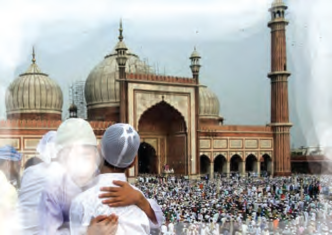
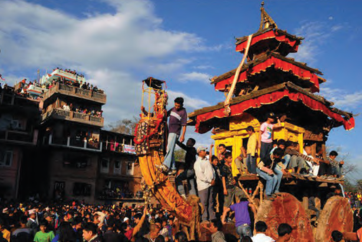
When you talk about a picture of a festival, work from the outside in. First describe what you can see: the people, their clothes, the place. Then say what they are doing. Last, say what feeling the scene gives you. For example: 'Hundreds of people are crowding round a tall wooden chariot. Some young men have climbed onto it and are shouting to the crowd. The whole square looks noisy, crowded and joyful.' When you talk about your own favourite festival, give its name, when it falls, what your family does, and why you like it more than the others.
Reading: Battle of the Oranges
This reading is a piece of travel journalism. A writer named Margherita visits the carnival of Ivrea, a town in northern Italy, where for three days every year crowds fight a battle in the town square using oranges as weapons. She writes in the first person ('I') and in the present tense ('I am hit in the chest'), so the reader seems to stand beside her and feel every orange land.
Carnival: a public festival, usually held once a year, with processions, costumes, music and wild, playful behaviour in the streets.
The piece opens in the middle of the action. The writer sees a flash of orange, is hit hard in the chest, slides backwards and falls bottom first into a pile of orange mush. Her first thought is to touch her head: her red hat is still there. That hat matters. During the carnival, official notices are plastered on the walls around Ivrea ordering people, especially tourists, to wear a red hat. Anyone without one can be treated as a 'fair target for gentle and moderate orange-throwing'.
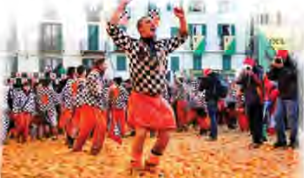
The red hat is not just any hat. It is the berretto frigio, a sock-shaped cap sold on every street corner, and it is the symbol of the carnival itself. It also stands for freedom. In Roman times it was worn by slaves who had been set free, and in the Middle Ages it was worn by peasants rioting against their feudal lords.
The red hat does two jobs. In history it is a symbol of freedom. At the carnival it is a signal to the throwers: this person is a spectator, not a fighter.
Back on her feet, the writer makes sure her hat is on and visible. Almost at once she is hit again, this time on the forehead. Her head jerks back, she wipes her face and sees red. She thinks it is blood and imagines stitches, even a concussion. Then she remembers blood oranges, a kind of orange whose flesh and juice are deep red. Shivering from the quick succession of shock and relief, she retreats to the back of the square, away from the flying fruit.
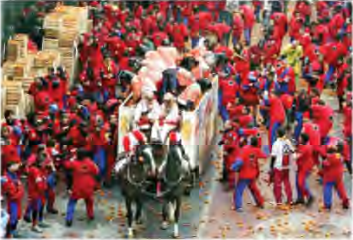
Now she can watch the battle properly. This is the first of three yearly battles, and everyone is fresh and excited after a year of waiting. Nine teams of aranceri (orange-throwers) on foot, wearing uniforms, hurl oranges at their opponents, who ride in horse-drawn carriages. The riders are clad in costumes that look like something from the science-fiction series Doctor Who: padded shoulders and leather-covered cylindrical helmets. After an hour the square is covered in a thick sludge of orange pulp and horse manure, and it smells sharp and sweet-and-sour.
The aranceri rush to the sides of the square, where orange crates are stacked, and fill their shoulder bags and baggy tops. As soon as a cart comes near, they charge and bombard it. The horses halt for a few minutes, oranges explode against the cart, then it moves off and the throwers chase it, hurling the last of their supplies. They wear no protection. Their hair is caked with orange bits and juice runs down their faces. Some have broken noses; some clutch a cheek, an arm or their ribs. Still they hold their heads high and shout their team's war cries.
Two local people explain why anyone would do this. Silvia sits with the writer, holding half an orange against her swollen eye and sipping mulled wine. 'This is the moment we wait for all the year,' she says. She believes the carnival is good for people's psychological health: for three days she can let out all the frustrations she has built up during the year, and afterwards she feels refreshed. Accidents happen, she admits, but she urges the writer to try it. Massi, a thrower from the Morte team with a gigantic skull on the back of his orange-stained uniform, goes further. Volunteers advise the public to stay behind protective nets, but Massi says, 'Forget the nets. If you want to live the carnival, you have to be in the middle of the battle.' Asked whether he is afraid of getting hurt, he laughs: compared with the rush of excitement, a black eye is a small price to pay.
The ending is quiet and honest. Massi fills his top with oranges, a cart approaches, and he invites the writer to throw away her red hat and join him. She is tempted, but she declines.
Notice how the writing works, because you will use the same tools yourself.
- First person and present tense put the reader inside the event: 'I slide backwards', 'I touch my head'.
- Very short sentences carry sudden moments: 'Then I remember blood oranges.'
- Details reach every sense: the flash of colour, the blow to the chest, the sweet-and-sour smell of the square.
- Real people speak in their own words, in quotation marks, so the reader hears them directly.
- The writer laughs at herself: her panic over the 'blood' turns out to be fruit juice.
Word Stress
Say the word 'retreat' aloud. It breaks into two beats, re and treat, and the second beat is stronger than the first: re-TREAT. Each beat is a syllable, and the stronger beat carries the stress.
Syllable: a unit of sound in a word that contains one vowel sound. 'Pot' has one syllable, 'hap-py' has two, 'cel-e-bra-tion' has four.
Word stress: an extra force used when pronouncing a particular syllable of a word. The stressed syllable is said a little louder, longer and higher than the others.
Count syllables by vowel SOUNDS, not vowel letters. 'Explode' has three vowel letters but only two vowel sounds, so it has two syllables: ex-PLODE. In a dictionary, stress is shown by a small raised mark written just before the stressed syllable.
Stress can change meaning. 'PRES-ent' with stress on the first syllable is a noun or an adjective: a gift, or here now. 'pre-SENT' with stress on the second syllable is a verb: to give or to show. A listener who hears the wrong stress may hear the wrong word, so stress is part of the word, not decoration.
The Seven Rules of Word Stress
English stress is not fixed to one position, but it follows patterns. These seven rules cover most everyday words.
- A word of one syllable is stressed on that one syllable: 'do, 'pot, 'song, 'read.
- Nouns, and most adjectives and adverbs, of two syllables are stressed on the first syllable: FA-ther, HAP-py, UN-der, PRES-ent.
- A verb of two syllables is stressed on the second syllable: cor-RECT, pre-SENT, be-LIEVE.
- Most three-syllable nouns and adjectives are stressed on the first syllable: POL-i-tics, GEN-er-al, DEL-i-cate, EX-cel-lent. Words with a long vowel sound near the end are the exception: en-gi-NEER.
- Three-syllable verbs are stressed on the first syllable: OR-gan-ize, DEC-o-rate, SIG-ni-fy. Verbs that begin with a prefix are the exception: re-MEM-ber, con-TIN-ue.
- Words ending in -cy, -ty, -phy and -gy are stressed on the third syllable from the end: de-MOC-ra-cy, un-CER-tain-ty.
- Compound nouns are stressed on the first part: HAIR-brush, SOME-thing, CLASS-room, BREAK-fast, FOOT-ball.
One more pattern helps with the long words in this unit: words ending in -tion and -sion are stressed on the syllable just before the ending, as in tra-DI-tion and con-FU-sion.
| Word | Syllables | Stressed syllable |
| song | one: song | the only one |
| harvest | two: HAR-vest | first (noun) |
| decide | two: de-CIDE | second (verb) |
| festival | three: FES-ti-val | first (noun) |
| decorate | three: DEC-o-rate | first (verb) |
| photography | four: pho-TOG-ra-phy | third from last (-phy) |
| tradition | three: tra-DI-tion | just before -tion |
| classroom | two: CLASS-room | first part of a compound |
These rules describe tendencies, not laws. 'Hotel' is a two-syllable noun, yet it is stressed on the second syllable: ho-TEL. When you are unsure, check the stress mark in a dictionary.
Reporting a Question Aloud
Reporters spend their working lives passing on what people asked and answered. In the orange battle, the writer asks Massi a question face to face. Later, someone telling the story to a friend passes that question on in their own words.


Compare the two sentences and five changes appear.
- A reporting verb comes first: 'The reporter asked Massi'.
- The word 'if' joins the question to the reporting verb.
- The question order 'Aren't you' becomes the statement order 'he was not'.
- The pronoun changes from 'you' to 'he', and the present 'are' moves back to the past 'was'.
- The question mark disappears; the sentence ends with a full stop.
Practise this in pairs. Imagine a young woman asking an older man about a festival dance he knew in his youth. She asks: 'Have you ever seen Chandi Naach?' Reported, that becomes: She asked him if he had ever seen Chandi Naach. She asks: 'How did you dance?' Reported: She asked him how he had danced. One partner reads a question aloud and the other reports it at once, without writing it down. Speaking quickly like this is how the pattern becomes automatic.
Grammar: Reported Questions
Direct speech: the exact words a speaker used, written inside quotation marks. Example: Agaman said to Timothy, 'Are you working tonight?'
Reported speech (indirect speech): an account of what someone said, without quotation marks and not in their exact words, with pronouns, tenses and time words changed to fit the moment of reporting. Example: Agaman asked Timothy if he was working that night.
Yes/no question: a question that can be answered 'yes' or 'no'. It begins with a helping verb such as are, is, do, did, have, can or will. Example: 'Is this the road to the station?'
Wh-question: a question that begins with a question word such as what, where, when, why, who, which, whose, how, how many or how long. It asks for information, not for yes or no. Example: 'Where will you stay tonight?'
Reporting verb: the verb that introduces reported speech. For questions it is asked, inquired, wanted to know or wondered, never 'said'.
A reported question is no longer a question. It is a statement about a question. That one idea is behind every rule below: once the words leave the quotation marks, they take the order of an ordinary statement, subject first and verb second, and they lose the question mark.
To report a yes/no question, follow these steps.
- Step 1: Change 'said' or 'said to' into a reporting verb: asked, inquired or wanted to know.
- Step 2: Join the question with 'if' or 'whether'.
- Step 3: Put the subject before the verb, in statement order.
- Step 4: Move the tense one step back into the past.
- Step 5: Change pronouns, and words of time and place, to suit the reporter.
- Step 6: Remove the question mark and end with a full stop.
Worked example: Agaman said to Timothy, 'Are you working tonight?' 'Said to' becomes 'asked'. The joining word is 'if'. 'Are you' becomes 'you are', then 'you' becomes 'he' and 'are' moves back to 'was'. 'Tonight' becomes 'that night'. The result: Agaman asked Timothy if he was working that night.
To report a wh-question, use the same steps with one difference: the question word itself is the joining word, so 'if' is not added. The helping verbs do, does and did disappear, and their tense passes to the main verb.
Worked example: I said to him, 'Where will you stay tonight?' 'Where' stays as the joining word. 'Will you stay' becomes 'he would stay'. 'Tonight' becomes 'that night'. The result: I asked him where he would stay that night.
Worked example with 'did': Kritika asked me, 'Why did you go out last night?' 'Did' disappears and its past meaning moves to the verb, which goes one step further back: 'went' becomes 'had gone'. The result: Kritika asked me why I had gone out the previous night.
When the question word is itself the subject, the order is already a statement order and does not move. 'How many players were shown a yellow card by the referee?' becomes: Sumangal asked his friend how many players had been shown a yellow card by the referee.
Do not keep the question order after the reporting verb. 'She asked me where was I going.' is wrong. 'She asked me where I was going.' is right.
Do not keep do, does or did in a reported question. 'He asked me what did I eat.' is wrong. 'He asked me what I had eaten.' is right.
Words still inside quotation marks are direct speech and keep their question form. The salesperson said to him, 'What can I do for you?' is correct, because the question is being quoted, not reported.
'If' and 'whether' mean the same in a reported yes/no question. 'Whether' is a little more formal and is the natural choice when 'or not' follows: The head teacher asked her whether or not she had filled out the exam form.
Tense and Time Word Changes
When the reporting verb is in the past (asked, wanted to know), the verb inside the reported question usually moves one step back into the past.
| In the direct question | In the reported question |
| present simple: Do you live in Patan? | past simple: if I lived in Patan |
| present continuous: Are you working? | past continuous: if he was working |
| present perfect: Have you been to Paris? | past perfect: if he had been to Paris |
| present perfect continuous: How long have you been working? | past perfect continuous: how long she had been working |
| past simple: Did you do your homework? | past perfect: if she had done her homework |
| past continuous: What were you doing? | past perfect continuous: what she had been doing |
| will: Where will you live? | would: where I would live |
| can: Can you remember? | could: if he could remember |
| may: May I come in? | might: if he might come in |
| is going to: What are you going to do? | was going to: what I was going to do |
Words of time and place change too, because the reporter is speaking at a different time and often in a different place.
| Direct | Reported |
| now | then |
| today | that day |
| tonight | that night |
| yesterday | the day before / the previous day |
| last night | the previous night / the night before |
| tomorrow | the next day / the following day |
| last week | the week before / the previous week |
| next week | the following week |
| ago | before |
| this / these | that / those |
| here | there |
If the reporting verb is in the present, nothing moves back: She asks me what time it is. The tense change happens only because the reporting is done later, in the past.
Writing an Essay about a Festival
Essay: a piece of connected writing on one subject, organised into an introduction, a body of several paragraphs and a conclusion.
An essay describing a festival of your community has to cover six things: its brief history, the people involved, its major activities, its religious or social importance, how long it lasts, and its drawbacks, if any. A reader who has never seen the festival should be able to picture it and understand why it matters.
- Introduction: name the festival, say which community celebrates it and when, and give one sentence on what it means.
- History: the legend or event it began with, told briefly.
- People and duration: who takes part and how many days it lasts.
- Activities: what happens, day by day or from morning to night, with specific details of food, clothes, songs and rituals.
- Importance: what the festival means religiously and what it does for families and society.
- Drawbacks: honest problems such as waste, expense, noise, gambling or accidents.
- Conclusion: your own view, and how the festival could be kept alive in a better form.
Use the present simple for customs that happen every year ('Sisters put a tika on their brothers' foreheads'), and the past tense for the history ('The festival began when...'). Name real things: the dish, the song, the god, the place. A sentence like 'People enjoy it very much' says nothing a reader can picture.
Reading: Thanksgiving around the World
Festivals are more than entertainment. They reflect a people's heritage, culture and traditions. Thanksgiving is the clearest example: a festival held to give thanks for the harvest, to enjoy plentiful food and to spend time with family and friends. It seems uniquely American, but the same tradition is kept in many countries in different forms. This reading is a feature article: a short introduction, followed by one section for each country.
Thanksgiving: a festival held to give thanks, above all for the harvest, marked by a large family meal.
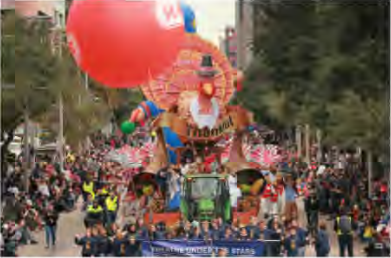
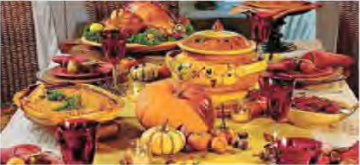
The USA. Thanksgiving is a national holiday held on the fourth Thursday of November. It commemorates the feast the Pilgrims held after their first harvest in 1621, attended by 90 Native Americans and 53 Pilgrims, and it has been celebrated intermittently ever since. The family dinner is at its centre: Americans eat more on Thanksgiving Day than on any other day of the year, including Christmas. Roast turkey is essential, and about 45 million turkeys are eaten every year, along with mashed potatoes, sweet potatoes, sweet corn and assorted fall vegetables, all foods native to the Americas. Parades range from small-town affairs with the local marching band to Macy's Thanksgiving parade in New York, billed as the world's largest parade, with floats and huge balloons based on cartoon characters, Broadway shows and other topical themes.
South Korea. Chuseok, also known as the Harvest Moon Festival, is held on the 15th day of the eighth month of the lunar calendar. It commemorates the autumn harvest and honours one's ancestors, and it is one of the most popular holidays in Korea. Traditionally, Koreans return to their ancestral hometowns to celebrate with their families. The day begins with a ceremony in which food and wine are offered to the ancestors, followed by a meal of fish and newly harvested vegetables and grains.
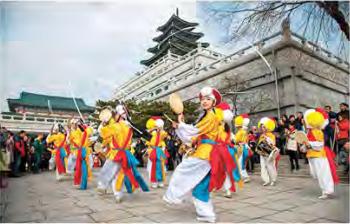
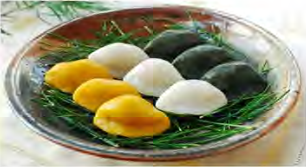
The food most linked with Chuseok is songpyeon, a crescent-shaped rice cake steamed on a bed of pine needles. Later in the day, celebrants visit the graves of relatives, where more ceremonies are held. Chuseok is also marked by gift giving and athletic events such as tug-of-war, archery contests and ssireum, Korean wrestling, as well as dancing and music. Many Koreans wear the hanbok, their traditional clothing.
Brazil. Here Thanksgiving is a fairly new festival, but it is celebrated with great gusto. The former Brazilian President Gaspar Dutra visited the USA, was fascinated by the holiday, and established it in his own country in 1949. Dia de Acao de Gracas begins with a mass to give thanks for an abundant harvest; then comes a vibrant carnival, and revellers head to the beach. Roast turkey is still the centrepiece of the feast, with an exotic twist: cranberries do not grow in Brazil, so a sauce made from jaboticaba, known as the 'Brazilian grape', is spread on the bird.
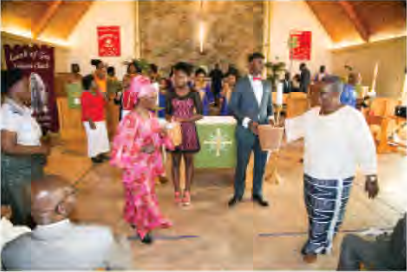
Liberia. Liberian Thanksgiving is vibrant and spicy. It was founded in the 19th century by liberated American slaves, and it gives thanks for freedom. Liberians celebrate the good things in life while also remembering their troubled past. After a church service, families gather for roasted chicken, green bean casserole and mashed cassava, all generously doused with spices. The feast is topped off with an evening of dancing, singing and celebration.
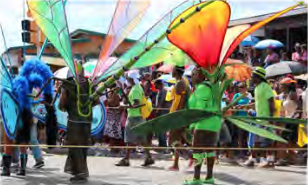
Barbados. Crop Over is Barbados's biggest party. It spreads over 12 weeks, from May until August, and culminates in a massive finale, the Grand Kadooment. It began as a celebration of the sugar cane harvest and has been held since the 1780s, when Barbados was the world's largest producer of sugar. Carnivals pervade the long celebrations, and calypso bands and dancers compete in ever grander and more flamboyant displays.
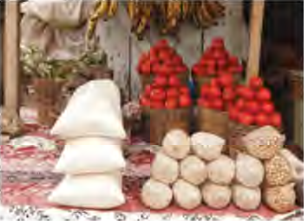
Ghana. The name Homowo means to jeer or hoot at hunger. The festival celebrates the end of a long famine suffered by the Ghanaians in the past, and what better way to celebrate the end of shortage than a feast? Palm nut soup with fish is served with traditional kpokoi, a kind of grits made from unleavened corn dough and palm oil. The season starts in May with the sowing of millet. After a ban on drumming and singing, meant to encourage proper care of the crops, the festival takes place through August and September. It culminates in a night of singing, dancing and frantic drumming in loud defiance of hunger and famine.
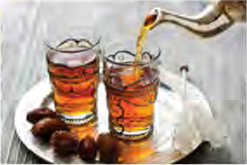
Iran. Mehregan dates back at least to the 4th century BC and is held on the 196th day of the Iranian year. It celebrates a successful harvest and the goddess Mehr. People wear new clothes, receive community blessings and share a feast on a table decorated with marjoram. The spread includes sherbet drinks and lavish dinners; in some villages a sheep is sacrificed and slow-roasted through the day. Revellers rub kohl around their eyes as a good omen and throw handfuls of marjoram, lotus and sugar plum seeds over one another.
| Country | Festival | When | Gives thanks for | Special custom or food |
| USA | Thanksgiving | fourth Thursday of November | the harvest (first feast in 1621) | roast turkey, Macy's parade |
| South Korea | Chuseok | 15th day of the eighth lunar month | the autumn harvest and ancestors | songpyeon, return to hometowns |
| Brazil | Dia de Acao de Gracas | since 1949 | an abundant harvest | mass, carnival, jaboticaba sauce |
| Liberia | Thanksgiving | since the 19th century | freedom | church service, spicy feast |
| Barbados | Crop Over | May to August, 12 weeks | the sugar cane harvest | calypso, Grand Kadooment |
| Ghana | Homowo | May, then August and September | the end of a famine | kpokoi, palm nut soup, drumming |
| Iran | Mehregan | 196th day of the Iranian year | the harvest and the goddess Mehr | marjoram, sherbet, kohl |
Every one of these festivals says thank you, but not always for the same thing. Five give thanks for a harvest, Liberia gives thanks for freedom, and Ghana celebrates the end of hunger. Korea also turns its thanks towards its ancestors.
Listening: Talking about Special Days
Not every special day is an old festival. Some are modern days that many countries share, each with its own purpose. Two pictures introduce the listening task.


| Special day | When | What it is about |
| April Fool's Day | 1 April | playing harmless tricks and jokes on people |
| Earth Day | 22 April | protecting the environment |
| Mother's Day | second Sunday of May in many countries | thanking and honouring mothers |
| Father's Day | third Sunday of June in many countries | thanking and honouring fathers |
| New Year's Eve | 31 December | the night before the new year, often with parties |
Nepal marks its own Mother's Day and Father's Day on new-moon days of the lunar calendar, when children visit their parents, bring sweets and gifts, and look at their faces with respect.
In the listening task, five speakers each talk about one of these days: April Fool's Day, Earth Day, Mother's Day, Father's Day and New Year's Eve. You do two things. First, decide whether each speaker likes or dislikes the day and tick the right column. Second, hear the five speakers again and decide whether statements about each of them are true or false: whether a co-worker played tricks, whether a book club planted flowers, whether a mother enjoyed a mess in the kitchen, whether someone went to a family dinner, whether neighbours had a noisy party.
Listening for attitude means listening for the words that show feeling, not only for facts.
- Words that show liking: I loved it, I had a great time, it was wonderful, I really enjoyed it, it was the best day.
- Words that show dislike: I can't stand it, I'm not a fan, it was awful, it drove me mad, I couldn't sleep.
- Tone of voice matters as well: a flat, tired voice can mean dislike even when the words sound polite.
A speaker may describe something nice and then say they did not enjoy the day overall, or the other way round. Decide only after the speaker has finished. Watch for small negatives such as didn't and wasn't, which turn a statement from true to false.
Before the recording starts, read every statement and underline its key words: co-workers, tricks, book club, flowers, kitchen, breakfast in bed, party, family dinner, neighbours. Then you know exactly what to listen for. Afterwards, tell the class about a special day you celebrated this year: what the day was, what you did, who was with you, and whether you liked it.
Reading a Report of an Interview
A report of an interview is where reported questions are most at home. Nihar Chaudhary interviewed her Social Studies teacher, Mr. Sudeep Prasad Joshi, about Ihi, a Newari tradition, and then wrote a report of what she learned. Almost nothing in it is in quotation marks. Her questions and his answers are all reported.
Here is what the report tells us. Ihi is a Newari ceremony in which pre-adolescent girls are married to the Suvarna Kumar, a symbol of the god Vishnu. It is done to ensure that the girl becomes and remains fertile, and it was started as a way to escape the Sati tradition: a girl married to Vishnu would never be a widow, even after the death of her mortal husband. It is performed for girls between the ages of five and nine. It is also known as Bel Bibaha, because a bel (wood apple) fruit is given as a witness to the marriage. The bel is chosen because it has the peculiar quality of not rotting, and for this reason it is considered Divya Purusha, an incarnation of the god. The ritual goes on for two consecutive days, which is tiring for the girl and her parents, and during the ceremony the participants cannot eat certain foods and drinks, especially those with salt.
You can work backwards from a report to the questions that were really asked. The report says: 'I asked him why it was done.' The direct question was: 'Why is it done?' Each fact in the report also answers a question the interviewer must have asked, even when the report does not say so.
| In the report | The direct question |
| I asked him why it was done. | Why is it done? |
| Ihi is a Newari ceremony in which girls are married to the Suvarna Kumar. | What is Ihi? |
| It is performed for girls between the ages of five and nine. | At what age is it performed? |
| It is known as Bel Bibaha because a bel fruit is given as a witness. | Why is it called Bel Bibaha? |
| He explained why this particular fruit was chosen. | Why is the bel fruit chosen? |
| The ritual goes on for two consecutive days. | How long does the ritual last? |
| Participants could not eat certain foods, especially those with salt. | What can't the participants eat? |
The same skill lets you choose the right form in a sentence. After a reporting verb, pick the choice in statement order and in the past: Sujita asked her mother when her father would come home, not when will her father come home. Inside quotation marks, pick the question form: I said to her, 'Have you ever had caviar?'
Writing a News Story
News story: a short, factual report of a recent event, written for a newspaper, website or bulletin, that gives the most important information first.
Headline: the short title in bold above a news story that tells the main point in a few words.
Lead: the opening paragraph of a news story, which answers the main questions who, what, when, where and why in one or two sentences.
A news story is built like an upside-down pyramid. The most important facts come first, the supporting details come next, and background comes last. An editor short of space can cut the last paragraph without losing the news.
- Headline: short and clear, often leaving out small words: 'Vitamin A Capsules Given to Children'.
- Dateline: the place and date of the report.
- Lead: who did what, to whom, when and where.
- Body: further details, such as numbers, ages, who announced it, and what else is included.
- Background: history or context, such as when the programme began.
The language is plain, factual and in the third person. Use the past tense for what has happened, the passive where the action matters more than the doer ('Capsules will be given'), and name your source ('according to the Department of Health Services'). Leave out your own opinions.
Project Work: A Festival Questionnaire
Questionnaire: a set of written questions given to a number of people in order to collect information from them.
A questionnaire is the tool for finding out about the festivals your friends celebrate. Good questions are short, ask one thing at a time and are easy to answer. Mix closed questions, which have a fixed answer, with open questions, which invite a longer reply.
- What is your name, and which community do you belong to?
- Which is the main festival celebrated in your family?
- In which month is it celebrated, and how many days does it last?
- Why is it celebrated?
- What special food is cooked?
- What activity do you enjoy most during the festival?
- Do you see any drawback in the way it is celebrated today?
After collecting the answers, write a brief report. Give it a title, say how many friends you asked, group the festivals you found, and describe the most interesting findings. This is where reported speech is the natural language: 'I asked Sonam when her family celebrated Lhosar. She said that they celebrated it in winter.' End with what you learned about the variety of festivals in your class, then present the report aloud.
The full lesson is waiting for you
The notes are free to read in full. A free account opens the rest of the practice, and tracks your progress and confidence score for every subject. Presentations and videos need approval from Learn Yeti.