Looking at Places: Villages, Towns and Cities
Every place has a character of its own. A hill village of slate roofs under a snow peak, a tight cluster of stone houses on a dry slope, a crowded city spread around an ancient stupa, and a wide new road with arched gateways: each shows a different way of living. When we set two places side by side and say how they are alike and how they differ, we are comparing and contrasting. This unit is built around that one skill. You will read a comparison, hear one, speak one and write one, and you will learn the grammar that makes a comparison precise.

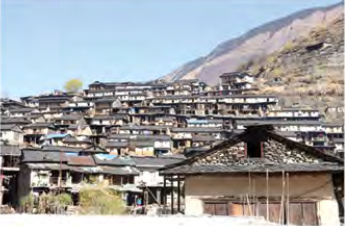


Look at the four places above and notice what changes from one to the next: the number of buildings, the materials they are made of, the space between them, the land around them and how busy each place seems. Those are the points of comparison. A good comparison always picks a point and then says something about both places on that point. Here are sentences that do exactly that:
- The village below the snow peak looks greener and more peaceful than the city.
- The stone village is more tightly packed than the mountain village, but both are built on steep slopes.
- The city around the stupa is far more crowded than either village.
- The new road is much wider than any path in the two villages, although it looks less busy than the city streets.
Comparing: showing how two or more things are alike, and in what ways one has more or less of a quality than the other. Contrasting: showing how they are different from each other.
Reading I: London vs Paris
London and Paris are two of the most visited cities on Earth, and travellers often cannot decide which to choose. 'London vs Paris' is a piece of travel journalism written for exactly that reader. It does not tell a story. It takes one topic at a time (location, size, culture, food, cost, entertainment, transport, tourism, sights, people and weather) and sets the facts about the two cities against each other, so that the reader can make up their own mind.

Location and history. London is the capital of the United Kingdom and also its largest city. It stands on the River Thames in South East England, and its history goes back to Roman times. Paris is the capital of France, in the north-central part of the country, on the River Seine. It has a rich European history and is regarded as a world centre for culture, fashion, art and gastronomy, which is the art of choosing, cooking and eating good food.
Size. London is one of the largest metropolitan areas in Europe, covering about 1,572 square kilometres. Paris covers only about 105 square kilometres, so London is roughly fifteen times larger. Yet Paris is one of the most densely populated cities in Europe, with about 20,700 people living in each square kilometre.
Culture. Visitors are often surprised by the cultural gap between the two cities, which comes from the difference between England and France. In England a handshake is the normal greeting, and the British assume that everyone speaks English. The French accept a handshake, but a kiss on the cheek is the conventional hello; a visitor who is uneasy with that can brush cheeks and kiss the air. The French are protective of their language, and Parisians are pleased when a foreigner tries to speak French, however rusty it is. When French urbanites meet for a drink, they head to a cafe and take their time over espressos.
Food and cost. France is famous for its cuisine, and Paris restaurants have earned more Michelin Stars than London's. London's food should not be written off, though. Because people come to London from all over the world, its restaurants have embraced food from many cultures, and its vibrant mix offers a wide array, from cheap curries to fish and chips. Paris is known for its bread, pastries and baguettes. Both cities are expensive to live in, but London is more expensive overall. Groceries and other consumer goods cost less in London, while local transport and utility bills are cheaper in Paris. For a traveller on a budget, Paris is the pocket-friendly choice.
Entertainment and transport. London has the advantage in leisure. It has 380 public libraries to Paris's 69 and 240 museums to Paris's 153. Football fans lean towards London, which has six major clubs in the top league, while Paris has only one, Paris Saint-Germain (PSG). London's transport network is widespread: six international airports (London City, Gatwick, Heathrow, Luton, Stansted and Southend) against three in Paris (Beauvais, Orly and Charles de Gaulle), about 22,500 registered taxis against 17,000, and twice as many bus and train lines. Paris, however, has subway stations that are more evenly spread, and it is steadily expanding a new tramway network.
Tourism and planning a visit. In a 2018 report by MasterCard, London was the second most visited city in the world after Bangkok, and Paris came third. Tourists also spend more money in London. Three to four days are enough to see the main sights of Paris, while four to five days suit London. In Paris a visitor should see the Eiffel Tower, the Louvre, the Palace of Versailles and Disneyland; in London, the London Eye, Warner Bros Studio and Big Ben.
People and weather. Locals in both cities are warm and welcoming, but it is easier to get to know someone in Paris. Londoners tend to keep to impenetrable cliques, small closed groups that are hard for a stranger to enter. Parisians are a little culture-sensitive but fun once you know them. In both cities a visitor must watch out for pickpockets and chuggers. London's weather is mild, so it can be visited at any time of year, though autumn is best, when the weather is pleasant and the city is full of events and festivals. The best time for Paris is June to August, when the days are long and sunny. The writer ends without a winner: which city is better depends on what you are looking for and on what you value.
London and Paris Side by Side
| Point | London | Paris |
| Status | Capital and largest city of the United Kingdom | Capital of France |
| River | Thames, in South East England | Seine, in north-central France |
| Area | About 1,572 square kilometres | About 105 square kilometres |
| Crowding | Spread over a far larger area | About 20,700 people per square kilometre |
| Greeting | A handshake | A kiss on the cheek, though a handshake is accepted |
| Food | A wide array from many cultures | Famous cuisine, more Michelin Stars, bread and pastries |
| Cost | More expensive overall; groceries cheaper | Cheaper transport and utility bills |
| Libraries | 380 | 69 |
| Museums | 240 | 153 |
| Top-league football clubs | Six | One (PSG) |
| International airports | Six | Three |
| Registered taxis | About 22,500 | About 17,000 |
| Tourists in 2018 | Second in the world | Third in the world |
| Days needed | Four to five | Three to four |
| Best time to visit | Any time; autumn is best | June to August |
How the Article Builds a Comparison
The article is easy to follow because every paragraph deals with one point and gives both cities a turn. Notice the small words that swing the reader from one city to the other. They are the tools you will need in your own writing:
- while: 'London has 380 public libraries, while Paris has 69.'
- on the other hand: 'Paris, on the other hand, is the capital city of France.'
- although: 'Although Paris is smaller in terms of area, it is one of the most densely populated cities in Europe.'
- nonetheless: 'Nonetheless, London's food should not be written off.'
- both ... but: 'Both London and Paris are known for their high cost of living, but London is more expensive.'
A fair comparison gives facts about BOTH places on EACH point, and it saves the final judgement for the end. This article even leaves the judgement to the reader.
The article says four to five days in London are enough 'to swindle across the streets'. Swindle normally means to cheat someone, usually out of money. The writer means to wander or roam about the city. In your own writing, use 'wander' or 'stroll' for that meaning.
Pronunciation: Intonation
Intonation: the rise and fall of the voice across a sentence. It tells the listener whether we are stating, asking, requesting or have not finished speaking.
Falling intonation (↘): the voice drops on the last stressed word. It is used for statements, commands, requests, wishes, exclamations and wh-questions (questions beginning with what, where, why, when, who, which or how).
Rising intonation (↗): the voice goes up at the end. It is used for yes/no questions, and for a part of a sentence that is not finished yet, such as a name called out before the main statement or the first half of a two-part sentence.
| Sentence | Pattern | Why |
| Please, have your ↘seat. | Falling | A polite request |
| Have a nice ↘trip. | Falling | A wish |
| Where does your brother ↘live? | Falling | A wh-question |
| ↘Thank you! | Falling | An exclamation |
| I am a me↘chanic. | Falling | A statement |
| Why did the man ↘call you? | Falling | A wh-question |
| Do you remember the time when we first met in ↗Japan? | Rising | A yes/no question |
| Is it Shrijana who topped the ↗list? | Rising | A yes/no question |
| Kumud attended the ↗test but did not ↘pass it. | Rising, then falling | The first half is unfinished; the second half completes it |
| Mr. ↗Pandey, he is our new ↘manager. | Rising, then falling | The name opens the sentence; the statement closes it |
A question mark does not always mean a rising voice. 'Where does your brother live?' asks for information, so it falls. Only a question that can be answered yes or no, like 'Is it Shrijana who topped the list?', normally rises.
Speaking: Comparing and Contrasting
In conversation, we compare things by agreeing, adding a point and then turning to a difference. Listen to how two friends talk about a traditional house and a modern one.


Roshan uses a comparative adjective, 'smaller than'. Sujita agrees by saying the same fact in a new way, 'not as big as', and then turns to a contrast with 'However', adding 'more artistic than'. Those three moves (compare, agree, contrast) are the pattern to copy. The pairs below each come with the adjectives or adjectival phrases to use.
Adjectival phrase: a group of words that does the job of an adjective, describing a noun. Examples: 'attractive to look at', 'easy to tame', 'economical to run', 'pleasant to shop at'.
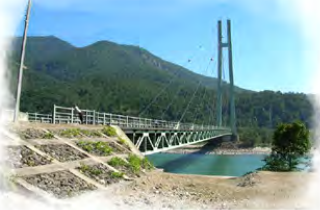
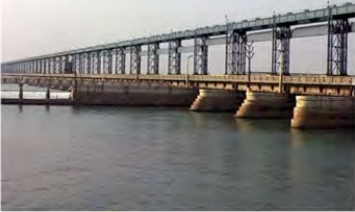
Bridges: long, attractive to look at, wide.
Dogs: big, easy to tame, hairy.


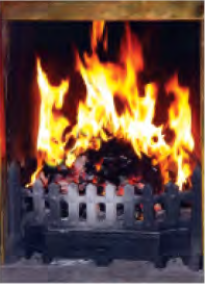
Heaters: clean, economical to run.

Shops: pleasant to shop at, wide range of goods.


Grammar I: Adjectives and Adverbs
Adjective: a word that describes a noun or pronoun. It tells us what kind, which one or how many. Example: 'The quiet children listened.'
Adverb: a word that describes a verb, an adjective or another adverb. It tells us how, when, where or how much. Many adverbs are formed by adding -ly to an adjective. Example: 'Sunil walked quietly to the kitchen.'
To choose between the two forms, find the word being described. If it is a person or thing, use the adjective; if it is an action, use the adverb. In 'The cook patiently removed the boiling pot', patiently tells us how the cook removed the pot, so it is an adverb. In 'My poor family can't afford a car', poor describes the family, so it is an adjective.
Rule for linking verbs: after verbs that link a subject to a description (be, seem, look, feel, become, appear), use an adjective, not an adverb. Example: 'Suraj is calm under pressure.'
- Adjective: 'She gave a soft answer.' (describes the answer)
- Adverb: 'She answered softly.' (describes how she answered)
- Adjective after a linking verb: 'The kitten looked timid.'
- Adverb with an action verb: 'The kitten peered timidly from under the couch.'
'Suraj is calmly under pressure' is wrong, because 'is' is a linking verb and needs an adjective. Likewise, 'The teacher spoke loud' should be 'The teacher spoke loudly', because loudly describes the action of speaking.
Degrees of Comparison
Degrees of comparison: the three forms of an adjective or adverb. The positive degree names a quality (heavy). The comparative compares two things (heavier). The superlative picks one out of three or more (heaviest).
- Most one-syllable words add -er and -est: long, longer, longest.
- Two-syllable words ending in -y change y to i and add -er and -est: heavy, heavier, heaviest.
- Longer words take more and most: complicated, more complicated, most complicated.
- Adverbs ending in -ly take more and most: quickly, more quickly; beautifully, more beautifully; gracefully, more gracefully.
- Some adverbs have the same form as the adjective and add -er: fast, faster; hard, harder; long, longer.
- Some words are irregular: good and well become better and best; bad and badly become worse and worst.
| Positive | Comparative | Superlative |
| heavy | heavier | heaviest |
| long | longer | longest |
| complicated | more complicated | most complicated |
| well | better | best |
| quickly | more quickly | most quickly |
| fast | faster | fastest |
'as ... as' and 'not as ... as': the positive degree placed between two 'as' shows two things are equal, or with 'not', that one falls short of the other. Example: 'The Karnali Bridge is not as long as the Koshi Bridge.'
To make a comparison stronger, put 'much' or 'far' before the comparative: 'The journey by bus takes much longer than by plane.' 'London is far larger than Paris.' A comparative is usually followed by 'than', and the superlative usually has 'the' before it: 'London is the largest city in the United Kingdom.'
Never use more and -er together. 'Metal is more heavier than wood' is wrong; say 'Metal is heavier than wood.' In the same way, 'more better' is wrong; 'better' is already comparative.
Writing I: Comparing Two Cities
A couple of paragraphs comparing Kathmandu with another city in Nepal is a small version of the London and Paris article. Work through it in this order:
- Choose the second city and list four or five points of comparison: location, size and crowding, famous places, climate, what life is like.
- Note one fact about each city for every point, so that no point is one-sided.
- Open with a sentence that introduces both cities and says what they share.
- Give the similarities in one paragraph and the differences in the next, using comparatives and linking words such as while, whereas, however and on the other hand.
- Close with a sentence of judgement: which city suits whom, and why.
Model: Kathmandu and Pokhara are the two cities most visitors to Nepal see first, and both depend heavily on tourism. Each is the capital of a province: Kathmandu is also the capital of the whole country and lies in Bagmati Province, while Pokhara is the capital of Gandaki Province. Both are surrounded by hills, and from both a visitor can see the Himalaya on a clear day.
There the likeness ends. Kathmandu is much bigger, busier and noisier than Pokhara. Its streets are crowded, its traffic is heavy and its air is often dusty. However, it is far richer in history, with ancient sites such as Pashupatinath, Swayambhunath and Boudhanath. Pokhara is calmer and cleaner. Its greatest treasure is natural rather than historical: Phewa Lake, with the peak of Machhapuchhre reflected in it on a still morning. A student of history will prefer Kathmandu, whereas someone looking for rest and fresh air will find Pokhara more pleasant.
Reading II: The Country Mouse and the City Mouse
The story of a country mouse and a city mouse is one of Aesop's fables, told for more than two thousand years. This version is a poem by Richard Scrafton Sharpe. It makes the same kind of comparison as the article, between country life and city life, but instead of facts it uses a story, and instead of leaving the choice to the reader it ends with a clear lesson.
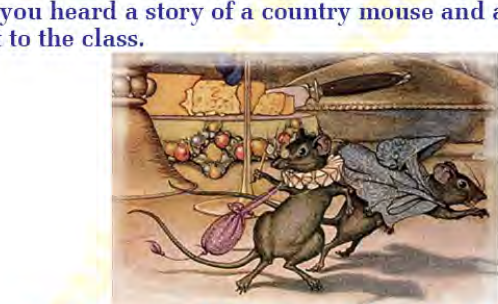
In a snug little cot lived a fat little mouse,Who enjoyed, unmolested, the range of the house;With plain food content, she would breakfast on cheese,She dined upon bacon, and supped on grey peas.A friend from the town to the cottage did stray,And he said he was come a short visit to pay;So the mouse spread her table as gay as you please,And brought the nice bacon and charming grey peas.The visitor frowned, and he thought to be witty:Cried he, 'You must know, I come from the city,Where we all should be shocked at provisions like these,For we never eat bacon and horrid grey peas.'To town come with me, I will give you a treat:Some excellent food, most delightful to eat.With me shall you feast just as long as you please;Come, leave this fat bacon and shocking grey peas.'This kind invitation she could not refuse,And the city mouse wished not a moment to lose;Reluctant she quitted the fields and the trees,The delicious fat bacon and charming grey peas.They slily crept under a gay parlour door,Where a feast had been given the evening before;And it must be confessed they on dainties did seize,Far better than bacon, or even grey peas.Here were custard and trifle, and cheese cakes good store,Nice sweetmeats and jellies, and twenty things more;All that art had invented the palate to please,Except some fat bacon and smoking grey peas.They were nicely regaling, when into the roomCame the dog and the cat, and the maid with a broom:They jumped in a custard both up to their knees;The country mouse sighed for her bacon and peas.Cried she to her friend, 'Get me safely away,I can venture no longer in London to stay;For if oft you receive interruptions like these,Give me my nice bacon and charming grey peas.'Your living is splendid and gay, to be sure,But the dread of disturbance you ever endure;I taste true delight in contentment and ease,And I feast on fat bacon and charming grey peas.'
What the Poem Says, Stanza by Stanza
- Stanza 1: A plump country mouse lives in a warm little cottage, free to roam the whole house without being disturbed. She is content with plain food: cheese for breakfast, bacon for dinner, grey peas for supper.
- Stanza 2: A mouse from the town wanders to the cottage for a short visit. She sets her table cheerfully and serves him her best bacon and peas.
- Stanza 3: The visitor frowns and tries to be clever. In the city, he says, everyone would be shocked by such food; nobody there eats 'horrid' grey peas.
- Stanza 4: He invites her to town and promises excellent food that she can feast on for as long as she likes.
- Stanza 5: She cannot refuse so kind an invitation, and he is in a hurry. Unwillingly, she leaves the fields, the trees and her simple meals.
- Stanza 6: They creep under the door of a grand parlour where a feast was held the night before, and they seize on delicacies far better than bacon and peas.
- Stanza 7: The table holds custard, trifle, cheesecakes, sweets, jellies and twenty other things: everything a cook could invent to please the taste, except bacon and peas.
- Stanza 8: In the middle of the feast the dog, the cat and a maid with a broom burst in. The terrified mice jump into a custard up to their knees, and the country mouse longs for her bacon and peas.
- Stanza 9: She begs her friend to get her away safely. She cannot stay in London any longer; if such interruptions are common, she would rather have her own plain food.
- Stanza 10: His life is splendid and cheerful, she admits, but he lives in constant fear of being disturbed. She finds true delight in contentment and ease, and her bacon and peas are a feast to her.
The Message and the Craft of the Poem
The moral: a simple life lived in peace is better than a rich life lived in fear. Contentment matters more than luxury.
| Country mouse's life | City mouse's life | |
| Food | Plain: cheese, bacon, grey peas | Rich: custard, trifle, cheesecakes, jellies |
| Home | A snug little cottage | A grand parlour in London |
| Safety | Unmolested, never disturbed | Interrupted by a dog, a cat and a maid with a broom |
| Feeling | Contentment and ease | Splendour, but constant dread |
Fable: a short story, often with animals that talk and behave like people, written to teach a lesson.
Moral: the lesson a fable teaches, usually about how to live or behave.
Rhyming couplet: two lines in a row that rhyme. Each stanza of this poem is two couplets, so its rhyme scheme is AABB: mouse and house, cheese and peas.
Refrain: a line or phrase repeated through a poem. Here almost every stanza ends on 'grey peas', which keeps the country mouse's simple food in the reader's mind.
Watch how the refrain changes with the speaker. When the city mouse talks, the peas are 'horrid' and 'shocking'. When the country mouse talks, they are 'charming' and 'delicious'. The same food is judged two ways, and by the end of the poem the reader agrees with the country mouse. The poem is also gently comic: the proud city mouse ends up knee-deep in custard.
In this poem 'gay' has its old meaning: bright, cheerful and lively. 'She spread her table as gay as you please' means she laid it out brightly and happily.
Listening: Quebec City and Montreal
Before listening, warm up by comparing two provincial capitals of Nepal that you know. For example, Pokhara is the capital of Gandaki Province and Janakpur is the capital of Madhesh Province. Both are important centres for their regions and both attract visitors. They differ in setting and character: Pokhara lies among hills beside Phewa Lake, and is known for mountain views and trekking; Janakpur lies on the flat plains of the Terai and is famous for the Janaki Temple and Mithila art.
The recording is a conversation in which Dave asks a friend about the province of Quebec in Canada. Two cities come up: Quebec City and Montreal. You have two tasks. First, you decide which city each of five statements describes and tick the correct column. Second, you listen again and decide whether five statements about Dave's trip are true or false.
Read every statement before the audio begins and underline its key word. That word is what you listen for:
- 'the biggest city': listen for size words such as biggest, largest, most people.
- 'the capital of the province': listen for capital, government or parliament.
- 'The St. Lawrence River runs through it': listen for the river's name.
- 'third-largest French-speaking city': listen for French and for a number such as third.
- 'Many of the buildings are very old': listen for old, historic or centuries.
- For Dave's trip: listen for why he is going, which languages people speak, how long he will stay, how good his French is and whom he will visit.
Numbers that sound alike trap careless listeners. 'Forty' is stressed at the start (FOR-ty), while 'fourteen' is stressed at the end (four-TEEN). Listen to where the stress falls before deciding whether 'forty days' is true.
To finish, talk briefly about your favourite city. Say where it is, what it is known for and why you like it, and compare it with one other place. Model: 'My favourite city is Pokhara. It is smaller and calmer than Kathmandu, and the air is much cleaner. I love walking beside Phewa Lake early in the morning, when Machhapuchhre is reflected in the water.'
Grammar II: Connectives of Contrast and Reason
Connectives join ideas and show how they relate. Some show a reason (why something happened) and some show a contrast (something surprising or opposite). The key to using them correctly is to know what kind of words follow each one.
because / because of: both give a reason. 'Because' is followed by a clause, with a subject and a verb: 'We stayed indoors because it was snowing.' 'Because of' is followed by a noun or noun phrase: 'We stayed indoors because of the snow.'
although: shows contrast and is followed by a clause. 'Although the shop was small, it sold everything we needed.'
despite / in spite of: show contrast and are followed by a noun, a noun phrase or an -ing form, never by a full clause. 'Despite the rain, the match went on.' 'In spite of feeling tired, he finished his homework.'
however: shows contrast between two sentences. It usually begins the second sentence and is followed by a comma. 'The hotel was expensive. However, the view was worth it.'
but: shows contrast and joins two clauses in the middle of one sentence. 'The road was long, but the scenery was beautiful.'
| Connective | Shows | Followed by |
| because | Reason | A clause |
| because of | Reason | A noun phrase |
| although | Contrast | A clause |
| despite / in spite of | Contrast | A noun phrase or -ing form |
| however | Contrast | A comma, at the start of a new sentence |
| but | Contrast | A clause, in the middle of a sentence |
'Despite of' is wrong: say 'despite' or 'in spite of'. And never use 'although' and 'but' together in one sentence. 'Although it was late, but we kept walking' has one connective too many; drop 'but'.
Writing II: Describing a Village
Many villages of Nepal are still untouched by modernity, and their simplicity and rural charm make them hidden treasures. Lamidada is one of them. A description of a place turns notes into flowing paragraphs, and here are the notes to work from:
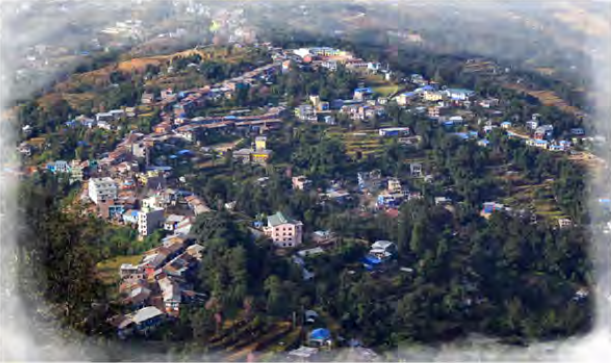
- located in the Khotang district
- gateway to the sacred temple of Halesi Mahadev
- gorgeous landscape, agricultural land, traditional houses, mountain views, humble villagers, dense forest and more
- a thick settlement of the Rai people
- on the stone-paved path uphill: villagers carrying wood from the forest, children grazing domestic animals
- weather: the morning can be slightly chilly, the daytime is warm
Group the notes into three paragraphs: where the village is and why it matters, what it looks like and who lives there, and what a visitor experiences, including the weather. Add describing words, but only ones the notes support.
Model: Lamidada is a quiet hill village in the Khotang district of eastern Nepal. It is best known as the gateway to the sacred temple of Halesi Mahadev, so many pilgrims pass through it on their way to worship.
The village is blessed with a gorgeous landscape. Traditional houses stand among green terraced fields, dense forest covers the slopes, and on a clear day the mountains rise in the distance. Lamidada is a thick settlement of the Rai people, who are humble and welcoming to visitors.
Walking up the stone-paved path, you meet villagers carrying loads of wood from the forest and children grazing goats and cattle. Mornings can be slightly chilly, but the days are warm and pleasant. Lamidada has kept its simple rural beauty, and that is exactly what makes it worth a visit.
Project Work: Interviewing Your Friends
The project asks you to interview five friends about their likes, dislikes, skills and similar things, then prepare a short report and present it to the class. A report is where comparison pays off: once you have five sets of answers, you can say what your friends share and where they differ.
- Prepare the same five or six questions for everyone, for example: What do you enjoy doing in your free time? What do you dislike? What are you good at?
- Interview each friend and note the answers briefly, with their name.
- Look for patterns: what most friends like, what only one likes, which skills are unusual.
- Write the report: a sentence on who you interviewed and what you asked, a paragraph of findings, and a closing sentence.
- Present it clearly, looking at the class, and use falling intonation at the end of each statement.
Model extract: 'I interviewed five classmates about their interests. Four of them enjoy football, while only Anu prefers reading. Everyone dislikes waking up early. Ramesh is the most skilled at drawing, whereas Sita speaks English more fluently than the rest of us.'
Clauses: Independent and Dependent
Clause: a group of words that has a subject and a predicate (the part that tells us about the subject, containing the verb).
Independent clause: also called a main clause. It makes complete sense and can stand on its own as a sentence. Examples: 'My dog loves bones.' 'I will go home and change my clothes.'
Dependent clause: also called a subordinate clause. It has a subject and a verb but does not make complete sense alone; it depends on a main clause. Example: in 'He was not allowed into the class because he arrived too late', the part 'because he arrived too late' is dependent.
Two or more independent clauses are joined by coordinating conjunctions: for, and, nor, but, or, yet, so. For example: 'London is expensive, but Paris is cheaper.' Both halves could stand alone. A dependent clause is joined to a main clause by a subordinating conjunction such as as, since, though, although, because, if, unless, provided that and so that. For example: 'Paris is a good choice if you are on a budget.' The part beginning with 'if' cannot stand alone.
This connects with Grammar II. 'Because' and 'although' introduce dependent clauses. 'Because of', 'due to', 'despite' and 'in spite of' are followed by a noun phrase instead, so what follows them is a phrase, not a clause.
The full lesson is waiting for you
The notes are free to read in full. A free account opens the rest of the practice, and tracks your progress and confidence score for every subject. Presentations and videos need approval from Learn Yeti.