Development Projects and the Nation
A country grows through the things it builds. A dam stores water for fields and turns falling water into electricity. A highway shortens the journey between markets. An airport links a town to the rest of the world. Projects like these cost huge sums and take years, so every citizen has a reason to ask what each one will give back.
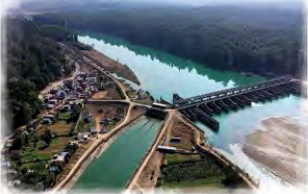
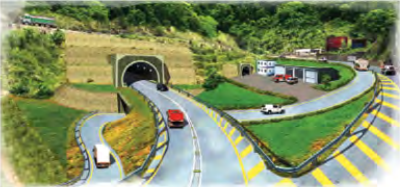
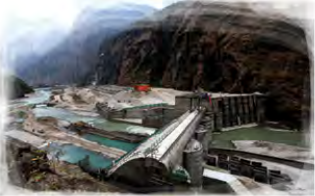
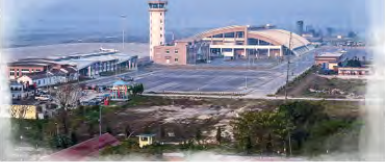
Each of these answers a need. Irrigation lets farmers grow crops in the dry season. Hydropower lights homes and runs factories without burning imported fuel. Good roads bring health posts, schools and buyers within reach of villages. An international airport brings tourists, and tourists bring foreign currency and jobs. When a project matters so much to the whole country that the government gives it top priority, Nepal calls it a project of national pride.
Project of national pride: a large development project that the government treats as especially important to the whole nation, and so funds and monitors with top priority.
Big projects also have a price that is not paid in money. Forests are cut, hills are blasted and rivers are turned. The title of this unit, Nature and Development, names that tension. A thoughtful citizen looks at both sides.
The Kathmandu-Terai/Madhesh Fast Track
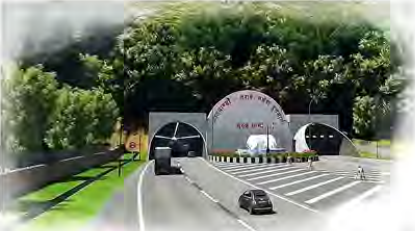
The Kathmandu-Terai/Madhesh Fast Track, usually shortened to KTFT, is a mega highway of strategic importance. It will run 72.5 km from Khokana in Lalitpur to Nijgadh in Bara, where it meets the East-West Highway. Today the drive from the capital to the plains winds for many hours over the hills. The fast track is planned to cut the journey to about one hour.
The 72.5 km is made of three kinds of structure, and the three parts add up exactly to the whole.
| Part of the fast track | Number | Total length |
| Road | 55.49 km | |
| Bridges | 87 | 10.60 km |
| Twin tunnels | 3 | 6.41 km |
| Whole fast track | 72.5 km |
The road is designed for an average speed of around 70 km/hr. Keep these numbers apart in your head. 72.5 km is the whole length; 55.49 km is only the road section. Questions about the fast track often test exactly this difference.
What the Fast Track Promises
A report on KTFT groups its benefits under five headings. Each is a separate argument, so learn them as a list.
- Faster economic growth. A shorter distance burns less fuel. The daily fuel saving could reach more than five billion rupees. Tourists who enter Nepal across the southern border, and tourists from countries beyond India, get a quick route to Kathmandu.
- Higher skills. High bridges and twin tunnels need technology that is new to Nepal. Nepali engineers and workers on the project sharpen their knowledge by using it.
- Jobs. The project creates work for young people, and steady wages help families upgrade their economic condition.
- Access between Kathmandu and the Terai. People of the Terai reach health care, education, jobs and new markets more easily. Cheaper transport lowers shipping costs, so goods cost less for the buyer. The road also links the capital to the planned Nijgadh International Airport, and it can carry food, water and medicine quickly in a calamity such as an earthquake or a flood.
- A less crowded valley. If the Terai is only an hour away, people can come to Kathmandu for its services and go home again. They need not settle there, so the congestion of the valley falls. Planners call this idea a greater Kathmandu.
Almost every benefit grows from one fact: a long, slow journey becomes a short, fast one. Less time on the road means less fuel, cheaper goods, quicker help in a disaster and less need to live in the capital.
What the Fast Track Could Cost
A fair report does not stop at the good news. The same report lists the constraints that could hold the project back.
- Road safety. Nepali roads are already vulnerable, and many road users drive carelessly. A road built for about 70 km/hr raises the risk of serious accidents.
- Link roads. Once KTFT is in operation, the biggest challenge is connecting it smoothly to nearby highways and cities. Without good link roads the fast track cannot work properly, and the stretch from the link roads to the zero point must be widened to accommodate the extra traffic.
- The environment. Rock blasting, quarrying and dumping of fill raise dust that pollutes the air. Clearing forest during construction adds to that pollution and degrades the land.
The report ends by weighing both sides. KTFT can accelerate a socio-economic revolution in Nepal, but only if the country uses innovative strategies and advanced technology in its transport system. So its success depends on technology and planning, not on the road alone.
One Word, Two Accents
British English and American English share most words but often say them differently. Sometimes the stress moves to another syllable. Sometimes a vowel changes, and sometimes a letter is silent in one variety and spoken in the other. The respellings below show the sound, with the stressed syllable in capitals. Say each pair aloud, and check any you are unsure of in a dictionary that marks both accents.
| Word | British English | American English |
| vitamin | VIT-uh-min | VY-tuh-min |
| privacy | PRIV-uh-see | PRY-vuh-see |
| schedule | SHED-yool | SKEJ-ool |
| advertisement | ad-VER-tis-ment | ad-ver-TYZE-ment |
| leisure | LEZH-uh | LEE-zhur |
| mobile | MOH-byle (rhymes with smile) | MOH-bul |
| vase | VAHZ | VAYSS |
| dynasty | DIN-uh-stee | DY-nuh-stee |
| herb | HERB (h spoken) | ERB (h silent) |
| produce (the noun) | PROD-yooss | PROH-dooss |
| basil | BAZ-ul | BAY-zul |
| garage | GARR-ahzh or GARR-ij | guh-RAHZH |
| hostile | HOS-tyle | HOS-tul |
| montage | MON-tahzh | mon-TAHZH |
| salon | SAL-on | suh-LAHN |
Look for patterns rather than memorising fifteen separate facts. Words borrowed from French, such as garage, montage and salon, keep their stress on the last syllable in American English. Words ending in -ile, such as mobile and hostile, rhyme with smile in British English but end in a light bul or tul sound in American English. Neither accent is more correct. What matters is that you choose one and stay consistent.
Sure, Likely or Just Possible
When we talk about what might happen, we rarely know for certain. English has a whole scale of words for how sure we are, from certain to impossible. Choosing the right one tells the listener how much to trust what you say.
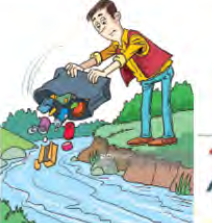

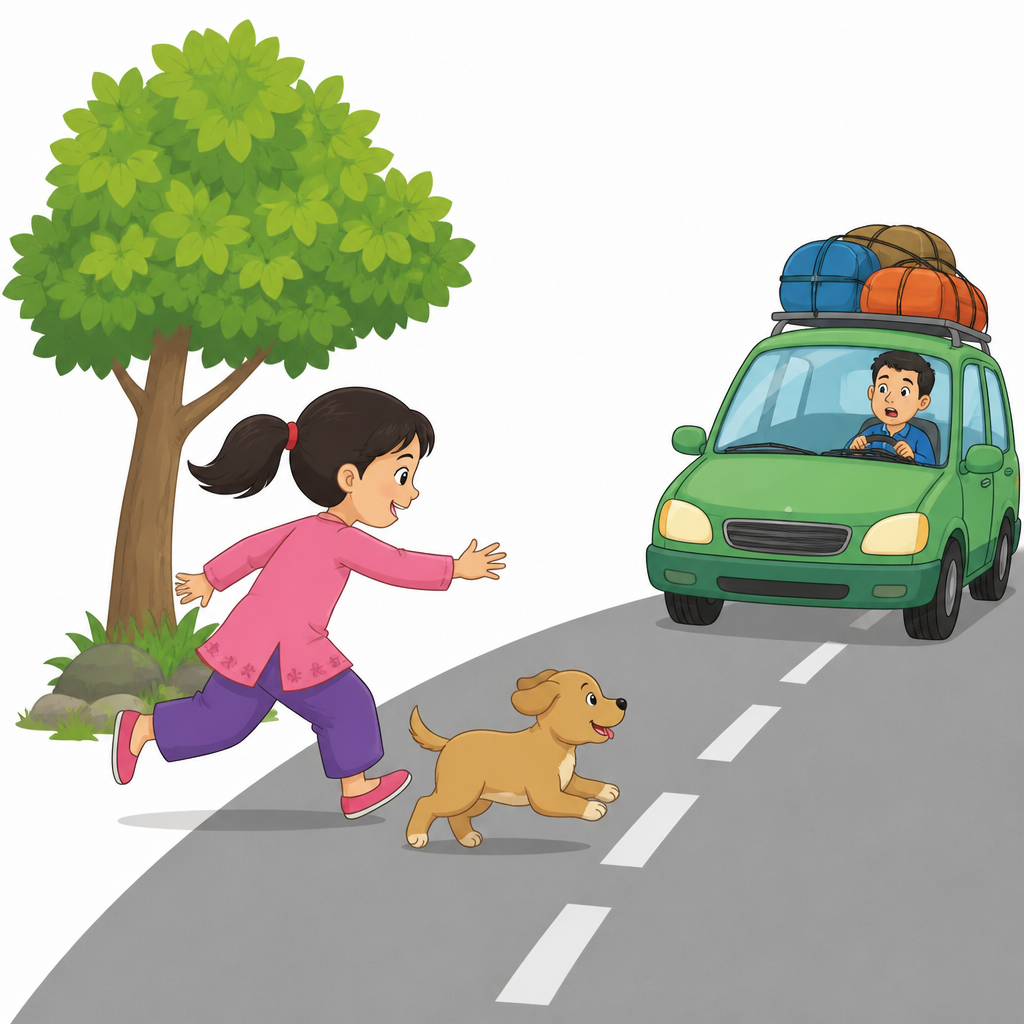
In picture a, the result is certain: the river is sure to be polluted. In picture b, a fall is likely but not certain: the chair is likely to tip over, and the glass could fall and break. In picture c, several things could happen: the driver will probably brake hard, but the car might hit the girl.
Must / can't + base verb: used when you are almost certain about the present from the evidence. Must means you are sure it is true; can't means you are sure it is not. Example: The lights are on, so someone must be at home. It's only six o'clock, so the shop can't be closed yet.
May / might / could + base verb: used when something is possible but you are not sure. Example: Karan might be at the canteen. The bus could be late because of the rain.
Must have / can't have + past participle: used when you are almost certain about something in the past. Example: The road is wet, so it must have rained last night. He can't have gone out, because his car is still in the car park.
May have / might have / could have + past participle: used when something in the past is possible but not certain. Example: She may have missed the bus. They could have taken the other road.
Sure to / likely to / unlikely to + base verb, and the adverbs definitely, certainly and probably: phrases that place a future event on the scale of certainty. Example: Fuel prices are likely to rise. The team will definitely win if it keeps playing like this.
Here is how the scale sounds in a real exchange. Four friends are asked whether petrol will become cheaper, and each answer shows a different level of certainty.
For a certain negative guess, use can't, not mustn't. Say "He can't be at home, his bike is gone." Mustn't means something is not allowed, so "He mustn't be at home" sounds like a rule. Also watch the position of probably: it comes after will but before won't. Say "She will probably come" and "She probably won't come".
Four Ways to Talk About the Future
English has no single future tense. It has several forms, and each one shows how the speaker sees the future event: as a prediction, a plan, something in progress, or something already finished by a certain time. The time expression in a sentence is often the clue to which form you need.
Future simple (will + base verb): used for predictions based on opinion, promises, offers, decisions made at the moment of speaking, and plain facts about the future. Example: I think he will be rich and famous one day. The phone is ringing, so I'll answer it.
Be going to + base verb: used for plans already decided before speaking, and for predictions based on something you can see now. Example: My friends and I are going to travel next winter. Look at those clouds. It's going to rain.
Future continuous (will be + present participle): used for an action that will be in progress at a particular time in the future. Example: At this time next week, they'll be watching a movie in the theatre.
Future perfect (will have + past participle): used for an action that will be complete before a stated time in the future. It usually goes with by. Example: We will have arrived home by this time on Sunday.
Two present forms also point to the future. The present continuous shows a fixed arrangement: "Hurry up! We're leaving in ten minutes." The present simple shows a timetable: "The exam starts at exactly 11 o'clock."
| Time clue | Form it usually needs | Example |
| one day, I think, probably | future simple | She will be a doctor one day. |
| already decided, look at | be going to | We are going to visit Rara next year. |
| at this time next week | future continuous | At this time tomorrow I'll be flying to Dubai. |
| by this time, by then | future perfect | By Friday I'll have finished the project. |
Do not use will for a decision you made earlier. If you bought the ticket last week, say "I'm going to fly to Pokhara on Monday", not "I will fly". Will is for the decision you make as you speak.
How a Report Is Organised
The article on the fast track is a model of a report. A report gives facts about a subject and then judges them, so a reader can understand the subject and decide what they think of it. It is organised under headings, so a busy reader can go straight to the part they need.
Report: a piece of factual writing, divided under headings, that describes a subject, presents its advantages and disadvantages with evidence, and ends with a conclusion.
- Title: names the subject clearly.
- Introduction: says what the project is, where it is, how big it is and when it will be finished. Give exact figures.
- Benefits: each benefit under its own subheading, with a reason or a figure to support it.
- Drawbacks: the problems or risks, again one per subheading.
- Conclusion: a balanced judgement, often saying what must be done for the project to succeed.
- Source: where your information came from, such as an interview with the ward office or a news article.
To write your own, choose a development work near you: a new road, a bridge, a drinking water scheme, a school building or an irrigation canal. Visit it if you can. Ask the people involved what it will cost, when it will finish and what they expect from it. Then write in a formal, neutral voice. Use "the project will" and "residents say", not "I think it's great".
Future forms appear naturally in a report about a project that is still being built: "The bridge will link two wards", "By next year the canal will have reached the lower fields".
A Sonnet on a London Morning
William Wordsworth was an English Romantic poet best known for poems about lakes, hills and flowers. So it surprised his readers when he wrote a poem in praise of a city. Early one morning in 1802 he crossed Westminster Bridge over the River Thames in London. The city was still asleep, and what he saw moved him to write this sonnet.
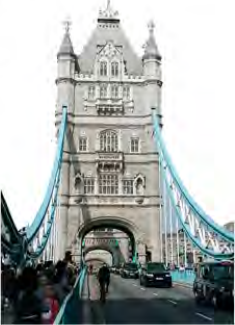
Earth has not anything to show more fair:Dull would he be of soul who could pass byA sight so touching in its majesty:This City now doth, like a garment, wearThe beauty of the morning; silent, bare,Ships, towers, domes, theatres, and temples lieOpen unto the fields, and to the sky;All bright and glittering in the smokeless air.Never did sun more beautifully steepIn his first splendour, valley, rock, or hill;Ne'er saw I, never felt, a calm so deep!The river glideth at his own sweet will:Dear God! the very houses seem asleep;And all that mighty heart is lying still!
The first three lines make a bold claim. Nothing on earth is more beautiful than this view, and anyone who could walk past without stopping must have a dull soul. The poet then describes the city itself. London wears the beauty of the morning as if it were a piece of clothing. Its ships, towers, domes, theatres and churches stand silent and open to the fields and sky. The air is smokeless, because the factory chimneys and kitchen fires have not yet been lit, so every building shines in the clear light.
In the last six lines the poet turns inward. He says the sun has never lit a valley, rock or hill more beautifully than it now lights the city. He has never seen or felt such a deep calm. The Thames flows gently as it pleases, the houses seem to sleep, and the great heart of London lies still. The closing exclamations show his wonder. In a few hours the same streets will be full of noise and smoke, and that is exactly why this quiet moment is so precious.
Sonnet: a poem of fourteen lines with a fixed rhyme scheme. This one is a Petrarchan sonnet. Its first eight lines, the octave, rhyme ABBAABBA and describe the scene. Its last six lines, the sestet, rhyme CDCDCD and give the poet's feeling about it.
How the Poem Makes Its Picture
Wordsworth brings the sleeping city to life with a few figures of speech. Learn to name them and to say what each one does.
Simile: a comparison that uses like or as. Example from the poem: the city wears the beauty of the morning like a garment, so the beauty seems to cover the city completely.
Personification: giving human qualities to something that is not human. Example from the poem: the river glides at his own sweet will, the houses seem asleep, and the city has a mighty heart that is lying still.
- Hyperbole, or deliberate exaggeration: "Earth has not anything to show more fair." The poet does not literally mean nothing on earth is lovelier; he means the sight overwhelms him.
- Metaphor: "that mighty heart" means London itself, the centre of a busy nation, now at rest.
- Contrast: the city is compared with valley, rock and hill, the kind of natural scene Romantic poets usually praised, to show that a city at dawn can be just as beautiful.
- Old verb forms: doth means does and glideth means glides. They give the poem a formal, solemn tone.
The theme of the poem is the calm beauty of a great city in the early morning. It suggests that beauty is not only found in nature, and that even a busy place has moments of perfect peace.
Listening for Facts About a Long Road
The listening task in this unit is about a road much longer than the fast track: the Pan-American Highway. Before you listen, study the globe. It shows North and South America, and the red line traces the route of the highway from the far north of one continent to the far south of the other.
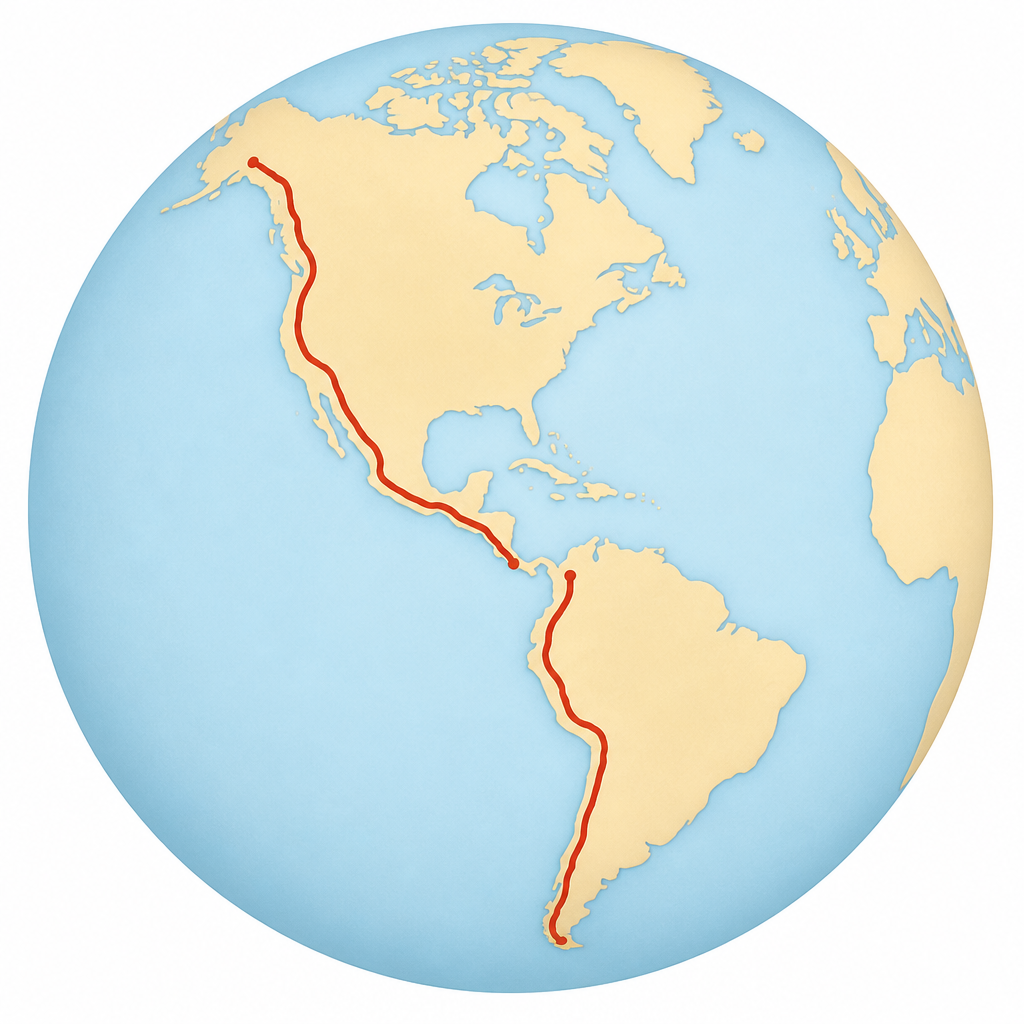
A factual recording like this is full of numbers and names, and the questions ask for exactly those. Get ready before the audio starts.
- Read every question first and underline what it wants: a length, a number of countries, a place, a reason.
- Listen for units. A length will come with kilometres or miles, so the number just before that word is your answer.
- For a where question, listen for between, near or at the border of. For a why question, listen for because, since or so.
- For a gap-fill sentence, decide what kind of word fits before you listen. "A network of ____" needs a plural noun; "the ____ in the world" needs a superlative such as longest.
- As the audio names each country, jot the first three letters. You can write the full names afterwards.
- On the second listening, check the answers you are unsure of, and do not change a confident answer without a reason.
The Future Perfect Continuous
One more future form measures time. It looks forward to a point in the future and then looks back to count how long something will have been going on by then.
Future perfect continuous (will have been + present participle): used for an action that will have continued for a stated length of time up to a point in the future. It usually has both a point in time and a duration. Example: By June, my sister will have been teaching at this school for ten years.
Compare it with the future perfect. "By 12 o'clock we will have finished the match" tells you the match will be over. "By 12 o'clock we will have been playing for two hours" tells you how long the playing will have lasted. The first is about completion; the second is about duration.
Here is the sentence being built for a real situation. The children are alone at home, and we will reach them two hours from when they were left.
- Step 1: Find the future point: "by the time we reach home".
- Step 2: Find the duration: "for two hours".
- Step 3: The action continues up to that point, so choose will have been + -ing.
- Step 4: Write it: By the time we reach home, the children will have been staying alone at home for two hours.
Writing a Notice
A notice is a short public announcement put up on a board or read out, so that everyone concerned knows about an event or a decision. Nobody reads a notice twice, so it must give every essential fact in a few clear lines.
Notice: a brief formal announcement from an organisation that tells a group of people what is going to happen, when and where it will happen, and what they are asked to do.
- The name and address of the organisation, at the top and centred.
- The date the notice is issued.
- The heading NOTICE, often with a short title of the event.
- The body: what the event is, why it is held, and its date, time and place.
- A request or instruction to readers, such as asking them to take part or to register.
- The signature and designation of the person issuing it, such as Headteacher or Secretary.
A notice has no salutation such as Dear Students and no closing such as Yours sincerely. It uses formal language, often in the third person or the passive: "All students are requested to take part." Future forms carry the plan: "The programme will begin at 10 a.m.", "About two hundred seedlings will be planted."
Finding Projects of National Pride
Nepal has named a number of projects of national pride. Among them are the Melamchi Water Supply Project, the Upper Tamakoshi Hydroelectric Project, the Pokhara, Gautam Buddha and Nijgadh international airports, the Mid-Hill (Pushpalal) Highway, the Postal Highway, the Sikta, Babai and Rani Jamara Kulariya irrigation projects, and the Kathmandu-Terai/Madhesh Fast Track. Search official government websites for the current list, because projects are added as others are completed.
Then ask which of them touch your own life. A family in the Kathmandu Valley drinks Melamchi water. A farmer in Banke waters crops from the Sikta canal. A student in Pokhara may one day take a flight from the new airport. Discuss with your friends what each project gives you directly, and what it gives the country as a whole.
British and American Spelling
British and American English differ in spelling as well as in accent and pronunciation. Most of the differences follow a few regular patterns of word endings. Learning the patterns means you can spell hundreds of words in either variety.
| Pattern | British English | American English |
| -re and -er | centre, metre, litre | center, meter, liter |
| -our and -or | colour, humour, neighbour | color, humor, neighbor |
| -ise and -ize | apologise, organise, recognise | apologize, organize, recognize |
| -yse and -yze | analyse, paralyse, catalyse | analyze, paralyze, catalyze |
| ae or oe and e | oestrogen, paediatric | estrogen, pediatric |
| -ence and -ense | defence, offence, licence | defense, offense, license |
| -ogue and -og | analogue, dialogue, catalogue | analog, dialog, catalog |
| double l and single l | travelled, travelling, traveller, fuelled, fuelling | traveled, traveling, traveler, fueled, fueling |
Two points need care. British English accepts both -ise and -ize, so organize is not wrong in a British text, but American English uses only -ize. And the double l rule is about adding -ed, -ing or -er to a word ending in l: British English doubles the l, American English usually does not. You have already met one of these patterns in the poem, which spells splendour the British way; an American dictionary lists it as splendor.
Do not mix the two systems in one piece of writing. "The colour of the center" uses a British spelling and an American one side by side. Nepal's schools and exams generally follow British spelling, so choose it and keep to it.
The full lesson is waiting for you
The notes are free to read in full. A free account opens the rest of the practice, and tracks your progress and confidence score for every subject. Presentations and videos need approval from Learn Yeti.