Qualities That Lead to Success
Think of someone you admire: a doctor who never turns a poor patient away, a teacher who marks every student fairly, a shopkeeper whose scales are always honest. Skill alone did not earn them their reputation. What earned it is a set of values that shapes how they behave, especially when no one is checking. These values are what we call ethics, and they decide not only whether a person succeeds but how.
Ethics: the principles of right and wrong that guide a person's behaviour, particularly in the way they treat other people and carry out their work.
Morality: a person's inner sense of what is good and bad, right and wrong, which shows in how they act towards others.
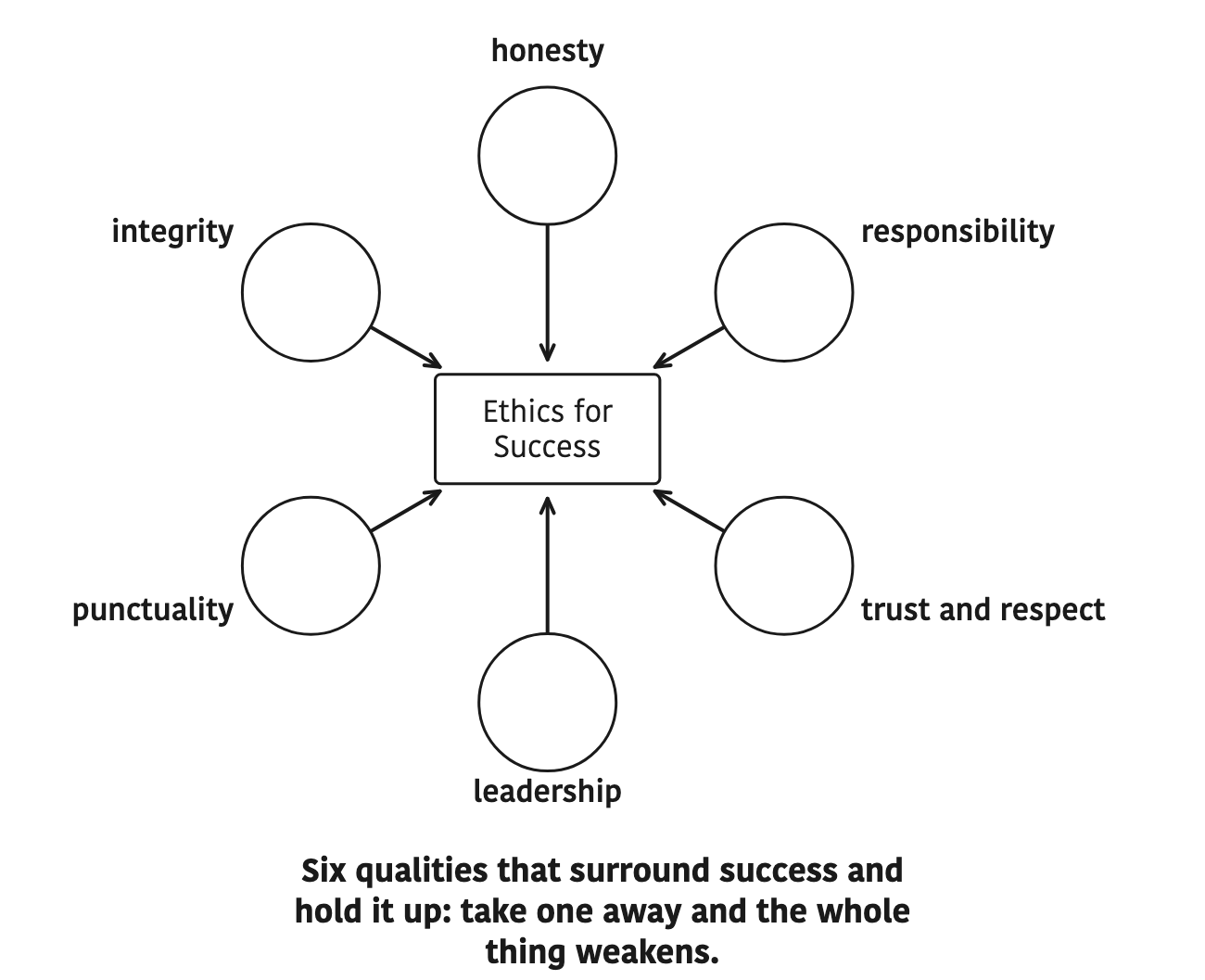
Honesty: telling the truth and refusing to cheat, even when a lie would be easier or more profitable.
Responsibility: doing your own duty properly and accepting the results of your actions instead of blaming others.
Trust and respect: being someone others can rely on, and treating every person with dignity whatever their age or position.
Leadership: guiding and encouraging a group towards a shared goal, and setting an example yourself.
Punctuality: being on time, which shows that you value other people's time as much as your own.
Integrity: behaving the same way whether or not anyone is watching, so that your words and actions match.
These qualities work as a set. A brilliant student who is never on time loses opportunities. A confident leader who is not honest soon loses the trust of the group. A hard worker without respect for others makes enemies. Success that lasts is built on all of them together, and the easiest way to understand that is to watch what happens when people forget them.
Wisdom of Little Girls: What Happens in the Story
Leo Tolstoy (1828 to 1910), the Russian novelist best known for War and Peace, also wrote short tales for ordinary villagers, each carrying a plain moral. This one is set in a Russian village on Easter Day at the very end of winter. The sledging season has just finished, snow still lies in the yards, and melted water runs in streams down the village street.
Two girls from neighbouring houses meet in a lane between two homesteads, where dirty water from the farmyards has collected into a large puddle. Malasha is very small and Akoulya is a little older. Their mothers have dressed them in new frocks, blue for Malasha and a yellow print for Akoulya, with red kerchiefs on their heads. They have just come from church, so first they show each other their finery, and then they start to play. Soon they feel like splashing in the water. Malasha is about to walk straight in, shoes and all, when Akoulya stops her: her mother will scold her. So both girls take off their shoes and stockings, lift their skirts and wade towards each other.
The water reaches Malasha's ankles and she is frightened, but Akoulya tells her it will not get any deeper. As they come close, Akoulya warns her to walk carefully and not splash. At that very moment Malasha plumps her foot down, and muddy water flies onto Akoulya's frock, her eyes and her nose. Seeing the stains, Akoulya is furious and runs after Malasha to hit her. Malasha scrambles out of the puddle and gets ready to run home.
Just then Akoulya's mother passes by. She sees her daughter's splashed skirt and dirty sleeves and demands to know what she has been doing. 'Malasha did it on purpose,' says Akoulya. Without asking another question, the mother seizes Malasha and strikes her on the back of the neck. Malasha howls so loudly that the whole street hears her, and her own mother comes out. 'What are you beating my girl for?' she shouts, and she begins scolding her neighbour.
One word leads to another. The men come out, a crowd collects in the street, and everyone is shouting while no one is listening. Someone gives someone else a push, and the affair very nearly comes to blows. Akoulya's old grandmother steps in among them and begs them to stop: Easter is a time for rejoicing, not for such folly. Nobody listens to her. They almost knock her off her feet.

Meanwhile the two girls have forgotten the whole thing. Akoulya has wiped the mud off her frock and gone back to the puddle. With a stone she scrapes away the earth at its edge to make a channel, so that the water can run out into the street. Malasha joins her and helps with a chip of wood. Just as the men are starting to fight, the girls' little stream runs down the street to the very spot where the grandmother is trying to pacify them. The girls follow it, one on each side. 'Catch it, Malasha! Catch it!' shouts Akoulya, while Malasha is laughing too hard to speak.
Delighted, and watching the chip float along, the two girls run straight into the group of men. The grandmother points at them and asks the men whether they are not ashamed of themselves. They are fighting on account of these lassies, while the lassies themselves have forgotten all about it and are playing happily together. 'Dear little souls! They are wiser than you!' The men look at the girls, feel ashamed, laugh at themselves, and each goes back to his own home.
The Meaning of the Story
The quarrel in the village does not begin as a quarrel at all. It grows, step by step, because at each step an adult reacts before thinking.
- A child splashes her friend by accident while playing.
- The friend, upset about her frock, tells her mother it was done on purpose.
- The mother punishes the other child without hearing her side.
- The second mother defends her daughter, and the two women begin to abuse each other.
- The men join in, pride takes over, and shouting turns into pushing.
The children, who started the trouble, are the first to leave it behind. Their anger lasts a few minutes, and then the fun of the water matters more to them than who splashed whom. The adults, on the other hand, carry the grudge further with every word, until they are ready to fight over something none of them even saw. The title is ironic for exactly this reason: we usually expect wisdom from grown-ups, yet here the only sensible people in the street are two little girls and a grandmother nobody will listen to.
The story closes with a line from the Bible: 'Except you turn, and become as little children, you shall in no wise enter into the kingdom of heaven.' Put simply, unless grown-ups learn to forgive and forget as easily as children do, they cannot reach what is truly good. It connects directly with the qualities of trust and respect. The mothers show neither: one trusts a hasty accusation, and neither respects the other enough to listen.
A quarrel grows when nobody listens, and it ends the moment someone is willing to let it go.
Sentence Stress
Listen to a fluent English speaker and you will notice that the voice does not give every word the same weight. Some syllables are said louder, longer and on a slightly higher note, while the words between them are said quickly and lightly. This pattern of strong and weak beats gives spoken English its rhythm. A speaker who gives every word equal force sounds flat and mechanical, and a listener finds it harder to pick out what matters.
Sentence stress: the extra force a speaker gives to the important words in a sentence. The word given the most force is said to carry the sentence stress, and moving that stress can change what the speaker means.
Stress mark ('): a small mark written just before a stressed syllable. Only the stressed syllable of a word is marked, so in a long word the mark may fall in the middle: re'ceive, com'puter, fa'miliar.
- The 'bus was 'late a'gain this 'morning.
- My 'brother 'plays 'football on 'Saturdays.
- 'Where did you 'leave your 'bag?
- They 'usually per'form at 'public 'places.
- 'Rita is 'spending her 'holiday in 'England.
Read these aloud and tap the desk on each marked syllable. The taps come at roughly even intervals, and the little words squeeze in between them. That steady beat is the rhythm of English. Stress also carries meaning. In the sentence 'I didn't say she took the money', strong stress on 'I' suggests somebody else said it, while strong stress on 'money' suggests she took something else.
Content Words and Grammatical Words
How do you know which words to stress? Divide them into two groups. A simple test helps: take the word out of the sentence and say it on its own. If it still calls up a meaning, such as 'football' or 'late', it is a content word. If it means very little by itself, such as 'the' or 'of', it is a grammatical word.
Content words: words that carry meaning even out of context. They are usually stressed.
Grammatical words: words that hold a sentence together but carry little meaning on their own. They are usually not stressed.
| Content words | Examples |
| Main verbs | sell, give, write |
| Nouns | car, music, Mary |
| Adjectives | red, big, interesting |
| Adverbs | quickly, why, never |
| Negative contractions | don't, aren't, can't |
| Grammatical words | Examples |
| Pronouns | he, we, they |
| Prepositions | on, at, into, behind |
| Articles | a, an, the |
| Conjunctions | and, but, because |
| Auxiliary verbs | do, be, have, can, must |
Apply the tables to a sentence. In 'He bought a red car for his daughter', the content words are bought, red, car and daughter, so the sentence is spoken as: He 'bought a 'red 'car for his 'daughter. The words he, a, for and his are grammatical, so they are said lightly.
When a Grammatical Word Takes the Stress
The two tables describe the usual pattern, not an unbreakable law. A grammatical word can take strong stress when the speaker wants to point at it, usually to correct someone or to set two people or things against each other.
In both replies the pronoun is stressed because the speaker wants to emphasise who did the action. Three more patterns are worth knowing.
- An auxiliary at the end of a short answer is stressed: 'Does she work with you?' 'Yes, she 'does.'
- An auxiliary used for emphasis is stressed: I 'did finish my homework!
- The verb 'be' used as a main verb is usually unstressed, even though a main verb is a content word: I am Bra'zilian. The 'soup is 'hot.
Do not put a stress mark on every word, and do not mark the whole of a long word. Mark only the stressed syllable of each content word: 'motorcycles, not motor'cycles, and 'dangerous, not dan'gerous.
Asking For and Giving Agreement

Groups make decisions by talking. A youth club president wants to hold a fair to raise money, so she asks the members whether they all agree. Surya agrees at once, because the club needs money for prizes. Asmita does not agree: not every student may want to spend money at a fair, so the club should look at other options too. Notice that Asmita disagrees without being rude. She says what she thinks, gives a reason, and suggests a way forward.
| Purpose | Useful expressions |
| Asking for agreement | Do we all agree that...? / Is everyone happy with...? / What do you think about...? / Shall we go ahead with...? |
| Agreeing | Yes, I agree. / That's a good idea. / I couldn't agree more. / I'm with you on that. |
| Partly agreeing | I agree up to a point, but... / That's true, but we should also think about... |
| Disagreeing politely | I don't think that's right. / I'm afraid I don't agree. / I see your point, but... / I'm not sure that will work. |
Here is how a conversation of three might run when a ward chairperson wants everyone to join a cleanliness campaign.
A disagreement stays polite when it gives a reason and offers another way forward.
Affirmative and Negative Sentences
Affirmative sentence: a sentence that states that something is true or happens. Example: Manisha has a bath daily.
Negative sentence: a sentence that states that something is not true or does not happen, usually by using 'not' or another negative word. Example: Manisha does not have a bath daily.
Most affirmative sentences become negative by the same method.
- Step 1: Look for a helping verb such as is, are, was, has, have, can, will or must.
- Step 2: If there is one, put 'not' straight after the first helping verb: She can swim becomes She cannot swim.
- Step 3: If there is no helping verb, add do, does or did to match the tense and the subject, then add 'not'.
- Step 4: After do, does or did, change the main verb to its base form: My sister lives with my parents becomes My sister does not live with my parents.
- Step 5: Check the rest of the sentence for words that must also change, such as some, already or too.
Words That Change in a Negative Sentence
Adding 'not' is often not enough. Certain words sound wrong in a negative sentence and have partners that replace them.
| Affirmative | Negative | Example |
| has or have as a main verb | do, does or did not have | Raju has a bicycle. → Raju does not have a bicycle. |
| a command | Do not + verb | Close the door. → Do not close the door. |
| Let's | Let's not | Let's watch the film. → Let's not watch the film. |
| already | not ... yet | The bus has already left. → The bus has not left yet. |
| too | not ... either | She likes mangoes, too. → She does not like mangoes, either. |
| some | any | I have some money. → I do not have any money. |
| a little (uncountable) | not ... much | We need a little sugar. → We do not need much sugar. |
| a few, several (countable) | not ... many | He has a few friends. → He does not have many friends. |
| sometimes | not always | She sometimes walks to school. → She does not always walk to school. |
| only (a person) | none but | Only Hari knew the way. → None but Hari knew the way. |
| only (a thing) | nothing but | Only rest can cure you. → Nothing but rest can cure you. |
| must | need not | You must pay now. → You need not pay now. |
| had to | did not have to | We had to wait. → We did not have to wait. |
Most of these changes turn the meaning round. Two pairs are different: 'sometimes' and 'not always' say the same thing, and so do 'only' and 'none but' or 'nothing but'. With those, the sentence becomes negative in form while its meaning stays the same.
'You must not buy it' means you are forbidden to buy it. The negative of an obligation is 'You need not buy it', which means buying it is not necessary.
Turning a Negative Sentence into an Affirmative One
The reverse process removes the negative and puts back the partner words. The verb has to be rebuilt as well, because it was in its base form after do, does or did.
| Negative | Affirmative | Example |
| helping verb + not | helping verb alone | She cannot swim. → She can swim. |
| does or did not + base verb | verb in its own tense | He does not work with us. → He works with us. |
| Do not + verb | verb alone | Don't open the gate. → Open the gate. |
| never | sometimes | He never eats meat. → He sometimes eats meat. |
| nobody, no one | somebody, someone | Nobody called me. → Somebody called me. |
| not anything | something | She does not have anything. → She has something. |
| not any | some | There isn't any milk. → There is some milk. |
| neither ... nor | both ... and (plural verb) | Neither Ram nor Sita sings. → Both Ram and Sita sing. |
| not ... much | a lot of | Don't add much salt. → Add a lot of salt. |
| not ... yet | already | I have not eaten yet. → I have already eaten. |
When you take away does or did, the main verb must take back its ending: 'He does not work' becomes 'He works', and 'The dog did not bite' becomes 'The dog bit'. Writing 'He work' or 'The dog bite' is the commonest slip.
Subject-Verb Agreement
Subject-verb agreement: the rule that a verb must match its subject in number, so a singular subject takes a singular verb and a plural subject takes a plural verb.
The basic rule is easy: The girl sings, but The girls sing. The difficulty lies in deciding whether a subject is singular or plural. These rules settle the cases that cause most mistakes.
| Rule | Example |
| 'A number of' + plural noun takes a plural verb. | A number of students were absent. |
| 'The number of' takes a singular verb. | The number of students is growing. |
| A collective noun seen as one group takes a singular verb. | A flock of sheep is crossing the road. |
| Nouns that come in pairs take a plural verb. | My trousers are torn. The scissors are sharp. |
| 'The' + adjective means a group of people and takes a plural verb. | The poor need our help. |
| An infinitive or an -ing word as subject takes a singular verb. | To lie is wrong. Swimming keeps you fit. |
| After 'Here' or 'There', the verb agrees with the subject that follows it. | Here lies the old king. There are two letters for you. |
| With either ... or and neither ... nor, the verb agrees with the nearer subject. | Neither she nor I am ready. Either Ram or his friends are coming. |
| Each, every, everyone, everything and nobody take a singular verb. | Each of the players has a number. Everything is ready. |
| 'None', meaning 'not one', takes a singular verb in careful writing. | None of the answers is correct. |
| 'All that' meaning 'everything that' takes a singular verb. | All that glitters is not gold. |
| Two subjects joined by 'and' take a plural verb. | My father and my uncle work together. |
| 'Along with', 'as well as' and 'together with' do not change the subject. | I, along with my friends, am going. |
| After 'that' or 'who', the verb agrees with the noun the word refers to. | I work for a company that is growing fast. |
The verb agrees with the head of the subject, not with the noun sitting nearest to it. Write 'The box of pencils is on the desk', because the subject is 'box', and 'Every person in the company helps', because the subject is 'every person'.
Writing a Moral Story
Moral story: a short story that teaches a lesson about right and wrong through what its characters do and what happens to them. The lesson itself is called the moral.
A good moral story shows its lesson through events rather than preaching it. Plan it in this order.
- Step 1: Choose the lesson you want to teach, such as honesty or forgiveness.
- Step 2: Create one or two main characters and a simple setting.
- Step 3: Give a character a choice or a problem that tests the lesson.
- Step 4: Tell the events in order, in the past tense, with a little dialogue to bring them alive.
- Step 5: Show the result of the choice, and end with a sentence that states the moral.
A short model, The Lost Purse: Sujan was waiting for the evening bus when he noticed a brown purse under the bench. Inside were four thousand rupees and a hospital card with a woman's name on it. His school fees were due, and for a moment he thought of keeping it. Then he pictured the owner searching her bag in panic. He went to the ticket counter and asked the clerk to announce the name. Ten minutes later an old woman came hurrying back, almost in tears. The money was for her husband's medicine. She pressed a hundred-rupee note into Sujan's hand, but he gently refused. That night he slept better than he had in weeks. Moral: honesty costs a little, but it leaves the conscience clear.
World Record: A Comedy on Television
World Record is a short comic play set in a big television studio during a live show. Its host invites members of the public to break world records in front of a studio audience, who applaud, laugh and giggle on cue.
- Michael Moonshine: the lively, rather rude host of the show.
- Albert Hargreaves: a contestant standing on one leg in a bucket of hot soup.
- Daisy Hargreaves: Albert's wife, who keeps the soup hot.
- Mabel Phillips: a second contestant, trying to break a record for leaning on a brush.
- A man without trousers: a stranger who wanders onto the set by mistake.
Albert has been standing in the soup for six hours and fifty-eight minutes, and the record is seven hours and three minutes. To keep the soup hot, Daisy comes in every half-hour and pours in more boiling soup, and each time Albert cries 'Aaargh!'. Michael jokes that he is glad it is Albert's leg in the soup and not his own. He then turns to Mabel, who is simply leaning on a brush. 'I can't help thinking the same,' he says, suggesting that the show is so dull he could lean on something himself.
Next a young man appears without any trousers. Michael assumes he is attempting a record too, but the man explains that he took his trousers off to have a bath, and when he got out they were gone. Michael pushes him out of the way because they are on television. Back with Albert, only one minute is left. When Michael asks how it feels, Albert answers 'Scorching!', thinking of the soup, not the record. He says he has dreamed of this moment and practised every day, twice on Sundays. Daisy begins the countdown: ten, nine, eight, seven. At that moment Mabel pushes Albert and says 'Congratulations, Albert!'. Albert falls over. Michael sums up: Albert has not broken a world record, but he has broken his leg.
Comedy: a play or story written to amuse, using a light tone, silly situations and jokes.
Irony: saying the opposite of what you really mean, or a situation that turns out the opposite of what was expected. Mabel's 'Congratulations' is ironic because she has just made sure Albert fails.
Pun: a joke built on two meanings of one word. The last line plays on 'break': Albert was meant to break a record and instead breaks his leg.
Beneath the laughter sits a question of ethics. Mabel gains nothing honest from the push: she has not leaned any longer on her brush. She simply stops a rival seconds before success. A contest is only worth winning if it is won fairly, and a competitor who harms another to get ahead has lost the integrity that makes a victory mean something.
Listening: Lessons from the Eagle

This listening task is a talk about eagles. Before you hear it, think about what makes an eagle different from other birds: its very sharp eyesight, its powerful hooked beak and talons, and its habit of flying far higher than most birds. While you listen, you match five facts about eagle behaviour with five messages for human life. The skill being tested is noticing how a speaker moves from a fact to the lesson drawn from it.
- Eagles fly alone.
- Eagles do not move their focus from the prey.
- Eagles never surrender to the size or strength of the prey.
- Eagles love storms.
- Eagles do not eat dead things.
- Don't be afraid of challenge; face it.
- Do not rely on your past success.
- Stay away from narrow-minded people.
- Remain focused in your life.
- Be fearless for your success.
One pair is already matched: eagles fly alone, and the lesson is to stay away from narrow-minded people, because an eagle flies high above the crowd of smaller birds. Use that pair as your model and follow this routine.
- Step 1: Read both lists before the audio starts, and predict which fact might lead to which lesson.
- Step 2: Listen for each fact about the eagle, then for the words that turn it into advice, such as 'in the same way' or 'so we should'.
- Step 3: Note key words as you hear them rather than whole sentences.
- Step 4: On the second listening, check each match and make sure no message is used twice.
Writing a Message of Condolence
Message of condolence: a formal message expressing sorrow at someone's death and offering comfort to the family and friends left behind. It is often published in a newspaper by an organisation.
Bereaved: having lost a close relative or friend through death. The bereaved family is the family who is mourning.
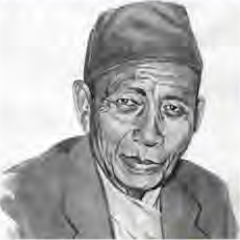
A model notice from the Newah Organization of America mourns Satya Mohan Joshi (12 May 1920 to 16 October 2022). It follows a clear order. It opens by sharing the sad news of the passing of a centenarian, a legend and a prominent Nepali Newah scholar. It then records his achievements: writer, researcher and historian, three-time winner of the prestigious Madan Puraskar, and author of more than 60 publications on the literature, culture and history of Nepal. Next it recalls his link with the organisation: he was Chief Guest and Keynote Speaker at its 11th National Convention in May 2012 and at the Nepal Sambat 1141 celebration in November 2020. Finally it offers heartfelt condolences to the bereaved family, prays for the eternal peace of the departed soul, and ends with the organisation's name.
- Heading: 'Heartfelt Condolences' or 'In Loving Memory'.
- Portrait, full name and the years of birth and death.
- Opening sentence sharing the news of the death.
- Who the person was and what they achieved.
- The person's link with the writer or the organisation.
- Condolences to the family and a prayer for peace.
- Name of the person or organisation sending the message.
- We are deeply saddened to share the news of the passing away of...
- His death is an irreparable loss to...
- We extend our heartfelt condolences to the bereaved family.
- Our thoughts and prayers are with the family at this difficult time.
- May the departed soul rest in eternal peace.
For practice, the same pattern is used for Jayananda Lama, a senior folk singer and actor who died at his home in Kaushaltar, Bhaktapur. His death was an incredible loss for the Nepali art sector. He was loved for super hit folk songs such as 'Kalakate Kainyo', 'Herda Ramro', 'Chuin Chuin Chuikane Joota' and 'Mulako Chana', and he acted in more than a hundred movies. Each of these facts fits one part of the outline above.
A condolence message is formal and gentle. Avoid jokes, casual words and exclamation marks in the body, and do not dwell on the details of how the person died.
Writing a Letter of Sympathy
Letter of sympathy: a personal letter to someone going through a misfortune, such as an illness, an injury or a loss, telling them you share their sorrow and wishing them well.
A condolence message mourns a death and is usually public. A letter of sympathy is usually private and can be written for any hardship. Imagine a friend and co-worker called Purna, 28 years old, who has worked beside you in a factory for three years. He is regular and dutiful, but on 20 October 2022 a mechanical failure in a machine broke his hand, and he is now in hospital. A letter to him would follow this plan.
- Your address and the date at the top.
- A friendly greeting: Dear Purna,
- Opening: say how sorry you were to hear the news.
- Middle: mention what happened briefly and kindly, and recall his good qualities.
- Comfort: reassure him, and offer practical help.
- Closing: wish him a speedy recovery.
- Sign-off: Your friend, followed by your name.
Project Work: A Collage of Condolence Messages
Condolence messages appear in newspapers almost every day. Collecting three of them and arranging them in a collage lets you compare real examples with the outline above. As you study them, notice which parts every message shares, which phrases are repeated from one to the next, and how organisations and families write differently. Present your collage to the class and point out one phrase you would borrow for your own writing.
The full lesson is waiting for you
The notes are free to read in full. A free account opens the rest of the practice, and tracks your progress and confidence score for every subject. Presentations and videos need approval from Learn Yeti.