Current Issues Around Us
A current issue is a problem or a change that people are arguing about right now. It affects many lives, it is reported in the news almost every day, and nobody has settled it yet. Four such issues shape the world you are growing up in, and each one can be recognised from a single strong picture.
Current affairs: events and issues of public importance that are happening now and are being reported and discussed in newspapers, on television and online.
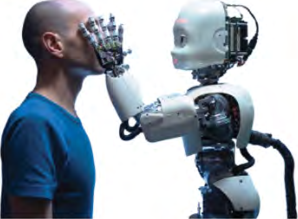


- Artificial intelligence and robots: machines now drive cars, answer questions and recognise faces. This saves time and effort, but it raises questions about jobs, privacy and who is responsible when a machine makes a mistake.
- Climate change: burning coal, oil and gas is warming the planet. The result is heatwaves, floods, melting glaciers and failing crops, and the young will live with these effects the longest.
- Social media: it connects friends and spreads news quickly, yet many young people feel anxious, compare themselves with others, or cannot put the phone down.
- Hunger and food insecurity: the world grows enough food, but millions of people still do not get enough to eat because of poverty, conflict and waste.
When you talk about a picture of an issue, move in three steps. First say what you can see. Then say what issue it stands for. Finally give your own opinion and a reason for it. These sentence openers help you speak in full, clear sentences.
- This picture shows ...
- It seems to represent the problem of ...
- This is a serious issue because ...
- In my opinion, we could deal with it by ...
Driverless Cars: Reading a Feature Article
Artificial intelligence (AI): the ability of a computer system to do things that normally need human intelligence, such as seeing, understanding language, learning from experience and making decisions.
A driverless car is one of the clearest uses of AI. Cameras and sensors act as its eyes, and a computer acts as its brain, deciding when to turn, stop or speed up. The article “How Driverless Cars will Change our World”, written by Jenny Cusack for BBC Future on 30 November 2021, explores what this technology means for all of us.
Feature article: a longer piece of journalism that explores a topic in depth. It often opens with a scene or a small story to pull the reader in, then widens out to facts, expert opinions and questions about the future.
The article opens like a film. It is late at night in the Metro area of Phoenix, Arizona. Under the glare of street lamps, a car approaches slowly. Its sensors give off a low hum, and a green and blue “W” glows from the windscreen, just bright enough to show that the driver's seat is empty. The car pulls up at the curb by itself, and a notification pings on the phone of the person waiting. When the passenger climbs in, a voice from the sound system says, “Good evening, this car is all yours, with no one upfront.”
Only then does the writer explain what we have been watching. It is a Waymo One robotaxi, hailed ten minutes earlier through an app. Because this service is now open to the public and is slowly spreading across the United States, the writer treats it as a sign that driverless technology is truly becoming part of our lives. Notice the technique: the scene makes you curious first, and the facts arrive when you already want them.

Promises and Hurdles of Driverless Technology
The writer describes the promise of driverless technology as enticing, and lists what it could do. It could change the way we commute to work and make long journeys. It could take people out of dangerous jobs and streamline whole industries. It could help build the cities of the future, where we depend less on owning cars, which would lower carbon emissions and lead to more sustainable ways of living. Above all, it could make travel safer. The World Health Organization estimates that more than 1.3 million people die every year in road traffic crashes.
Much still has to change before driverless cars become mainstream, and the article lets three experts explain why. Their words are quoted directly, which gives the article authority: the reader hears the argument from people who work on the problem every day.
| Expert | Position | Main point |
| Camilla Fowler | Head of automated transport, Transport Research Laboratory (TRL), UK | People want safer roads and fewer deaths, and automation could provide that. |
| David Hynd | Chief scientist for safety and investigations, TRL | A driverless car should be a calm, serene way to travel, but the human drivers around it will speed and break rules, and it must cope with them. There are also problems of regulation, rewriting the Highway Code, public perception, better roads and towns, and liability for accidents. |
| Richard Jinks | Vice president of commercial, Oxbotica, a driverless software company based in Oxfordshire | The insurance industry is working out how to handle the move from a person being responsible to the vehicle being responsible. |
The final aim is completely driverless vehicles, in industry, in wider transport networks and as personal cars, that can be used anywhere in the world. For the next two years, however, the biggest hurdle is getting the cars to work safely and effectively in complex and unpredictable human surroundings.
Experts are tackling this at the Mcity Test Facility at the University of Michigan, the world's first testing ground built only for autonomous vehicles. It is a mini town of 16 acres with traffic signals and signs, underpasses, building fronts, trees, and a home and garage for testing deliveries and ride hailing. It also has different terrains: roads, pedestrian walkways, railway tracks and road markings. Here experts test situations that would trouble even a very experienced driver, from children playing in the street to two cars trying to merge at a junction at the same moment.
A feature article moves in a clear order: a scene to hook the reader, the facts behind the scene, the promise, the problems, and finally what the future holds. Following that order is the fastest way to understand and summarise it.
Pronunciation: Reading Dictionary Transcriptions
English spelling does not always show how a word sounds. The letters “ar” in car and “ur” in curb and hurdle are pronounced quite differently from how they look. A good dictionary solves this by printing each word in phonetic symbols between two slashes. Once you can read those symbols, you can pronounce any new word correctly without hearing it first.
Phonetic transcription: a way of writing a word with the symbols of the International Phonetic Alphabet (IPA), so that each symbol stands for exactly one sound.
Take glare, written /ɡleə(r)/. The ɡ and l are the sounds you expect. The symbol eə is one gliding vowel, the same sound as in hair and there. The r in brackets means the r is sounded in some accents, such as American English, and silent in others, such as British English, unless a vowel follows it. Three more marks appear again and again:
- ː after a vowel means the vowel is long, as in /kɑː(r)/ for car and /kɜːb/ for curb.
- ˈ before a syllable shows that syllable is stressed, as in /ˈtræfɪk/ for traffic, which is said TRAF-ic, not tra-FIC.
- ə is the weak, relaxed vowel heard in the second syllable of carbon /ˈkɑːbən/ and in the last syllable of driver /ˈdraɪvə(r)/.
Direct Speech and Reported Speech
There are two ways to pass on what somebody said. You can repeat their exact words inside quotation marks, or you can tell the listener what they said in your own sentence. News writers use both all the time: the driverless car article quotes experts directly, and a news summary of the same article would report them.
Direct speech: the exact words a speaker used, written inside quotation marks. Example: Anjali said, “I am hungry.”
Reported speech (indirect speech): the speaker's meaning passed on in the reporter's own sentence, without quotation marks and usually after “that”. Example: Anjali said that she was hungry.
Reporting verb: the verb that introduces the words, such as said, told, asked, promised or warned. The part it introduces is called the reported clause.
Say and tell are the two basic reporting verbs, and they follow different patterns. Say is used without a person after it: He said that he was busy. Tell must have a person after it: He told me that he was busy. So said to me in direct speech normally becomes told me in reported speech. You cannot write “He said me” or “He told that he was busy.”
Here is the pattern at work. Your uncle says to you, “You have improved your handwriting a lot.” When you pass this on to a friend, you say: My uncle told me that I had improved my handwriting a lot. Three things changed: said to me became told me, you became I, and have improved moved back to had improved. The next two sections explain each of these changes.
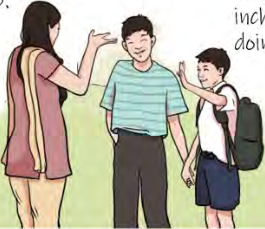
Try reporting the voices from the driverless car article. The robotaxi's own sound system greeted the passenger and said that the car was all theirs, with no one in front. David Hynd said that driverless vehicles should be a very calm and serene way of getting from A to B. He added that such a car had to be able to cope with human drivers who were speeding. Richard Jinks said that the whole insurance industry was looking into how it would deal with the change from a person being responsible to the vehicle being responsible.
Tense Changes in Reported Speech
When the reporting verb is in the past, such as said or told, the words were spoken at an earlier time than the moment you report them. So the verb in the reported clause usually moves one step back into the past.
Backshift: the rule that, after a past reporting verb, each verb in the reported clause moves one step further into the past. Present becomes past, and past becomes past perfect.
| Direct speech | Reported speech | Example |
| Present simple (go, goes) | Past simple (went) | “I go to school by bus.” → She said that she went to school by bus. |
| Present continuous (am/is/are going) | Past continuous (was/were going) | “I am cooking.” → He said that he was cooking. |
| Present perfect (has/have gone) | Past perfect (had gone) | “I have finished my work.” → She said that she had finished her work. |
| Past simple (went) | Past perfect (had gone) | “I saw the accident.” → He said that he had seen the accident. |
| Past continuous (was going) | Past perfect continuous (had been going) | “I was sleeping.” → She said that she had been sleeping. |
| will | would | “I will help you.” → He said that he would help me. |
| can | could | “I can swim.” → She said that she could swim. |
| may | might | “It may rain.” → He said that it might rain. |
| shall | should or would | “I shall return.” → She said that she would return. |
| must | had to or must | “I must leave.” → He said that he had to leave. |
Some forms are already as far back as they can go, so they stay the same: the past perfect, and the modals would, could, should, might and ought to. “I would like to come,” she said. → She said that she would like to come.
Pronouns, Time and Place Words
Pronouns change to fit who is now speaking and who is now listening. Imagine Karma says to you, “I am sorry I missed your party.” Karma's I becomes he, and your becomes my, because you are the one reporting: Karma told me that he was sorry he had missed my party. Always ask yourself who each pronoun points to in the real situation, and choose the pronoun that points to the same person from your side.
Words about time and place change too, because the report usually happens at a different time and in a different place from the original words. If your friend said “tomorrow” last Monday, that tomorrow was Tuesday, not the day after you are speaking.
| In direct speech | In reported speech |
| now | then |
| today | that day |
| tonight | that night |
| tomorrow | the next day / the following day |
| yesterday | the previous day / the day before |
| next week | the following week |
| last week | the previous week / the week before |
| ago | before |
| this / these | that / those |
| here | there |
Put all three changes together. Susan said, “I will leave for Bhaktapur next week.” becomes Susan said that she would leave for Bhaktapur the following week. The pronoun changed, will became would, and next week became the following week.
Do not mix the two kinds of speech. Once you write “that”, the quotation marks and the speaker's own pronouns must go. “She said that “I am tired”” is wrong. Write: She said that she was tired.
Reporting Verbs That Say More
Said and told only tell us that words were spoken. Good writers often choose a reporting verb that also tells us what the speaker was doing with those words: apologising, promising, warning, advising. One well chosen verb can replace a whole sentence of direct speech. Each of these verbs has its own pattern, and the pattern must be learned together with the verb.
Summarising reporting verb: a reporting verb such as advise, admit, warn, offer, thank, inform, agree, apologise or promise, which reports the purpose of what was said rather than every word of it.
| Verb | Pattern | Direct speech | Reported speech |
| admit | admit that ... / admit + -ing | “I ate the last mango,” said Ravi. | Ravi admitted that he had eaten the last mango. |
| advise | advise someone to ... | “You should drink more water,” the nurse said to me. | The nurse advised me to drink more water. |
| warn | warn someone (not) to ... | “Don't touch the wire,” the electrician said to us. | The electrician warned us not to touch the wire. |
| offer | offer to ... | “I'll carry your bag,” said Mina. | Mina offered to carry my bag. |
| thank | thank someone for ... | “Thank you for the flowers,” Grandma said to us. | Grandma thanked us for the flowers. |
| inform | inform someone that ... | “The exam begins on Sunday,” the principal said. | The principal informed us that the exam began on Sunday. |
| agree | agree to ... | “All right, I'll lend you my notes,” said Bikash. | Bikash agreed to lend me his notes. |
| apologise | apologise (to someone) for + -ing | “I'm sorry I lost your pen,” Tara said. | Tara apologised for losing my pen. |
| promise | promise to ... | “I will call you every week,” Dad said. | Dad promised to call me every week. |
Look at what the speaker is doing. Sorry means apologised, thank you means thanked, if I were you means advised, OK or all right means agreed, and I will surely means promised.
Writing a Newspaper Article
AI is making life easier, but it is also creating new problems, and this is exactly the kind of current issue a newspaper article explains to the public. A newspaper article is not an essay. It gives the most important information first, it is written for a general reader, and it keeps the writer's own feelings out of the way.
Newspaper article: a factual report on a current event or issue, written in the third person for the general public, with a headline, a byline and the most important facts in the first paragraph.
- Headline: a short, striking title in the present tense that tells the main point, such as “Smart Machines Bring New Worries”.
- Byline: the writer's name, for example “By a Staff Reporter”.
- Dateline: the place and date of the report, for example “Kathmandu, 5 May”.
- Lead paragraph: one or two sentences that answer the key questions who, what, when, where, why and how.
- Body: two or three paragraphs of details, facts, examples and quotations, the most important first.
- Conclusion: what may happen next, or what people are being asked to do.
Here is a short model on the challenges that AI brings.
SMART MACHINES BRING NEW WORRIES. By a Staff Reporter. Kathmandu, 5 May.
Artificial intelligence is making daily life faster and easier across the country, but experts warn that the same technology is creating problems that society is not yet ready to face.
Banks now answer customers through chatbots, and factories use machines that sort and pack goods without human workers. Many people fear that jobs in offices, shops and call centres will disappear faster than new ones are created. At the same time, apps collect huge amounts of personal information, often without users understanding where it goes.
A newer danger is fake content. AI can now produce photographs, voices and videos of real people saying things they never said, and such clips spread quickly on social media. Teachers also report students handing in assignments written by AI tools. “AI is a powerful tool, but it only repeats what it has learned,” said a computer science lecturer. “People must still check its answers.”
Experts are calling for clear laws on the use of personal data and for digital literacy lessons in schools, so that citizens can enjoy the benefits of AI without becoming its victims.
Children and Climate Action: An Open Letter

Open letter: a letter addressed to one important person but published for everyone to read, so that public attention adds weight to its request.
On 7 August 2020 two organisations that work for children's rights, Save the Children and Child Rights Connect, wrote an open letter to Antonio Guterres, Secretary-General of the United Nations. It was addressed to him at the United Nations Secretariat, 42nd Street, New York, NY 10017. Its subject line reads: “RE: Inclusion of children in the Youth Advisory Group on Climate Change.” Because he holds one of the highest offices in the world, the letter opens with the formal salutation “Your Excellency”.
The letter begins politely with congratulations. Guterres had just named seven young climate leaders, aged 18 to 28, to his Youth Advisory Group on climate change. They were to advise him regularly on speeding up global action to tackle the worsening climate crisis. The writers welcome this focus on young people, the promise of frank and fearless advice, and the urgency of holding governments and corporate leaders to account.
Then comes the complaint. The writers are disappointed that the group does not include children in all their diversity. They back this up with evidence. Millions of children joined school strikes for climate action in 2019 and early 2020, showing outrage and practical solutions in equal measure. Children have been agents of change, using schools, social media and street protest to catalyse action around the world. From the global North to the global South, they have met political and business leaders, and at the UN Human Rights Council they claimed their right to a safe, clean, healthy and sustainable environment.
Two young people are named as proof. Greta Thunberg sparked the whole global movement with a solo protest in 2018, and by 2019 she could say, “We proved that it does not matter what you do and that no one is too small to make a difference.” In 2020 Fabrizio, a 16 year old boy from Peru, told an online conversation led by children, “The Future of Children is at stake now, tomorrow will be too late.” Children like him fear that the rush to rebuild the economy after a crisis will wreck the promise to reach net-zero carbon emissions, and they keep pressing for a green recovery.
Finally the letter makes its requests. The group should include children and adolescents younger than 18, respecting their right to be heard and to share their expertise directly. As preparations for COP26, the United Nations climate conference hosted by the UK with Italy as partner, moved forward, Guterres should ask those two countries to give children a safe space to influence the preparatory events. The writers offer to help. They close with the lesson of the past two years: children armed with information and a sense of purpose have a unique role in decision making and in combating crises with constructive solutions. The letter is signed “Sincerely Yours”.
A persuasive letter to a powerful person moves from praise, to disappointment, to evidence, to precise requests, and ends on a principle. The tone stays respectful throughout, which makes the criticism harder to ignore.
In a True, False or Not Given task, False means the text says the opposite. Not Given means the text does not say it at all. If you cannot point to a sentence that proves or disproves the statement, the answer is Not Given, even if the statement sounds likely.
Listening: The Greenhouse Effect
The listening task is about why the Earth is getting warmer and what that does to us. Before listening, you need to understand the picture it is built around, because the recording explains the same process.
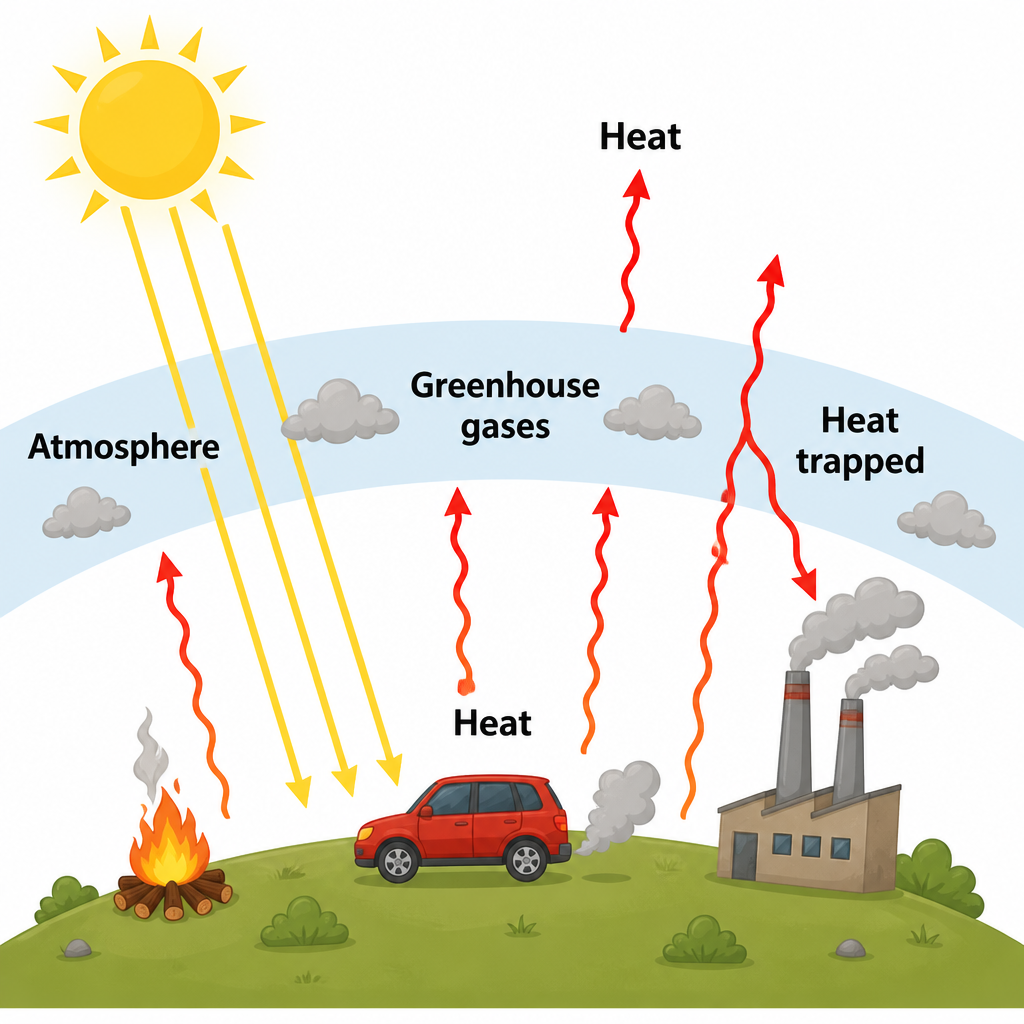
Greenhouse effect: the warming of the Earth's surface that happens when certain gases in the atmosphere let sunlight in but stop some of the heat from escaping back into space, much like the glass of a greenhouse.
Greenhouse gases: gases that trap heat in the atmosphere, mainly carbon dioxide, methane, nitrous oxide and water vapour.
Fossil fuels: coal, oil and natural gas, formed underground from plants and animals that died millions of years ago. Burning them releases carbon dioxide.
Renewable energy: energy from sources that do not run out, such as sunlight, wind and flowing water, which produce little or no greenhouse gas.
A natural greenhouse effect keeps the Earth warm enough to live on. The problem is that human activity has added far more of these gases. Burning fossil fuels in vehicles, power plants and factories releases carbon dioxide, and cutting down forests removes the trees that would absorb it. The extra heat raises the Earth's temperature. That in turn changes the oceans, the weather and our food supplies, and it brings extreme weather: storms, floods, heatwaves and long droughts. Polluted air also harms health, leading to illnesses such as asthma, heart disease and lung cancer.
Listening for detail is a skill you can prepare for. Work in this order:
- Read every incomplete sentence before the recording starts, and underline the words just before and after each blank.
- Predict the kind of answer each blank needs: a noun, a place, a time, or an item in a list.
- While listening, follow the sentences in order, since the answers usually come in the same order as the questions.
- Listen for signal words such as because, caused by, such as and for example, which often come right before an answer.
- When a question says no more than three words, write a short phrase, not a sentence.
- On the second listening, check your spelling and fill any gaps.
The speaker may not use the exact words printed around a blank. Listen for the same meaning in different words.
More Rules of Reported Speech
Backshift is the usual rule, but it has clear exceptions. In each case below the tense stays as it was, and knowing these cases is what separates a careful writer from a careless one.
- The reporting verb is in the present: says, tells, reports. The speaker's words are still current, so nothing moves back. Sachita says, “I love to listen to music.” → Sachita says that she loves to listen to music. Pronouns still change.
- The words state a universal truth or a scientific fact. The teacher explained, “The earth revolves round the sun.” → The teacher explained that the earth revolves round the sun. It was true then and it is true now.
- The verb is already in the past perfect, or is would, could, should, might or ought to. “I had already left,” he said. → He said that he had already left.
Everyday speech also contains words that are not really part of the message, such as sorry, thank you, OK and names of the people addressed. These are absorbed into the reporting verb. Smarika said, “I will meet you tomorrow, friends.” → Smarika told her friends that she would meet them the next day. Dorje said, “Sorry, I cannot lend you any money today.” → Dorje apologised and said that he could not lend me any money that day.
A present reporting verb never backshifts. “Smarika says that she could not stay there anymore” is wrong. Write: Smarika says that she can't stay here anymore.
Writing a Formal Letter of Request
The open letter to the UN shows that a respectful, well organised letter can ask powerful people for real change. You can do the same at the level of your own municipality, for example by asking the Mayor or Chairperson to include children's representatives when decisions about children are made. A formal letter has a fixed layout, and each part has a job.
- Sender's address, at the top right or top left.
- Date, below the sender's address.
- Receiver's designation and address: The Mayor, followed by the name of the municipality.
- Subject: one line that states the purpose, such as “Request to include child representatives in decision making”.
- Salutation: Dear Sir or Madam, or Respected Sir or Madam.
- Opening paragraph: who you are and why you are writing.
- Middle paragraph: your reasons, with facts or examples.
- Request paragraph: exactly what you want done.
- Closing: thanks, then Yours faithfully, your signature and your name.
A model letter follows.
Shree Saraswati Secondary School, Tilottama 5, Rupandehi. 12 June 2025.
The Mayor, Tilottama Municipality, Rupandehi.
Subject: Request to include child representatives in decision making.
Respected Sir,
I am a student of Class 10 and a member of our school's child club. On behalf of the children of our municipality, I would like to request that representatives of children be included when the municipality makes decisions on issues that concern us.
Many decisions, such as the location of playgrounds, the safety of roads near schools, school meal programmes and the budget for libraries, affect children more than anyone else. Yet children are rarely asked what they need. Child clubs in our wards already meet regularly, discuss local problems and propose practical solutions. With a voice in planning, we could help the municipality spend its budget where it makes the greatest difference.
I therefore request you to invite two representatives from the ward child clubs to municipal meetings on education, health and child protection, and to hold an open meeting with children once a year.
Thank you for your kind attention. I hope you will consider this request positively. Yours faithfully, Anisha Gurung.
Project Work: Designing a Newspaper Front Page
The unit ends by turning you into an editor. You collect at least five news items on current affairs and arrange them as the front page of your own newspaper. An editor's first decision is which story matters most, because that story gets the biggest headline and the top of the page.
- Masthead: the name of your newspaper, with the date and place of publication.
- Lead story: the most important news, under the largest headline.
- Photograph or drawing, with a one line caption explaining it.
- Four or more shorter stories, each with its own headline, set in columns.
- A small box or index telling readers what is inside.
Reading Comprehension Techniques
You do not read a bus timetable the way you read a novel. Reading with the right technique helps you understand a text better and faster, and the right technique depends on your purpose. There are four main strategies.
Skimming: running your eyes quickly over a text to collect its most important information, or gist, without trying to understand every word. It is used to find the main idea, for example by reading the title and headings carefully.
Scanning: running your eyes through a text to find one particular piece of information, such as a name, a date or a number. It is used for schedules, meeting plans and similar texts.
Extensive reading: reading longer texts, often for pleasure, to gain a general understanding of a subject. Fiction, non-fiction, newspaper articles and statistical data all call for it.
Intensive reading: close, accurate reading of a shorter text to take out specific details. Here every word, number and fact matters.
| Technique | Your purpose | Use it in this unit |
| Skimming | The main idea | Read the headline, the first paragraph and the subheading of the driverless car article to learn what it is about. |
| Scanning | One fact | Find the age of Fabrizio, the date of the letter, or the size of Mcity in acres. |
| Extensive reading | General understanding | Read the whole open letter to follow its argument from start to end. |
| Intensive reading | Exact details | Decide whether a statement is True, False or Not Given, word by word. |
Skim first to know what a text is about, scan when you need one fact, and read intensively when an answer depends on exact wording.
The full lesson is waiting for you
The notes are free to read in full. A free account opens the rest of the practice, and tracks your progress and confidence score for every subject. Presentations and videos need approval from Learn Yeti.