Greetings in Our Communities
Nepal is a country of many communities, and each community has its own dress, its own language and its own way of greeting. A Gurung grandmother, a Newar aunt and a Sherpa girl may wear very different clothes, yet when they meet someone, many of them do the same thing: they press their palms together and say Namaste. In English, people greet with words instead. They say Good morning before noon, Good afternoon after noon, and Good evening later in the day. When they meet someone new, they often shake hands.

A greeting is what we say or do when we meet someone, to show respect and friendliness. Good morning, Namaste and a handshake are all greetings.
Notice one thing about greetings in English: the words change with the time of day, but Hello and Hi work at any time. Hello is safe with anyone. Hi is friendly and casual, so we use it with friends, not with a headteacher or an officer we are meeting for the first time.
A Song About a Friend
Before meeting new people in this unit, sing about a friend we already know. The song below introduces a boy called Sam by telling us the things he can do. When you introduce a friend, this is exactly what you do too: you say the name, and then you say something interesting about the person.
I've got a friend whose name is Sam.He goes with me wherever I am.If you need fast, Sam can fly a plane.If you need water, Sam can make it rain.If you need some sugar, Sam gets sugarcane.Everybody knows Sam's name.
Try it yourself. Pick a friend and say two lines like the song does: the name first, then one thing your friend can do. That is an introduction, and this whole unit builds on it.
A Job Interview
Mike is the Finance Department Manager of a company. There is an open position in his department, which means there is a job nobody is doing yet, and he needs somebody to fill it soon. John wants that job, so Mike interviews him. Read how they speak to each other and notice how polite every line is.
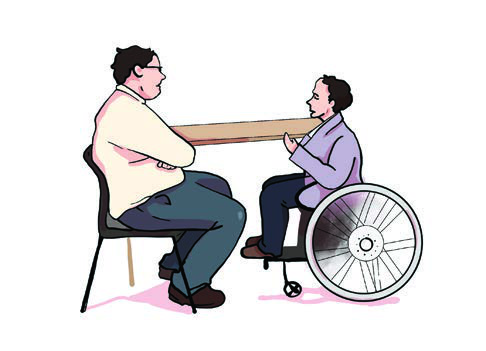
Watch what happens in this conversation. It opens with a greeting, not with business. Mike asks small, friendly questions about the morning and the traffic before the real interview begins. This is called small talk, and it helps both people relax. Then Mike introduces himself, explains why the interview is happening, and asks John to talk about himself. John answers in short, honest sentences. The talk closes politely from both sides. An interview is a formal meeting, so nobody uses slang, and John even says sir.
An interview is a formal meeting in which somebody is asked questions, for example to decide whether the person should get a job.
Sounds at the Start of Words
English spelling and English sound are not the same thing. The letters th can make two different sounds, and the letters ph make the sound of f. So we listen to the first sound of a word, not its first letter. Say each of these words aloud and feel where your tongue and lips go: than, thank, first, phone, closely, payroll, theory, check, ply, chat, there, quick.
| Sound | Words that start with it | How to make it |
| /p/ | payroll, ply | press the lips together, then let air burst out |
| /f/ | first, phone | top teeth touch the bottom lip and air hisses out |
| /θ/ | thank, theory | tongue between the teeth, air only, no voice |
| /ð/ | than, there | tongue between the teeth, with voice from the throat |
| /k/ | closely, quick | back of the tongue touches the roof of the mouth |
| /tʃ/ | check, chat | the ch sound, like the start of chair |
Thank and than look almost the same but begin with different sounds. Put your fingers on your throat. For than and there the throat buzzes, so the sound is /ð/. For thank and theory it does not buzz, so the sound is /θ/.
Introducing People
When two of your friends do not know each other, you introduce them. Read how Jim introduces Carol to Peter.
Has Carol met Peter before? No, she has not. We know because Jim has to introduce them, and because Carol says Pleasure to meet you, which people say only at a first meeting. If they had met before, she would say Good to see you again. Notice also what Jim adds after each name: She is from Argentina, Peter works for our New York branch. One small fact about each person gives the two strangers something to talk about.
- To introduce yourself, say: Hello! My name is Anita. or Let me introduce myself. I am Anita.
- To introduce others, say: This is my friend Reena. or Let me introduce you to Nitesh. or Meet my friend Reena.
- Then add one fact: She is from Kathmandu. He is an English teacher. She is good at teaching pronunciation.
- The person being introduced replies: Pleased to meet you. and the other answers: Pleased to meet you too.
- If you have met before, say: Good to see you again!
Listening: Who Is Who in an Office
The listening task for this unit plays a short conversation from an office. In it, a lady introduces a man called Thomas to another man, Mr. Peterson. Your job while listening is to work out who each person is. Three sentences have to be completed, using the words boss, new staff and Mr. Peterson: Mr. Thomas is a certain kind of worker, the lady introduces Thomas to somebody, and Mr. Peterson seems to hold a certain position.

You will not hear the answers spoken as single words. Nobody in an office says the word boss about himself. Instead, listen for clues. A person who has just joined is welcomed, shown around and introduced to others, so that person is the new staff. A person others report to, who welcomes people to the team, is the boss. Listen for who greets whom first, who is being introduced, and how respectfully each person is addressed. Before the audio starts, read the three unfinished sentences so your ears know what to hunt for.
Articles: a, an and the
The words a, an and the are called articles. A and an point to any one thing, not a particular one. The points to one particular thing that both the speaker and the listener know about.
Use a before a word that begins with a consonant sound, and an before a word that begins with a vowel sound: a college, a clerk, a problem, but an open position, an exercise bike, an honest guy. Listen to the sound, not the letter. Honest begins with the letter h but the h is silent, so the first sound is a vowel and we say an honest guy. Use the when there is only one such thing, or when it has already been mentioned: the Finance Department Manager, because the company has only one; the problem, because Lisa has already told Karen about it.
See the difference inside one story. Lisa phones a shop and says, I bought an exercise bike from your store. It is the first mention, so she says an. A minute later Karen asks, What seems to be the problem? By now both of them know which bike and which problem, so the is the right word. First mention takes a or an; known things take the.
Do not choose a or an by looking at the first letter. A university takes a because university begins with the sound of y. An hour takes an because the h is silent. Say the word aloud and trust the sound.
The Verb to be: am, is and are
Am, is and are are the present tense forms of the verb to be. Use am with I, is with he, she, it and every singular noun, and are with you, we, they and every plural noun.
Study these sentences and watch the verb change with the subject: I am a strong girl. He is an honest guy. Nature is beautiful. You are a hard working student. Trees are important for us. Social workers are the real heroes. To make a sentence negative, put not after the verb: I am not weak. He is not, or isn't, a cheat. You are not, or aren't, lazy. To ask a question, move the verb to the front: Is everybody equal? Is nature beautiful? Are trees useful for us?
| Subject | Verb | Sentence | Negative | Question |
| I | am | I am a new student. | I am not weak. | Am I late? |
| He, She, It, singular noun | is | The Dharahara is in Kathmandu. | He isn't a cheat. | Is nature beautiful? |
| You, We, They, plural noun | are | My sister and I are students. | You aren't lazy. | Are trees useful for us? |
My sister and I names two people, so the verb is are, not am and not is. Whenever and joins two subjects, treat them as they.
Reading a Notice
A notice is a short written announcement put up for many people to read. It tells who it is for, what will happen, when and where, and who issued it.
Read this notice the way you would read one on your school board. Jyoti Girls Hostel has announced interviews for accommodation, which means for places to stay in the hostel. The interviews for hostel applicants run from March 5th to March 7th, 2021. Each candidate's turn comes on a first come first served basis between 10:30 am and 5:00 pm, so the girl who arrives first is interviewed first. Every applicant must bring three original documents: her birth registration certificate, the mark sheets and certificates of the previous class, and proof of admission at Jyoti Secondary School. Anyone who needs further help can contact the school administration team. At the bottom stands one word, Warden, which tells us who issued the notice.
Whenever you meet a notice, ask yourself the same four questions. What is it about? Who is it for? What must I do, and by when? Who wrote it? A notice that answers all four is complete, and when you write your own notice in the project work, your readers will ask exactly these questions of you.
Writing Dialogues and Filling Forms
The writing tasks of this unit use everything above. First, you compose a dialogue in which you introduce two of your friends to each other. Use the pattern you learned: greet, give each name with This is, add one interesting fact about each person, and let them reply with Pleased to meet you. Here is a model with the names changed to yours when you write your own.
Second, you complete a hotel guest registration card. A form introduces you on paper, so it asks for the same facts you would say aloud: your family name and given name, your address, mobile number and date of birth, where you arrived from and where you are travelling to, your arrival and departure dates with their times, your purpose of visit, and your mode of payment, cash or credit card. At the end you sign it. Write every entry clearly, and never leave a required line empty. If a line does not apply to you, write a short dash of words such as not applicable rather than guessing.
Project Work and the Dictionary
For project work, get into a group of four and choose a club: an eco club, a dance club, a social club or a sports club. Together, prepare a short notice for the club. Give your notice everything the hostel notice had: a clear heading, what the club event is, the date and time, what members should bring or do, whom to contact for further help, and the name of the person or group issuing it.
One more skill closes the unit: reading a dictionary entry. Look up the word independent and see what the entry gives you. The head word is the word you searched for. The part of speech tells you what type of word it is; independent is an adjective. The phonemic transcript shows how the word is said, sound by sound. The definition tells you the meaning: not governed or ruled by another country. Then comes an example sentence, such as Croatia became independent from Yugoslavia in 1991, which shows the word working inside real English. In an online dictionary there is also a pronunciation audio you can click to hear the word spoken. When you meet a new word in this book, the dictionary gives you all of this for free, so make looking words up a habit.
The head word is the word you look up in a dictionary. Its entry gives the part of speech, the phonemic transcript, the definition and an example sentence.
The full lesson is waiting for you
Create a free account to unlock activities, practice tests, presentations and videos - and to track your progress and confidence score for every subject.
- traffic: the vehicles that are on a road
- interview: a formal meeting in which somebody is asked questions
- position: a post, a job in an organisation
- department: a section of a large organisation
- part-time: for part of the day or week, not for the whole working day
- clerk: a person whose job is to keep records and do office work
- accommodation: a place to live or stay in
- applicant: a person who formally asks for a job or a place
- original: real and first-made, not a copy
- registration: the act of recording a name officially, or the record itself
- proof: a thing that shows something is true
- further: more, extra
Look at the picture and answer these questions.
- Do you think the two men know each other?
- What do you think they are doing?
- What is the woman doing?
Sign in to play the audio.
Listen to the audio and complete the sentences with the given words/phrases below.
Use these words
- Mr. Thomas is a
- The lady introduces Thomas to
- Mr. Peterson seems to be the
Make a group of three. Role play as different people in different situations to introduce one another.
Greetings change with community and time of day: Namaste, Good morning, Good afternoon, Good evening, Hello.
11 more points to remember - sign in to see the rest.
Question 1 of 15