Every time we buy something in a shop we are doing the same piece of arithmetic. We know the price of one thing and we want the price of many, or we know the price of many and we want the price of one. The method that handles both jobs is called the unitary method.
The price of one and the price of many
In one shop a pencil costs Rs. 10. Krishna buys one pencil, Santosh buys two pencils and Khados buys three pencils. How much money does each of them have to hand to the shopkeeper?
Krishna bought only one pencil, so he pays Rs. 10. Santosh bought two, so he pays the price of one pencil twice, that is Rs. 10 and Rs. 10. Khados bought three, so he pays Rs. 10 three times. Adding the same number again and again is exactly what multiplication does, so adding and multiplying give the same answer here.

| Number of pencils | By adding | By multiplying | Amount to pay |
| 1 | 10 | \( 10 \times 1 = 10 \) | Rs. 10 |
| 2 | \( 10 + 10 = 20 \) | \( 10 \times 2 = 20 \) | Rs. 20 |
| 3 | \( 10 + 10 + 10 = 30 \) | \( 10 \times 3 = 30 \) | Rs. 30 |
Once you know what one thing costs, you find the cost of many of the same thing by multiplying that price by the number of things.
The rate written on a bill
A shop bill sets out, for each item, the quantity bought, the rate and the amount charged. Suntali Lama bought 3 kg of sugar and 5 kg of flour from a shop. Her bill is shown below.
| S.N. | Item | Quantity | Rate (Rs.) | Amount (Rs.) |
| 1 | Sugar | 3 kg | 80 | 240 |
| 2 | Flour | 5 kg | 45 | 225 |
| Total | 465 |
The bill gives the rate of sugar as Rs. 80. That means 1 kg of sugar costs Rs. 80. To get the amount for 3 kg, that Rs. 80 is multiplied by 3, so \( 80 \times 3 = 240 \). The flour row shows the same idea travelling the other way. Five kilograms of flour cost Rs. 225, and dividing gives \( 225 \div 5 = 45 \), which is the rate printed on the bill.
Rate is the price of one unit of a thing. One unit means one single measure of it: one piece, one kilogram, one litre or one metre.
Unit cost and total cost
The two kinds of amount on that bill have names in mathematics: the unit cost and the total cost. There is a direct relationship between them, and that relationship is the foundation of this whole topic.
The unit cost is the price of one article, or of one unit of quantity.
The total cost is the whole amount paid when several of the same article are bought together.
When the unit cost is known, multiplication gives the total cost:
\[ \text{Total cost} = \text{unit cost} \times \text{number of items} \]
When the total cost is known, division gives the unit cost:
\[ \text{Unit cost} = \dfrac{\text{total cost}}{\text{number of items}} \]
From one to many: when the unit cost is known, multiply by the number of items to reach the total cost.
From many to one: when the total cost is known, divide by the number of items to reach the unit cost.
Finding the total cost
One exercise book costs Rs. 50. What do six exercise books cost? Here the price of one is given and the price of many is wanted, so this is a multiplication.

Step 1: Multiply the price of one book, Rs. 50, by the number of books, 6. The mathematical statement is:
\[ 50 \times 6 \]
Step 2: Carrying out the multiplication gives:
\[ 50 \times 6 = 300 \]
Step 3: So six exercise books cost Rs. 300 altogether. Always write the rupees in the answer, because a price is only meaningful when its unit is written with it.
Finding the unit cost
Now turn the situation round. Twenty kilograms of rice cost Rs. 2500. What does 1 kg of rice cost? Here the price of many is given and the price of one is wanted, so this is a division.
Step 1: Divide the total cost, Rs. 2500, by the quantity, 20 kg. The mathematical statement is:
\[ \dfrac{2500}{20} \]
Step 2: Carrying out the division gives:
\[ \dfrac{2500}{20} = 125 \]
Step 3: So 1 kg of rice costs Rs. 125. This Rs. 125 is the rate of that rice, and it is the number that would be printed on the bill.
The unitary method: find the price of one first
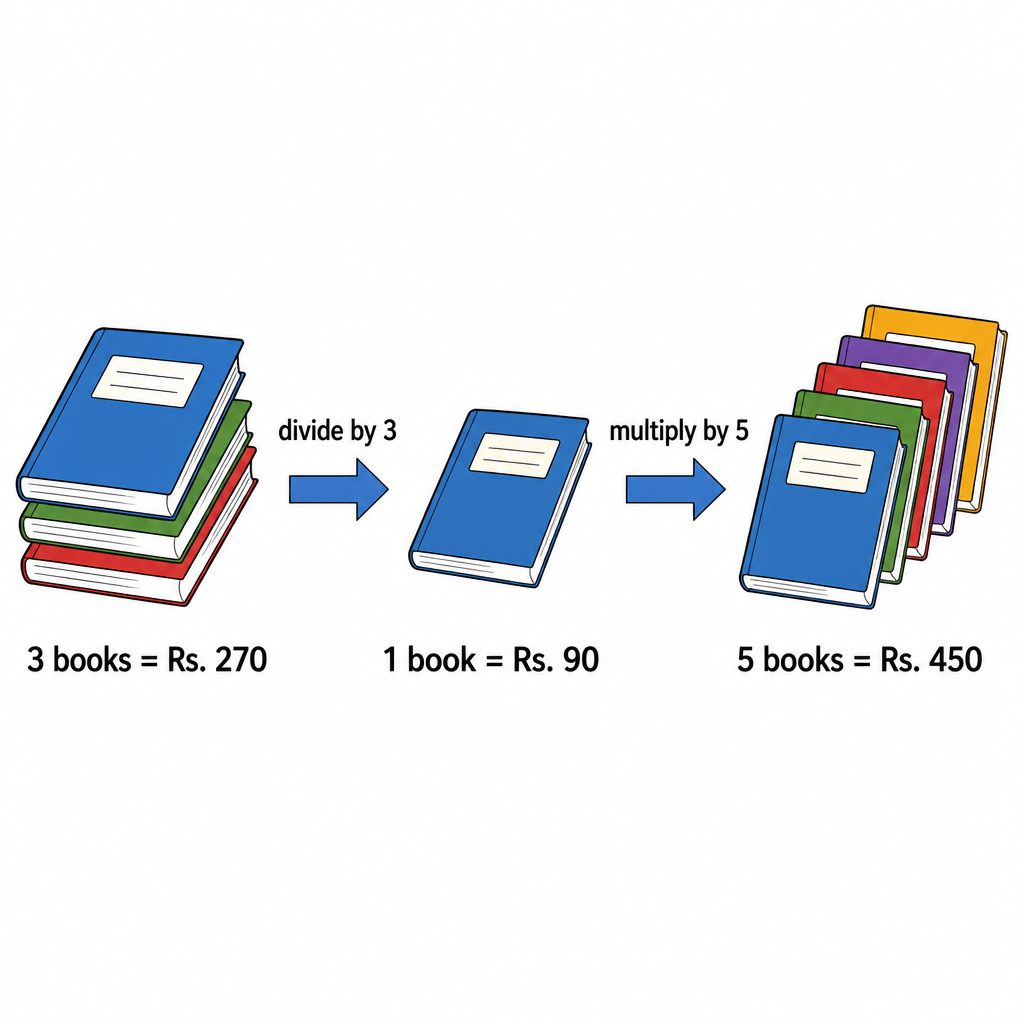
In most problems neither the price of one is given nor does the answer come in a single step. Three exercise books cost Rs. 270. What do five of them cost? The price of three is given and the price of five is wanted, so a bridge is needed between them, and that bridge is the price of one book.
The unitary method is the way of solving such problems by first finding the value of one article and then using it to find the value of as many articles as are wanted.
Step 1: Divide the cost of three books, Rs. 270, by 3 to get the cost of one book:
\[ \dfrac{270}{3} = 90 \]
Step 2: Now one book is known to cost Rs. 90. Multiply that by 5 to get the cost of five books:
\[ 90 \times 5 = 450 \]
Step 3: So five exercise books cost Rs. 450. Dividing down to one and then multiplying up to the number wanted are the two steps that make up the whole unitary method.
Dozens and larger quantities
A dozen is a group of 12. One dozen means 12 pieces, and 5 dozen means 60 pieces.
Ram paid Rs. 600 for 5 dozen bananas. What would he have paid for only 1 dozen? The counting here is in dozens, so a dozen itself can be treated as the unit.
Step 1: Divide the cost of 5 dozen, Rs. 600, by 5 to get the cost of 1 dozen:
\[ \dfrac{600}{5} = 120 \]
Step 2: So one dozen bananas cost Rs. 120.
Sometimes the count given is in pieces while the question asks about dozens. Mina bought 60 notebooks for Rs. 6000. What would she have paid for just one dozen?
Step 1: Divide the total cost, Rs. 6000, by 60 to get the cost of one notebook:
\[ \dfrac{6000}{60} = 100 \]
Step 2: One dozen means 12 notebooks, so multiply the price of one by 12:
\[ 100 \times 12 = 1200 \]
Step 3: So one dozen notebooks cost Rs. 1200.
Many students slip and treat a dozen as ten. A dozen is always 12, so when one pencil costs Rs. 10, a dozen costs Rs. 120 and not Rs. 100.
The method does not change when the quantity is in kilograms or litres. If 25 kg of rice costs Rs. 2250, first divide, \( 2250 \div 25 = 90 \), so 1 kg costs Rs. 90, and then multiply, \( 90 \times 60 = 5400 \), giving Rs. 5400 for 60 kg.
Checking whether the answer is sensible
After the working is finished a quick look at the answer catches most errors. The price of many must come out bigger than the price of one, and the price of one must come out smaller than the price of many. If three books cost Rs. 270 and your answer for one book is Rs. 810, you have multiplied where you should have divided.
A surer check is to work backwards. If five books came to Rs. 450, divide that by 5. Since \( 450 \div 5 = 90 \), which is the price of one book you had found, the answer is right.
Before multiplying or dividing, check that both quantities are measured in the same unit. A rate per kilogram multiplied by a number of litres, or a rate per piece multiplied by a weight, gives an answer that means nothing.
The full lesson is waiting for you
Create a free account to unlock activities, practice tests, presentations and videos - and to track your progress and confidence score for every subject.
The unit cost is the price of one article, or of one unit of quantity.
11 more points to remember - sign in to see the rest.
Question 1 of 12