The same football at two different prices
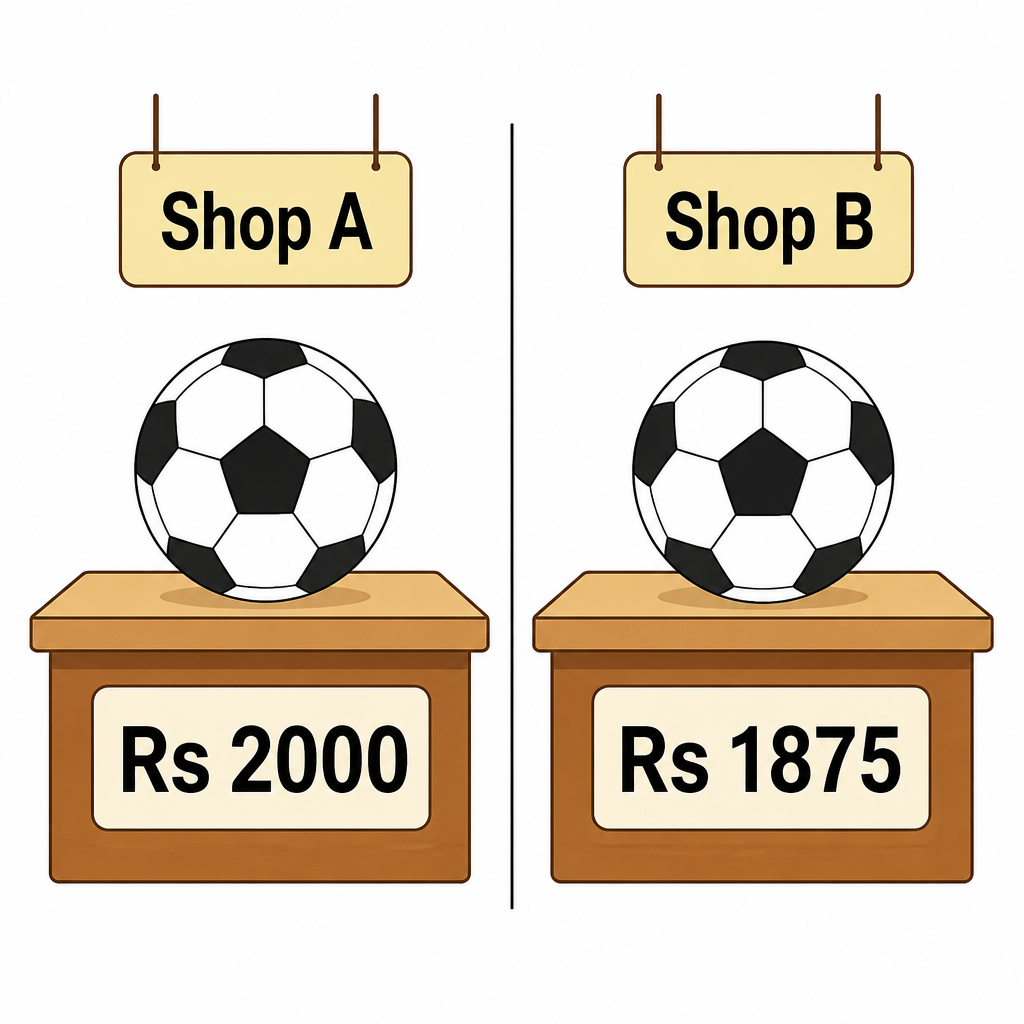
The same kind of goods does not carry the same price in every shop. Suppose a football costs Rs 2000 in Shop A and the same kind of football costs Rs 1875 in Shop B. The two footballs are alike, but the prices are not. The football is dearer in Shop A. In Shop B it is cheaper by Rs 125, because \( 2000 - 1875 = 125 \). A buyer who asks both shops before paying saves that Rs 125. Comparing prices before buying is a habit worth keeping.
A shopkeeper does not sell goods at the price he paid for them. He brings the goods from a wholesale shop or a factory and then puts his own price on them in his shop. If the price he takes is more than the price he paid, he gains. If it is less, he is out of pocket. Working out that gain or that shortfall is what this topic teaches.
A bag trader works out his money
Harkaman trades in bags. He brought bags from a wholesale shop at Rs 700 each. One of those bags he sold to Lakpa for Rs 900. Another bag had faded a little in colour, so he could sell it to Raju for only Rs 650. His accounts are worth looking at in two parts.
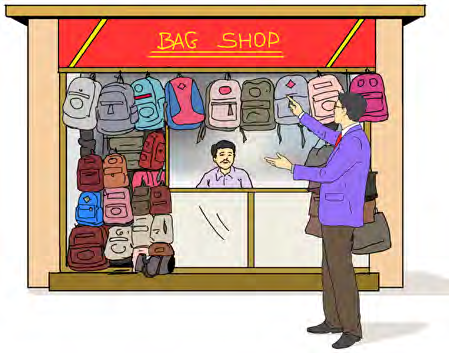
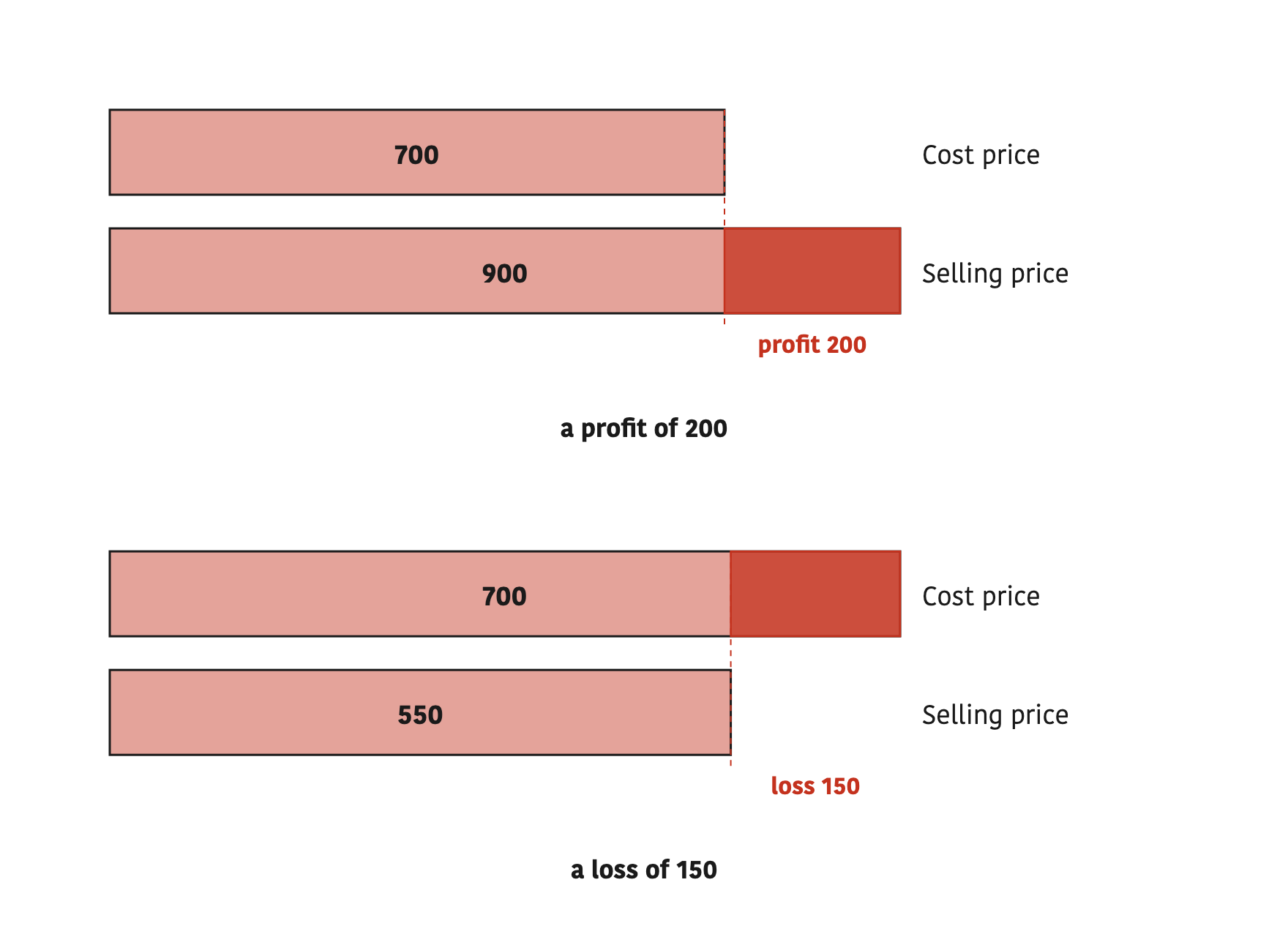
The first bag he bought for Rs 700 and sold for Rs 900. The price he took is more than the price he paid, so he gained. Subtracting shows how much he gained:
\[ 900 - 700 = 200 \]
The second bag he had also bought for Rs 700, but he got only Rs 650 for it. Here the price he took is less than the price he paid, so he was out of pocket. That shortfall is found by subtracting too:
\[ 700 - 650 = 50 \]
One bag brought in Rs 200 more than it cost, the other brought in Rs 50 less. To see how he stands overall, both bags are counted together. The total amount the two bags cost him:
\[ 700 + 700 = 1400 \]
The total amount the two bags brought in:
\[ 900 + 650 = 1550 \]
The money that came in is more than the money that went out, so overall he gained. Subtracting gives how much:
\[ 1550 - 1400 = 150 \]
So the two bags together left Harkaman Rs 150 better off. The loss on one deal was covered by the larger gain on the other. A trader looks at each deal by itself, and then adds them up to see where he stands altogether.
Cost price, selling price, profit and loss
The four amounts used in those accounts each have a name of their own. These names are used in shops and in trade as well as in mathematics, so they are worth learning properly.
Cost price: the price paid to buy an article. It is written in short as C.P.
Selling price: the price received on selling an article. It is written in short as S.P.
Profit: when the selling price is more than the cost price, the extra amount received is the profit.
Loss: when the selling price is less than the cost price, the amount that falls short is the loss.
One article carries both prices at once. Harkaman's bag had a cost price of Rs 700, and the selling price when he sold it to Lakpa was Rs 900. Profit and loss are both amounts of money, so they are always written in rupees. An answer without its unit is not finished, so never leave the Rs off.
Cost price (C.P.): the money paid out
Selling price (S.P.): the money taken in
Profit: what is left over when S.P. is the bigger price
Loss: what falls short when S.P. is the smaller price
The rules for profit and loss
Which of the two happens is settled by comparing the two prices. If the selling price is greater than the cost price there is a profit, and the profit is found like this:
\[ \text{Profit} = \text{S.P.} - \text{C.P.} \]
If the cost price is greater than the selling price there is a loss, and the loss is found like this:
\[ \text{Loss} = \text{C.P.} - \text{S.P.} \]
These two rules can be turned round to find the other amounts. When there is a profit:
\[ \text{S.P.} = \text{C.P.} + \text{Profit} \]
\[ \text{C.P.} = \text{S.P.} - \text{Profit} \]
When there is a loss:
\[ \text{S.P.} = \text{C.P.} - \text{Loss} \]
\[ \text{C.P.} = \text{S.P.} + \text{Loss} \]
Before using any rule, look at which of the two prices is the bigger one. Subtracting the smaller from the bigger gives the amount, and which price was bigger decides whether that amount is profit or loss.
Adding the profit to the selling price to get the cost price is wrong. The profit is added to the cost price, not to the selling price. In the same way, saying there is a loss when the selling price is the bigger one is wrong. That case is a profit.
Finding the profit
Sharmila bought a bicycle for Rs 8,500 and sold it for Rs 9,800. Did she gain or lose, and by how much?
Step 1: Write down the prices that are given. The cost price of the bicycle is Rs 8,500 and the selling price is Rs 9,800.
Step 2: Compare the two prices to see which is bigger:
\[ 9800 > 8500 \]
Step 3: The selling price is the bigger one, so this is a profit. Since profit is the selling price minus the cost price, the statement is:
\[ 9800 - 8500 \]
Step 4: Carry out the subtraction:
\[ 9800 - 8500 = 1300 \]
So Sharmila made a profit of Rs 1,300.
Finding the cost price when the profit is known
Sunita sold a sweater for Rs 1,600 and made a profit of Rs 250. What had she paid for it?
Step 1: Write down what is given. The selling price of the sweater is Rs 1,600 and the profit is Rs 250. The cost price is what has to be found.
Step 2: Remember that the selling price was made by adding the profit to the cost price. So:
\[ \text{C.P.} + 250 = 1600 \]
Step 3: Using the rule that the cost price is the selling price minus the profit, the statement is:
\[ 1600 - 250 \]
Step 4: Carry out the subtraction:
\[ 1600 - 250 = 1350 \]
So Sunita had bought the sweater for Rs 1,350.
Finding the selling price when the loss is known
Kamal bought a wooden table for Rs 6,200 and sold it at a loss of Rs 450. What did he sell it for?
Step 1: Write down what is given. The cost price of the table is Rs 6,200 and the loss is Rs 450. The selling price is what has to be found.
Step 2: In a loss the selling price falls short of the cost price by exactly that amount. So:
\[ \text{S.P.} + 450 = 6200 \]
Step 3: Using the rule that the selling price is the cost price minus the loss, the statement is:
\[ 6200 - 450 \]
Step 4: Carry out the subtraction:
\[ 6200 - 450 = 5750 \]
So Kamal sold the table for Rs 5,750.
Buying and selling many items together
A shopkeeper usually buys and sells many of the same article at once. In that case the total cost price and the total selling price are worked out first, and only then compared. Suppose a shopkeeper bought 12 pens at Rs 40 each and sold all of them at Rs 45 each.
Step 1: Find the total cost price of the 12 pens:
\[ 12 \times 40 = 480 \]
Step 2: Find the total selling price of all 12 pens:
\[ 12 \times 45 = 540 \]
Step 3: Compare the two totals. Since \( 540 > 480 \), this is a profit. The statement for the profit is:
\[ 540 - 480 = 60 \]
So the 12 pens brought the shopkeeper a profit of Rs 60. Each pen gained Rs 5, and \( 12 \times 5 = 60 \), which checks the answer.
How to tell whether it is profit or loss
Whatever the question, the same short order of work settles whether it is a gain or a shortfall.
Once this order is fixed in mind, no question of this kind is confusing.
- Write down the cost price on its own line.
- Write down the selling price on its own line.
- Compare the two prices and see which one is bigger.
- If the selling price is bigger it is a profit; if the cost price is bigger it is a loss.
- Subtract the smaller amount from the bigger one to get the amount.
- Write the answer in rupees and say plainly whether it is profit or loss.
| Situation | Comparison | Result | How to find it |
| More came in than went out | S.P. is bigger | Profit | S.P. minus C.P. |
| Less came in than went out | C.P. is bigger | Loss | C.P. minus S.P. |
| Both prices equal | S.P. equals C.P. | Neither profit nor loss | The subtraction gives zero |
The table below shows the accounts for four articles. In each row the two prices are compared and the result is written out.
| Article | Cost price | Selling price | Result |
| Watch | Rs 1200 | Rs 1500 | Profit Rs 300 |
| Umbrella | Rs 450 | Rs 400 | Loss Rs 50 |
| Shoes | Rs 1800 | Rs 1800 | Neither profit nor loss |
| Exercise book | Rs 60 | Rs 75 | Profit Rs 15 |
A price survey of nearby shops
Profit and loss are not only sums in a book; they show up in everyday shopping. Visit the shops near your home and your school, note the price of seven things you use every day, and compare them.
- Choose seven everyday things such as rice, oil and salt.
- Go to at least two shops and note the price of each thing.
- Subtract to find by how much each thing is cheaper or dearer in one shop than the other.
- Work out which goods the shops take the biggest gain on.
- Make a table of your findings and present it to the class.
The full lesson is waiting for you
Create a free account to unlock activities, practice tests, presentations and videos - and to track your progress and confidence score for every subject.
The price paid to buy an article is the cost price, written in short as C.P.
11 more points to remember - sign in to see the rest.
Question 1 of 13