Showing a part in hundreds
When we want to talk about a part of a whole, we very often cut that whole into 100 equal parts first. A hundred is a friendly number to work with, because every small part is then one out of a hundred, and two different things can be compared on the same scale. Look at the square below. It is divided into 100 small boxes of exactly the same size. Some boxes are coloured and the rest are left white.
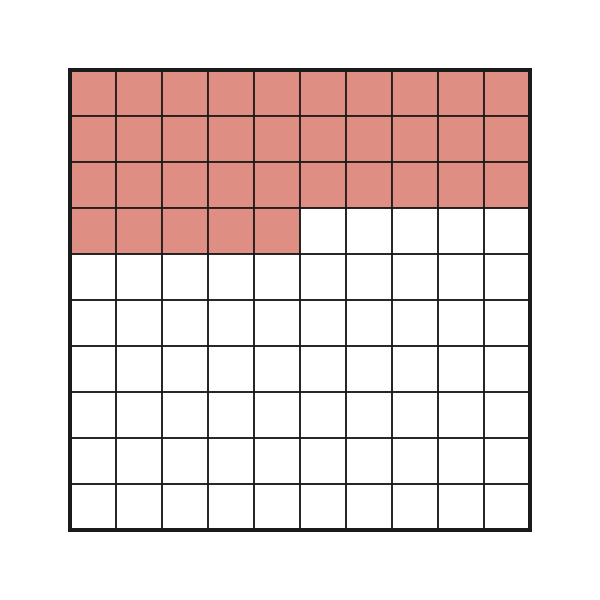
Counting the coloured boxes gives 35 out of 100. That one coloured part can be named in three different ways. As a fraction it is \( \frac{35}{100} \). As a decimal it is \( 0.35 \). As a percentage it is \( 35\% \). These are three names for the same amount, not three different amounts.
\[ \frac{35}{100} = 0.35 = 35\% \]
Percentage: in a fraction whose denominator is 100, the numerator gives the percentage value of that fraction. A percentage is written with the sign '%'.
Read '%' as 'out of a hundred'. So \( 35\% \) means 35 parts out of every 100 parts. A complete whole is always \( 100\% \).
The real power of a percentage shows up when we compare. Suppose Sirjana scored 17 out of 20 in one test and Binod scored 43 out of 50 in another. Comparing \( \frac{17}{20} \) with \( \frac{43}{50} \) is awkward, because the denominators are different. Once both are changed to percentages we get \( 85\% \) and \( 86\% \), and it takes one glance to see who did better.
Relationship between fraction, decimal and percentage
Take a line running from 0 to 1 and cut it into ten equal steps. One step can be written as \( 0.1 \) in decimals, as \( \frac{1}{10} \) or \( \frac{10}{100} \) in fractions, and as \( 10\% \) in percentages. The four lines below are drawn one under the other, lined up, so the four names of one point sit together.
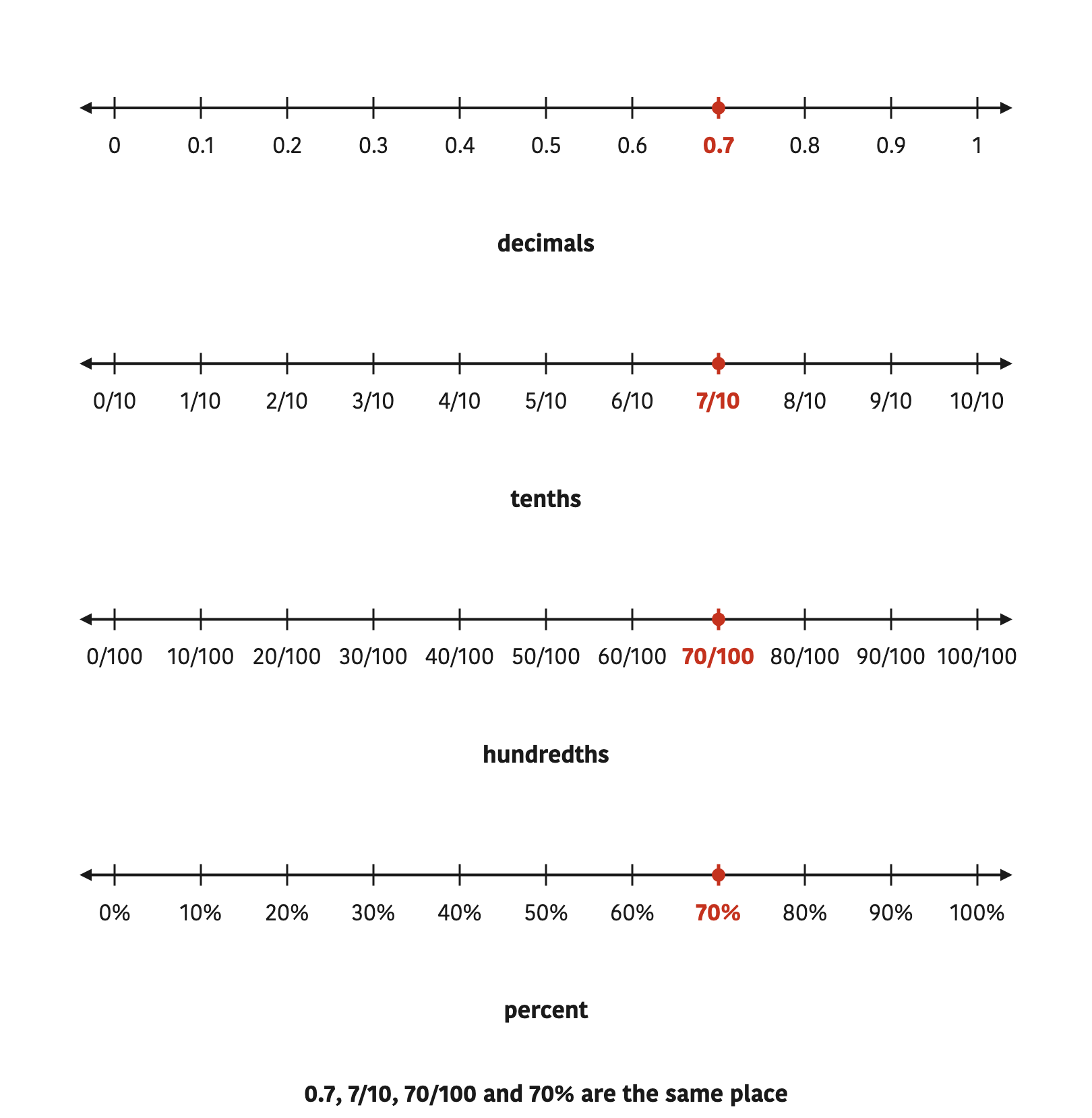
Wherever \( 0.5 \) sits on the line, \( \frac{5}{10} \), \( \frac{50}{100} \) and \( 50\% \) sit at the very same place. That is why changing from one form to another never changes the value. Only the way of writing it changes. A few of these matching forms are set side by side below.
| Fraction | Decimal | Percentage |
| \( \frac{1}{10} \) | 0.1 | 10% |
| \( \frac{1}{4} \) | 0.25 | 25% |
| \( \frac{1}{2} \) | 0.5 | 50% |
| \( \frac{3}{4} \) | 0.75 | 75% |
| \( \frac{1}{1} \) | 1.0 | 100% |
To change a fraction or a decimal into a percentage, multiply by 100 and put the % sign. To change a percentage into a fraction, divide by 100 and take the % sign away.
Changing a fraction into a percentage
Let us write \( \frac{7}{20} \) as a percentage. It can be done in three ways, and all three give the same answer.
First way. Step 1: Multiply the fraction by 100:
\[ \frac{7}{20} \times 100 \]
Step 2: Dividing 100 by 20 gives 5, so the multiplication that is left is:
\[ 7 \times 5 = 35 \]
Step 3: Finally put the % sign on the answer:
\[ \frac{7}{20} = 35\% \]
Second way. Step 1: To turn the denominator 20 into 100 we must multiply it by 5, so multiply both the numerator and the denominator by 5:
\[ \frac{7}{20} = \frac{7 \times 5}{20 \times 5} \]
Step 2: Carry out the multiplication on the top and on the bottom:
\[ = \frac{35}{100} \]
Step 3: The denominator is now 100, so the numerator itself is the percentage:
\[ = 35\% \]
The third way comes from plain reasoning. Here \( \frac{7}{20} \) means 7 parts out of 20 parts.
So in 1 part there is \( \frac{7}{20} \) of a part.
Then in 100 parts there are \( \frac{7}{20} \times 100 = 35 \) parts, which says that \( \frac{7}{20} = 35\% \).
Changing a decimal into a percentage
The rule is the same for a decimal. Let us write \( 0.65 \) as a percentage. Step 1: Multiply the decimal by 100:
\[ 0.65 \times 100 = 65 \]
Step 2: Put the % sign on the answer:
\[ 0.65 = 65\% \]
In the same way \( 0.03 \times 100 = 3 \), so \( 0.03 = 3\% \), and \( 1.8 \times 100 = 180 \), so \( 1.8 = 180\% \). Since \( 1.8 \) is bigger than one whole, it is quite natural for its percentage to be more than \( 100\% \).
Multiplying a decimal by 100 moves the decimal point two places to the right, so \( 1.8 \) becomes \( 180\% \) and not \( 18\% \). Going to a percentage you multiply, coming back to a fraction you divide. Swapping these two spoils the whole answer.
Changing a percentage into a fraction
Let us write \( 8\% \) as a fraction and reduce it to its lowest terms. \( 8\% \) means 8 parts out of 100 parts. Step 1: Take away the % sign and divide by 100:
\[ 8\% = \frac{8}{100} \]
Step 2: Write the numerator and the denominator as products of factors, using \( 8 = 2 \times 2 \times 2 \) and \( 100 = 25 \times 2 \times 2 \):
\[ \frac{8}{100} = \frac{2 \times 2 \times 2}{25 \times 2 \times 2} \]
Step 3: Cancel the common factors 2 and 2, which leaves the fraction in lowest terms:
\[ = \frac{2}{25} \]
Lowest terms: a fraction is in its lowest terms when the numerator and the denominator have no common factor left except 1.
When the percentage itself carries a decimal the method does not change. Let us write \( 1.5\% \) as a fraction. Step 1: Divide by 100:
\[ 1.5\% = \frac{1.5}{100} \]
Step 2: To clear the decimal from the top, multiply both the numerator and the denominator by 10:
\[ = \frac{15}{1000} \]
Step 3: Divide both by their common factor 5:
\[ = \frac{3}{200} \]
Finding a percentage of a quantity
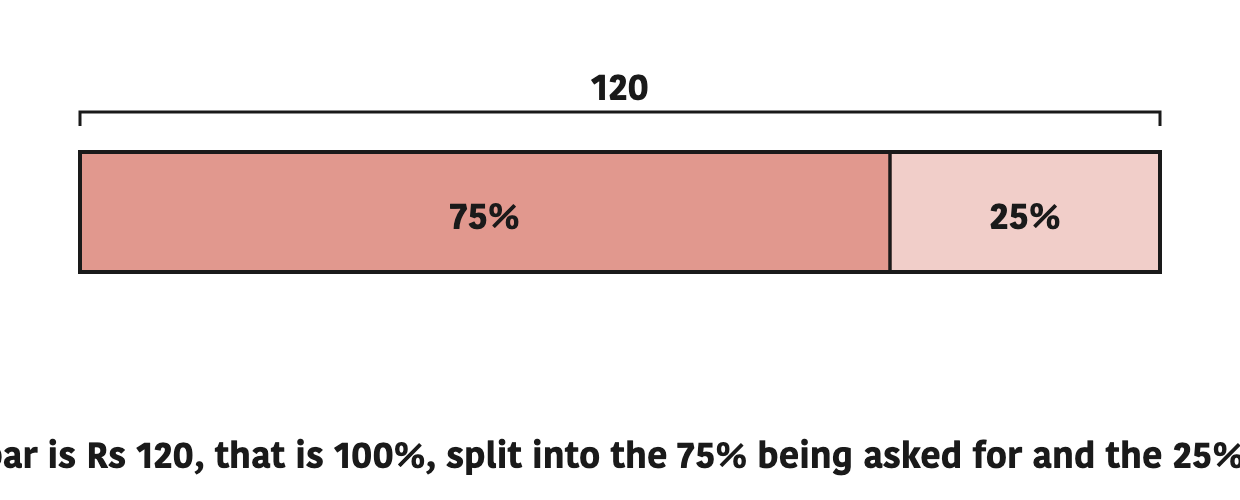
In a question that asks what \( 75\% \) of Rs 120 is, the whole of Rs 120 is the \( 100\% \), and we want 75 parts of it. Step 1: Write the percentage as a fraction and multiply it by the quantity:
\[ 120 \times \frac{75}{100} \]
Step 2: Multiply out the top:
\[ = \frac{9000}{100} \]
Step 3: Divide by 100:
\[ = 90 \]
So \( 75\% \) of Rs 120 is Rs 90, and the remaining \( 25\% \) is Rs 30. The picture below shows how the whole amount splits into the part we want and the part left over.
When the quantity carries a unit, the answer must carry a unit too. For example, to find \( 15\% \) of 2 km, Step 1: Change the distance into metres:
\[ 2 \text{ km} = 2000 \text{ m} \]
Step 2: Write the percentage as a fraction and multiply:
\[ 2000 \times \frac{15}{100} = 300 \]
So \( 15\% \) of 2 km is 300 m.
If one question mixes two units such as km and m, bring both to the same unit first and only then work out the percentage. An answer written without its unit is an incomplete answer.
What percentage one number is of another
There were 50 students in a class. If 8 of them were absent, let us find what percentage were absent and what percentage were present. Here the total of 50 is the \( 100\% \). Step 1: Divide the number absent by the total and multiply by 100:
\[ \frac{8}{50} \times 100\% \]
Step 2: Since \( \frac{100}{50} = 2 \), the multiplication left is:
\[ = 8 \times 2\% = 16\% \]
Step 3: The number present is \( 50 - 8 = 42 \), so their percentage is:
\[ \frac{42}{50} \times 100\% = 42 \times 2\% = 84\% \]
When a group is split into just two parts, their percentages always add up to \( 100\% \). So the present percentage can also be checked as \( 100\% - 16\% = 84\% \).
Everyday problems using percentage
A class of 50 students has \( 60\% \) girls. Let us find the number of girls, the number of boys and the percentage of boys. Step 1: Take \( 60\% \) of the total to get the number of girls:
\[ 50 \times \frac{60}{100} = 30 \]
Step 2: Subtract the number of girls from the total to get the number of boys:
\[ 50 - 30 = 20 \]
Step 3: Divide the number of boys by the total and multiply by 100:
\[ \frac{20}{50} \times 100\% = 40\% \]
So there are 30 girls and 20 boys, and the boys form \( 40\% \) of the class. Since \( 60\% + 40\% = 100\% \), we can trust that the answer is right.
In problems like these, always sort out three things. First, which quantity is the whole, that is the \( 100\% \). Second, which part is being asked for. Third, whether the answer should be a number or a percentage. If a part is wanted, multiply the whole by the percentage written as a fraction. If a percentage is wanted, divide the part by the whole and multiply by 100.
- Find the whole quantity and treat it as \( 100\% \).
- Decide whether the question wants a number or a percentage.
- Make the units match if the question mixes them.
- After working it out, check that the parts add up to \( 100\% \).
The full lesson is waiting for you
Create a free account to unlock activities, practice tests, presentations and videos - and to track your progress and confidence score for every subject.
A percentage is the numerator of a fraction whose denominator is 100, and it is written with the % sign.
11 more points to remember - sign in to see the rest.
Question 1 of 14