The numbers we count with
Pencils lying on a table can be counted. Saying one, two, three and going on, you reach a number that tells you exactly how many there are. Now look at a sack of rice. The grains can be counted too, one by one, but finishing that count would take a very long time. The grains are not impossible to count, only hard to count. The numbers we use when we count objects like these are called natural numbers.


Natural numbers start at 1 and go on for ever. There is no last one, because you can always add 1 to whatever number you have reached and get a new number. The set of natural numbers is written with the letter N.
The counting numbers, taken together, are called natural numbers.
\[ N = \{1, 2, 3, 4, \ldots\} \]
When zero joins the counting numbers
Add two natural numbers and the answer is again a natural number. Multiply two natural numbers and the answer is again a natural number. Subtraction does not behave the same way. Look at these pairs.
- \( 8 + 6 = 14 \) and \( 8 + 8 = 16 \), and both answers are natural numbers.
- \( 8 \times 6 = 48 \) and \( 8 \times 8 = 64 \), and both answers are natural numbers.
- \( 8 - 6 = 2 \) is a natural number, but \( 8 - 8 = 0 \) is not a natural number.
Zero has turned up here. Zero is the number we use to say that there is none of something at all. Zero is not a natural number, but it certainly is a number. So we take the natural numbers and put zero in front of them to make a new set, written with the letter W.
The natural numbers together with zero are called whole numbers.
\[ W = \{0, 1, 2, 3, 4, \ldots\} \]
The first and smallest whole number is 0. The smallest natural number is 1.
Smallest and largest numbers
We have only ten digits to write with: 0, 1, 2, 3, 4, 5, 6, 7, 8 and 9. Using these ten digits over and over, a number of any size at all can be written. Once we fix how many digits a number is to have, its smallest and largest values are fixed too.
| Number of digits | Smallest number | Largest number |
| One digit | 1 | 9 |
| Two digits | 10 | 99 |
| Three digits | 100 | 999 |
| Four digits | 1000 | 9999 |
| Five digits | 10000 | 99999 |
| Six digits | 100000 | 999999 |
The value a digit carries depends on the place it sits in. Move the digits into different places and the number becomes larger or smaller. Take the digits 1, 5 and 8. Whichever digit you put in the hundreds place decides how big the number turns out.
- Putting 1 in the hundreds place gives 158 and 185.
- Putting 5 in the hundreds place gives 518 and 581.
- Putting 8 in the hundreds place gives 815 and 851.
- That makes six numbers in all. The largest of them is 851 and the smallest is 158.
Now let us write every possible number that the digits 9, 2 and 7 can make. No digit may be repeated, and all three must be used.
- With 9 in the hundreds place we get 927 and 972.
- With 2 in the hundreds place we get 297 and 279.
- With 7 in the hundreds place we get 792 and 729.
- The possible numbers are 927, 972, 297, 279, 792 and 729.
Next, find the difference between the largest and the smallest three digit number that 5, 0 and 1 can make.
- Step 1: To make the number as large as possible, put the largest digit first, so the largest number is 510.
- Step 2: To make it as small as possible, put the smallest digit first, but zero in front would leave a two digit number, so the smallest number is 105.
- Step 3: Take the difference, \( 510 - 105 = 405 \).
When you build the smallest three digit number, zero must not go in the hundreds place. Written as 051 the number reads 51, which is not a three digit number at all.
Simplification
Krishna has 20 pencils and shares them equally among his 10 friends. His friend Ram gets his share, and then his mother gives him 4 more pencils. Later Ram gives 5 pencils to his sister. How many pencils are left with Ram? The whole story can be written as one mathematical statement and then simplified.

Step 1: The mathematical statement is:
\[ 20 \div 10 + 4 - 5 \]
Step 2: Do the division first, because division and multiplication come before addition and subtraction. Since \( 20 \div 10 = 2 \), the statement becomes:
\[ 2 + 4 - 5 \]
Step 3: Now work from left to right and add. Since \( 2 + 4 = 6 \), the statement becomes:
\[ 6 - 5 \]
Step 4: Subtracting the last two numbers:
\[ 6 - 5 = 1 \]
So Ram is left with 1 pencil.
When you simplify, do multiplication and division first, then addition and subtraction. Operations of equal standing are done from left to right in order.
Here is another one. Goma had 20 rubber bands. She gave 18 of them to her friend Gita. Later her mother gave her 16 more. How many rubber bands does Goma have now?
Step 1: The mathematical statement is:
\[ 20 - 18 + 16 \]
Step 2: Only subtraction and addition appear here, so start from the left. Subtracting the first two numbers:
\[ 20 - 18 = 2 \]
Step 3: Now adding the remaining numbers:
\[ 2 + 16 = 18 \]
So Goma has 18 rubber bands.
Now take three times 18, subtract 12 from it and add 20. A multiplication appears here, so the order matters.
Step 1: The mathematical statement is:
\[ 18 \times 3 - 12 + 20 \]
Step 2: Multiplication is done first. Since \( 18 \times 3 = 54 \), this becomes:
\[ 54 - 12 + 20 \]
Step 3: Subtracting from the left:
\[ 54 - 12 = 42 \]
Step 4: Adding the last two numbers:
\[ 42 + 20 = 62 \]
Simplification with brackets
Sajan has 12 chocolates. He keeps 4 for himself and shares the rest equally between 2 friends. How many does each friend get? Here the subtraction has to happen before the division. The operation that must come first is put inside a bracket.
Step 1: The mathematical statement is:
\[ (12 - 4) \div 2 \]
Step 2: The work inside the bracket is done first. Since \( 12 - 4 = 8 \), this becomes:
\[ 8 \div 2 \]
Step 3: Now dividing:
\[ 8 \div 2 = 4 \]
So each friend gets 4 chocolates.
The brackets used in simplification are, in order, the small bracket ( ), the curly bracket { } and the square bracket [ ]. The work inside the small bracket is done first, then the work inside the curly bracket, and last of all the work inside the square bracket.
Now simplify \( \{(45 - 3) \div 6\} + 8 \). Here 3 must be taken from 45 before dividing by 6, and 8 is added at the very end. That is why \( (45 - 3) \) sits in the small bracket and \( \{(45 - 3) \div 6\} \) sits in the curly bracket.
Step 1: Doing the work in the small bracket gives:
\[ \{42 \div 6\} + 8 \]
Step 2: Doing the division in the curly bracket gives:
\[ 7 + 8 \]
Step 3: Adding at the end:
\[ 7 + 8 = 15 \]
Here is an example with all three kinds of bracket. To simplify \( [20 \times \{40 - 6 \times (7 - 2)\}] + 16 \), work from the innermost bracket outwards.
Step 1: Doing the work inside the small bracket gives:
\[ [20 \times \{40 - 6 \times 5\}] + 16 \]
Step 2: Inside the curly bracket multiplication comes first, so this becomes:
\[ [20 \times \{40 - 30\}] + 16 \]
Step 3: Doing the subtraction in the curly bracket gives:
\[ [20 \times 10] + 16 \]
Step 4: Doing the multiplication inside the square bracket gives:
\[ 200 + 16 \]
Step 5: Adding at the end:
\[ 200 + 16 = 216 \]
Another example is \( 128 \div [4 + \{12 \times (5 - 4)\}] + 6 \). Once the brackets are cleared, the division and addition that remain must still be done in the right order.
Step 1: Clearing the small bracket gives:
\[ 128 \div [4 + \{12 \times 1\}] + 6 \]
Step 2: Doing the multiplication in the curly bracket gives:
\[ 128 \div [4 + 12] + 6 \]
Step 3: Doing the addition in the square bracket gives:
\[ 128 \div 16 + 6 \]
Step 4: Doing the division gives:
\[ 8 + 6 \]
Step 5: Doing the addition gives:
\[ 8 + 6 = 14 \]
Testing whether one number divides another
Does 3 divide 365 exactly? Doing the division gives a quotient of 121 and leaves a remainder of 2. Because a remainder is left, 3 does not divide 365 exactly. There are short ways of finding this out without doing the long division every time.
Working out whether one number divides another exactly, without actually carrying out the division, is called a divisibility test.
| Divisor | Test | Example |
| 2 | The ones place holds 0, 2, 4, 6 or 8 | 2 divides 1644 |
| 3 | The digits add up to a number 3 divides | The digits of 7542 add to 18 |
| 5 | The ones place holds 0 or 5 | 5 divides 1250 |
| 7 | Twice the ones digit taken from the rest of the number leaves a multiple of 7 | For 651, 65 - 2 = 63 |
| 11 | Taking the ones digit from the rest of the number, repeated, leaves a multiple of 11 | For 2431, 243 - 1 = 242 |
Now test whether 3 divides 12345 exactly.
- Step 1: Add the digits of the number. \( 1 + 2 + 3 + 4 + 5 = 15 \).
- Step 2: 3 divides 15 exactly, so 3 also divides 12345 exactly.
Next, test whether 7 divides 651. This test uses twice the digit in the ones place.
Step 1: The ones place holds 1. Doubling it:
\[ 1 \times 2 = 2 \]
Step 2: Removing the ones digit leaves the number:
\[ 65 \]
Step 3: Subtracting:
\[ 65 - 2 = 63 \]
Step 4: 7 divides 63 exactly, so 7 divides 651 exactly as well.
The test for 11 works in a similar way, except that the ones digit is subtracted as it is, without doubling. The process is repeated until the answer is a two digit number. Test 2431.
Step 1: Removing the ones digit 1 from 2431 leaves:
\[ 243 \]
Step 2: Subtracting the removed digit:
\[ 243 - 1 = 242 \]
Step 3: Removing the ones digit 2 from 242 leaves 24, so subtracting again:
\[ 24 - 2 = 22 \]
Step 4: 11 divides 22 exactly, so 11 divides 2431 exactly.
Factors and multiples
Take 6 paper squares, each 1 cm by 1 cm. In how many different ways can all six be arranged into a rectangle? One row of 6 works, two rows of 3 work, three rows of 2 work and six rows of 1 work. So the rectangles are \( 1 \times 6 \), \( 2 \times 3 \), \( 3 \times 2 \) and \( 6 \times 1 \), four ways in all.
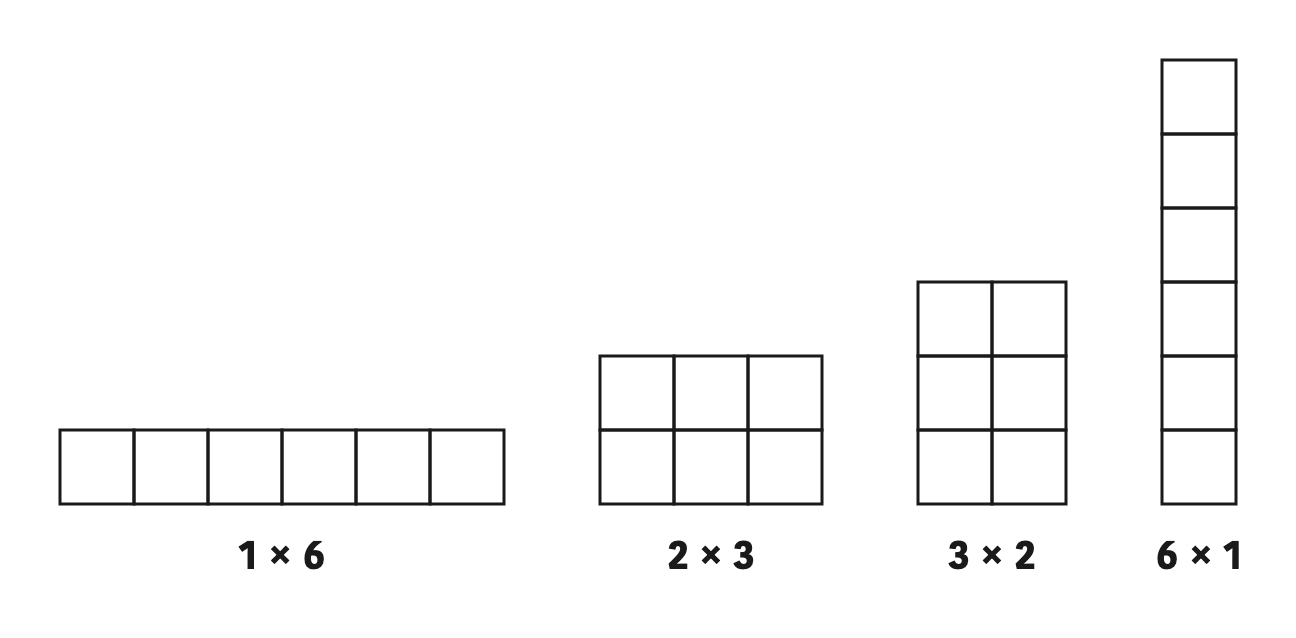
The measurements of these rectangles are 1, 2, 3 and 6, and each of those numbers divides 6 exactly. So 1, 2, 3 and 6 are called the factors of 6. In the same way \( 1 \times 12 \), \( 2 \times 6 \), \( 3 \times 4 \), \( 4 \times 3 \), \( 6 \times 2 \) and \( 12 \times 1 \) all give 12, so the factors of 12 are 1, 2, 3, 4, 6 and 12. The set of them is written \( F_{12} \).
\[ F_{12} = \{1, 2, 3, 4, 6, 12\} \]
The numbers that divide a given number exactly are called the factors of that number. Every number has at least two factors, namely 1 and the number itself.
Now find the factors of 18. Write down every pair of numbers whose product is 18.
Step 1: Write the pairs that multiply to 18:
\[ 1 \times 18,\ 2 \times 9,\ 3 \times 6,\ 6 \times 3,\ 9 \times 2,\ 18 \times 1 \]
Step 2: Collect every number that appears in those pairs, writing each one only once.
Step 3: Put them in order from smallest to largest:
\[ F_{18} = \{1, 2, 3, 6, 9, 18\} \]
Now look at the multiplication table of 5. Going \( 5 \times 1 = 5 \), \( 5 \times 2 = 10 \), \( 5 \times 3 = 15 \) and onwards gives 5, 10, 15, 20, 25 and so on. These numbers are called the multiples of 5, written \( M_5 \). A list of multiples never ends, because the multiplication table can always be carried further.
\[ M_5 = \{5, 10, 15, 20, 25, \ldots\} \]
The products you get when a number is multiplied by the natural numbers one after another are called the multiples of that number.
The set of the first ten multiples of 8 is \( M_8 = \{8, 16, 24, 32, 40, 48, 56, 64, 72, 80\} \). Factors and multiples are two sides of the same fact. In \( 5 \times 6 = 30 \), the numbers 5 and 6 are factors of 30, and 30 is a multiple of both 5 and 6.
Prime numbers and composite numbers
Write out the factors of each number from 1 to 10 and count how many factors each one has. Doing this shows numbers behaving in three different ways.
| Number | Factors | How many factors |
| 1 | 1 | 1 |
| 2 | 1, 2 | 2 |
| 3 | 1, 3 | 2 |
| 4 | 1, 2, 4 | 3 |
| 5 | 1, 5 | 2 |
| 6 | 1, 2, 3, 6 | 4 |
| 7 | 1, 7 | 2 |
| 8 | 1, 2, 4, 8 | 4 |
| 9 | 1, 3, 9 | 3 |
| 10 | 1, 2, 5, 10 | 4 |
In the table the number 1 has just one factor. The numbers 2, 3, 5 and 7 have exactly two factors each. The numbers 4, 6, 8, 9 and 10 have more than two factors.
A number whose only factors are 1 and the number itself is called a prime number, for example 2, 3, 5, 7 and so on.
A number that has more than two factors is called a composite number, for example 4, 6, 8, 9, 10 and so on.
1 is neither prime nor composite, because it has only one factor. And 2 is prime even though it is an even number. It is the only even prime number there is.
Prime factorization
The number 24 can be written as a product in eight ways, such as \( 1 \times 24 \), \( 2 \times 12 \), \( 3 \times 8 \) and \( 4 \times 6 \). In none of these are all the factors prime. Break the composite factors down again and again, and in the end only prime numbers are left, giving \( 24 = 2 \times 2 \times 2 \times 3 \).
Writing a composite number as a product of prime numbers only is called the prime factorization of that number.
There are two ways of doing this. The first is the division method. You keep dividing the number by a small prime, and you do not stop until the quotient itself is prime. Take 486.
Step 1: 486 is an even number, so 2 divides it exactly. Dividing by 2:
\[ 486 \div 2 = 243 \]
Step 2: The digits of 243 add to \( 2 + 4 + 3 = 9 \), which 3 divides. Dividing by 3:
\[ 243 \div 3 = 81 \]
Step 3: The digits of 81 add to \( 8 + 1 = 9 \), so 3 divides again. Dividing by 3:
\[ 81 \div 3 = 27 \]
Step 4: Dividing 27 by 3 again:
\[ 27 \div 3 = 9 \]
Step 5: Dividing 9 by 3:
\[ 9 \div 3 = 3 \]
Step 6: The last quotient, 3, is prime, so the dividing stops here.
\[ 486 = 2 \times 3 \times 3 \times 3 \times 3 \times 3 \]
The same method works on 630. It is even, so 2 divides it and leaves 315. The digits of 315 add to 9, so 3 divides it and leaves 105. The digits of 105 add to 6, so 3 divides it again and leaves 35. Dividing 35 by 5 leaves 7, and since 7 is prime the work stops there.
\[ 630 = 2 \times 3 \times 3 \times 5 \times 7 \]
The second way is the factor tree. You split the number into two factors, then split any composite factor again, and carry on. The tree is finished when every branch ends in a prime number.
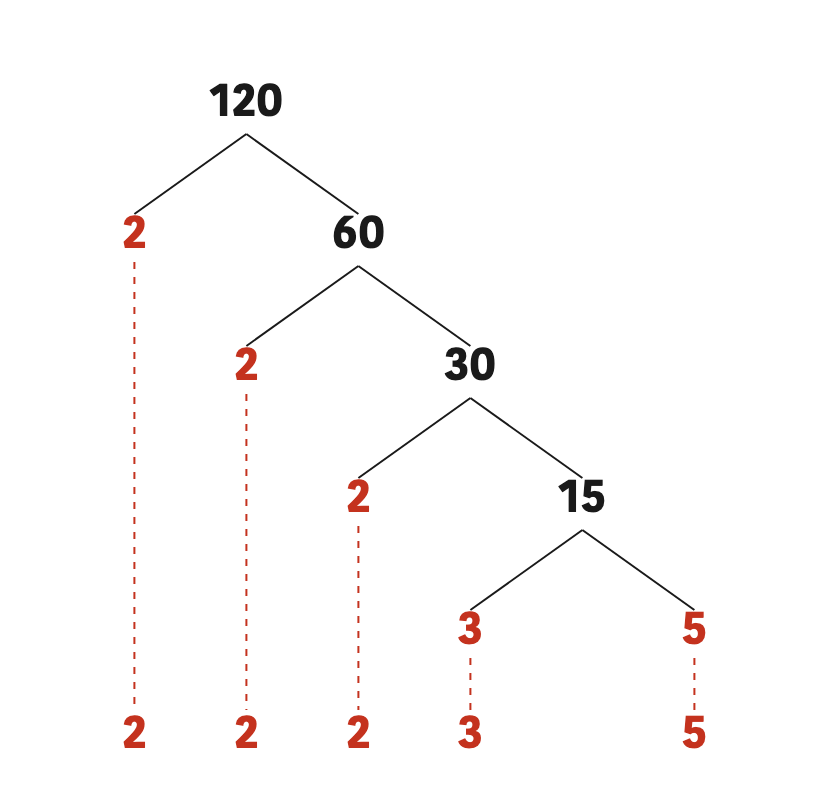
Step 1: Writing 120 as the product of two factors:
\[ 120 = 2 \times 60 \]
Step 2: 60 is composite, so splitting it gives:
\[ 120 = 2 \times 2 \times 30 \]
Step 3: 30 is composite as well, so splitting it gives:
\[ 120 = 2 \times 2 \times 2 \times 15 \]
Step 4: Splitting 15 gives:
\[ 120 = 2 \times 2 \times 2 \times 3 \times 5 \]
Every factor is now prime.
The tree for 588 follows the same path. Splitting 588 by 2 gives 294, and 294 is composite so splitting by 2 again gives 147. Splitting 147 by 3 gives 49, and splitting 49 by 7 gives 7. Since 7 is prime, the tree stops.
\[ 588 = 2 \times 2 \times 3 \times 7 \times 7 \]
Square numbers and square roots
Some numbers of dots can be arranged into a square, with the same number of dots in every row and in every column. The numbers 1, 4, 9, 16, 25, 36 and 49 behave like this. Each of them is the product of two equal numbers, as in \( 1 \times 1 = 1 \), \( 2 \times 2 = 4 \) and \( 3 \times 3 = 9 \).
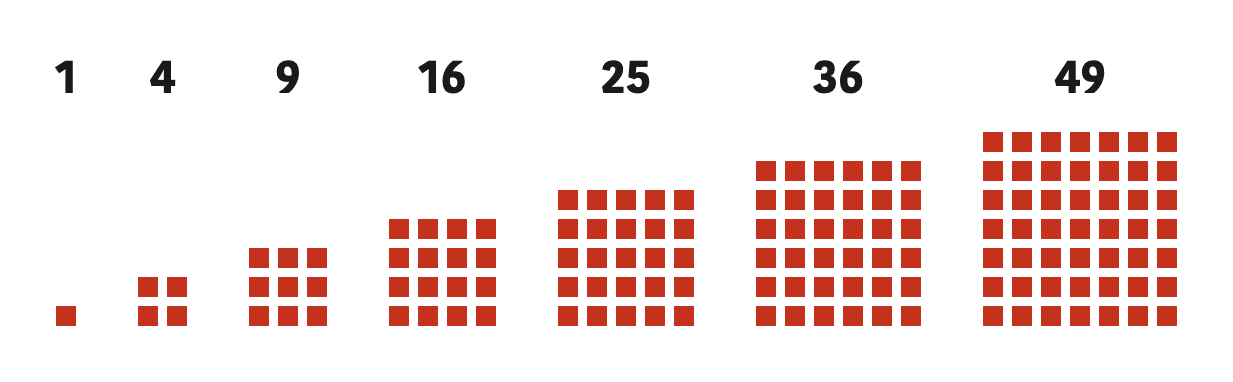
When a number is multiplied by itself, the product is called the square number of that number.
If a number can be written as the product of two equal factors, then one of those factors is called the square root of the number.
| Number | Its square | What the square root says |
| 4 | 16 | The square root of 16 is 4 |
| 5 | 25 | The square root of 25 is 5 |
| 6 | 36 | The square root of 36 is 6 |
| 7 | 49 | The square root of 49 is 7 |
| 9 | 81 | The square root of 81 is 9 |
| 10 | 100 | The square root of 100 is 10 |
Lakshmi wants to plant cabbages in her kitchen garden with 6 plants in every row and 6 in every column. She needs \( 6 \times 6 = 36 \) plants in all. In the same way, work out how many students stand in each row when 81 students are arranged in a square.
- Step 1: The total number of students is 81.
- Step 2: A square arrangement means 81 must be written as a product of two equal factors, and \( 81 = 9 \times 9 \).
- Step 3: So 9 students stand in each row.
Highest common factor
Take two rods, one 4 units long and one 10 units long. A rod of 1 unit measures both exactly, and a rod of 2 units measures both exactly, but rods of 3 units and 4 units do not. Among the lengths that measure both, the largest is 2, and that is the highest common factor of 4 and 10.
Factors that belong to both numbers are called their common factors. The largest of the common factors is called the highest common factor of those numbers, written in short as H.C.F.
The first method is to list the sets of factors. Find the H.C.F. of 27 and 36.
Step 1: Writing the set of factors of 27:
\[ \{1, 3, 9, 27\} \]
Step 2: Writing the set of factors of 36:
\[ \{1, 2, 3, 4, 6, 9, 12, 18, 36\} \]
Step 3: Picking out the factors that appear in both sets:
\[ \{1, 3, 9\} \]
Step 4: The largest of these is 9, so the H.C.F. of 27 and 36 is:
\[ 9 \]
The second method uses prime factorization, and it is quicker when the numbers are large. Find the H.C.F. of 24 and 60.
Step 1: Break both numbers into primes. The prime factorisation of 24 is:
\[ 24 = 2 \times 2 \times 2 \times 3 \]
Step 2: In the same way, the prime factorisation of 60 is:
\[ 60 = 2 \times 2 \times 3 \times 5 \]
Step 3: The prime factors shared by both are:
\[ 2 \times 2 \times 3 \]
Step 4: Multiplying the shared factors gives the H.C.F.:
\[ 2 \times 2 \times 3 = 12 \]
The same method works for three numbers, but a factor counts as common only if it appears in all three. Take 12, 15 and 18. Here \( 12 = 2 \times 2 \times 3 \), \( 15 = 3 \times 5 \) and \( 18 = 2 \times 3 \times 3 \). The only factor present in all three is 3, so the H.C.F. is 3.
Lowest common multiple
Two buses set off together from the same bus park. The first bus has a stop every 5 km and the second has a stop every 10 km. Which is the first stop the two buses share, and how far is it from the bus park?
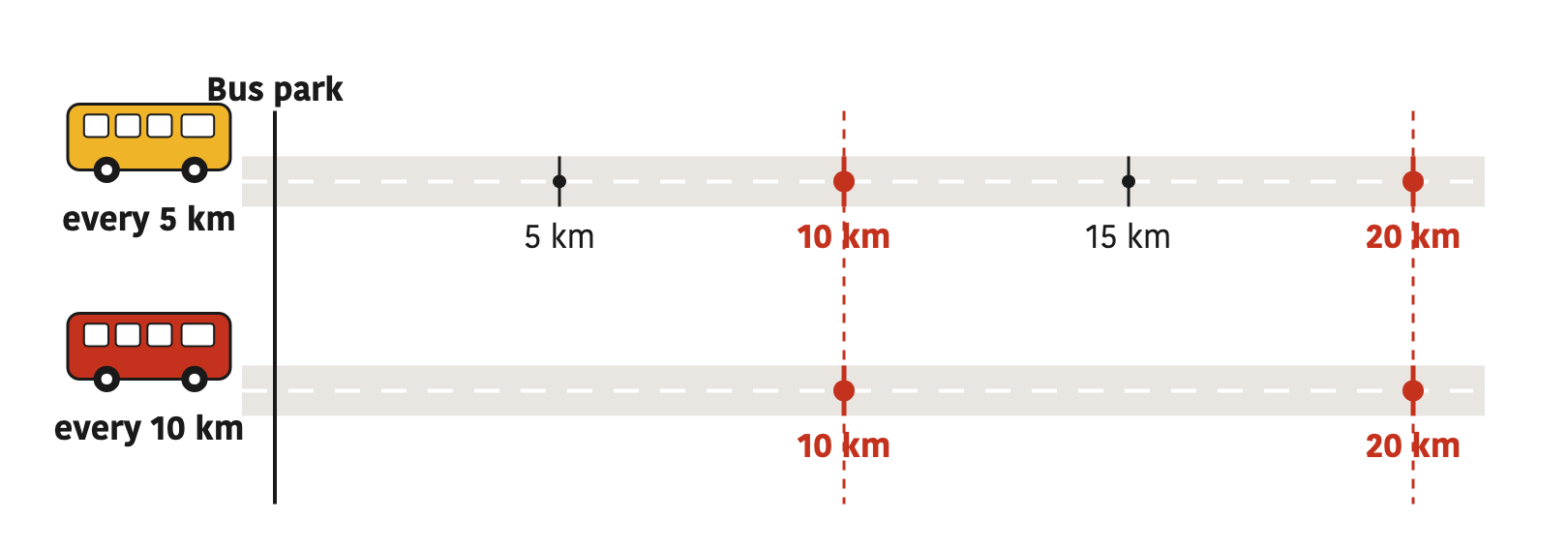
The yellow bus stops at 5, 10, 15 and 20 km, while the red bus stops at 10 and 20 km. The two buses meet at 10 km and again at 20 km. The first stop they share is 10 km from the bus park. Since the smallest of the common multiples of 5 and 10 is 10, the lowest common multiple of 5 and 10 is 10.
The smallest number that the given numbers all divide exactly is called their lowest common multiple, written in short as L.C.M.
The first method is to list the multiples of each number. It is an easy method when the numbers are small. Find the L.C.M. of 12 and 18.
Step 1: Listing the multiples of 12:
\[ \{12, 24, 36, 48, 60, 72, 84, \ldots\} \]
Step 2: Listing the multiples of 18:
\[ \{18, 36, 54, 72, 90, \ldots\} \]
Step 3: Picking out the multiples common to both:
\[ \{36, 72, \ldots\} \]
Step 4: The smallest of these is 36, so the L.C.M. of 12 and 18 is:
\[ 36 \]
The second method uses prime factorization. Here you multiply the shared prime factors together with the ones that are left over. Find the L.C.M. of 24 and 36.
Step 1: Writing each number as a product of its prime factors:
\[ 24 = 2 \times 2 \times 2 \times 3 \]
\[ 36 = 2 \times 2 \times 3 \times 3 \]
Step 2: Multiplying the shared factors:
\[ 2 \times 2 \times 3 = 12 \]
Step 3: The leftover factors are 2 from 24 and 3 from 36. Multiplying them:
\[ 2 \times 3 = 6 \]
Step 4: The L.C.M. is the shared factors times the leftover factors:
\[ 12 \times 6 = 72 \]
How the L.C.M. and the H.C.F. are linked
Take 22 and 33. Here \( 22 = 2 \times 11 \) and \( 33 = 3 \times 11 \). The only prime factor shared by both is 11, so the H.C.F. is 11. Multiplying the shared factor by the leftover factors gives \( 11 \times 2 \times 3 = 66 \), so the L.C.M. is 66.
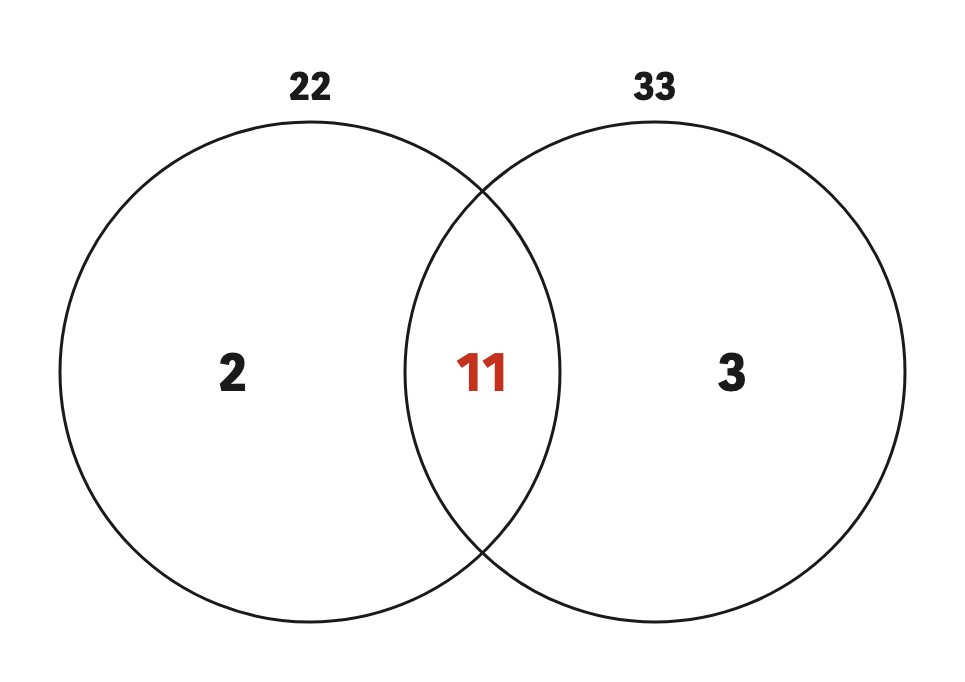
Now compare the product of the two numbers with the product of their L.C.M. and H.C.F. Here \( 22 \times 33 = 726 \) and \( 11 \times 66 = 726 \). The two agree, and this relationship always holds.
\[ \text{L.C.M.} \times \text{H.C.F.} = \text{first} \times \text{second} \]
Check it on 24 and 36 as well. Their H.C.F. is 12 and their L.C.M. is 72. Since \( 72 \times 12 = 864 \) and \( 24 \times 36 = 864 \), the two sides match. This relationship lets you find one of them once you know the other.
Here is a practical question. Two rods, one 14 cm long and one 35 cm long, are used to measure along the same line. What is the shortest distance that both of them can measure exactly?
Step 1: The multiples of 14 are:
\[ M_{14} = \{14, 28, 42, 56, 70, \ldots\} \]
Step 2: The multiples of 35 are:
\[ M_{35} = \{35, 70, \ldots\} \]
Step 3: The smallest multiple common to both is 70, so the shortest distance both rods can measure is:
\[ 70 \text{ cm} \]
The H.C.F. is never larger than the given numbers, and the L.C.M. is never smaller than them. If your answer breaks that rule, something has gone wrong in the working.
The full lesson is waiting for you
Create a free account to unlock activities, practice tests, presentations and videos - and to track your progress and confidence score for every subject.
Natural numbers start at 1 and go on for ever, written as \( N = \{1, 2, 3, 4, \ldots\} \).
11 more points to remember - sign in to see the rest.
Question 1 of 14