Folding a Shape Exactly in Half
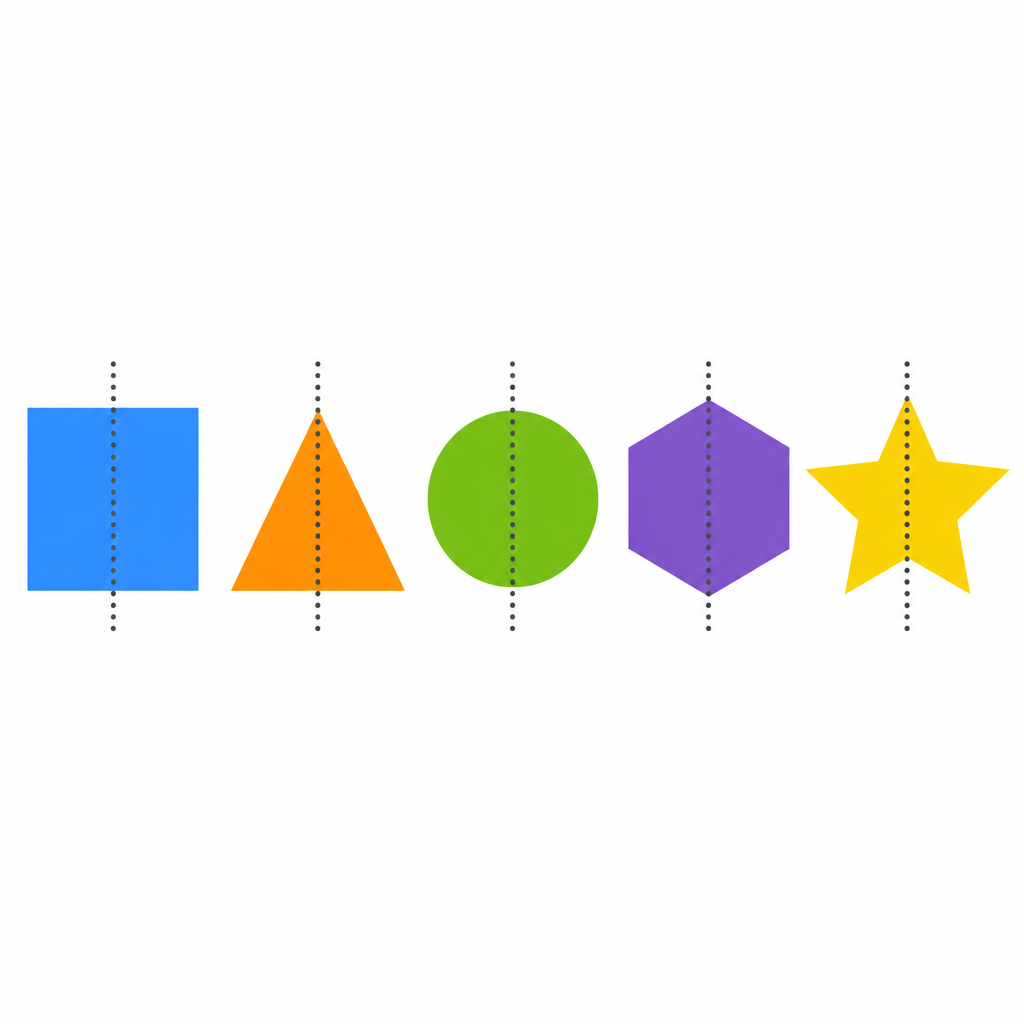
Cut a square out of paper and fold it straight across the middle. The top half lands exactly on the bottom half. No corner sticks out, and no gap is left anywhere. Open it out and fold it again, this time along the line down the middle. The two halves match exactly once more. This matching of halves is what mathematics calls symmetry.
Now cut out a rectangle and try the same thing. Folding along the line down the middle works, and folding across the middle works too. But fold it along a diagonal and the two halves refuse to match. So not every fold gives matching halves. The work is to find which fold does.
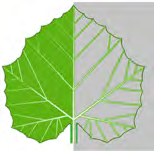
A leaf shows the same thing. Fold it along the vein that runs down its centre and the two sides carry almost the same shape. Windows, doors, plates, fans and the wings of a bird all carry this matching.
Symmetric Figures
A figure that can be folded into two equal matching parts is called a symmetric figure.
The dotted line drawn where the figure folds is called the axis of symmetry. It is also called the line of symmetry.
The matching copy that appears on the other side of the axis, of the same size and shape, is called the image of the figure.
Linear symmetry means the kind of symmetry you get by folding along a straight line so that the two parts match.
Not every figure is symmetric. A lightning bolt, a right-angled triangle with three different sides, and a speech bubble with a tail on one side give no matching halves along any fold at all. Such figures are called asymmetric figures. Whether a figure is symmetric is settled by folding it or measuring it, not by a quick look.
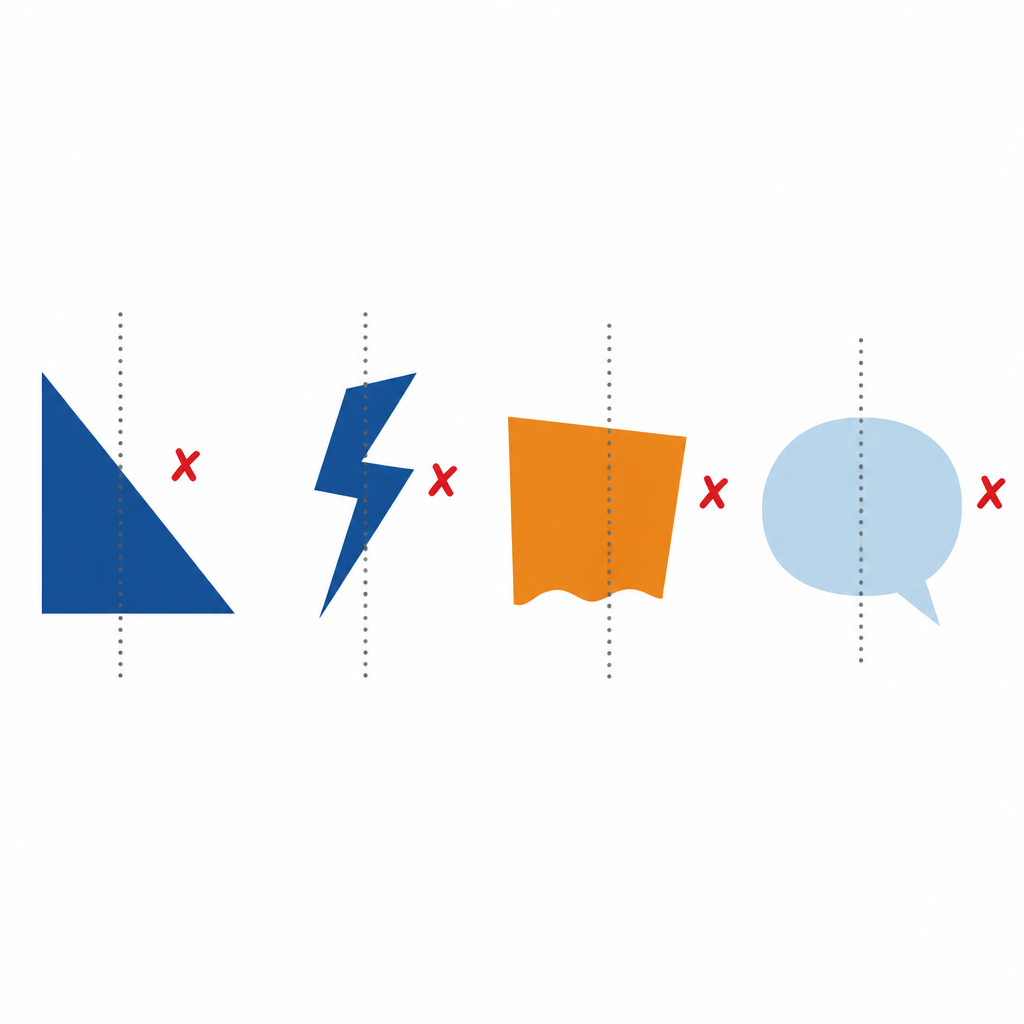
A line that cuts a figure into two parts of equal area is not always an axis of symmetry. The diagonal of a rectangle splits it into two triangles of equal area, yet folding along that diagonal does not make the two parts land on each other. So the diagonal of a rectangle is not a line of symmetry.
How Many Axes of Symmetry a Shape Has
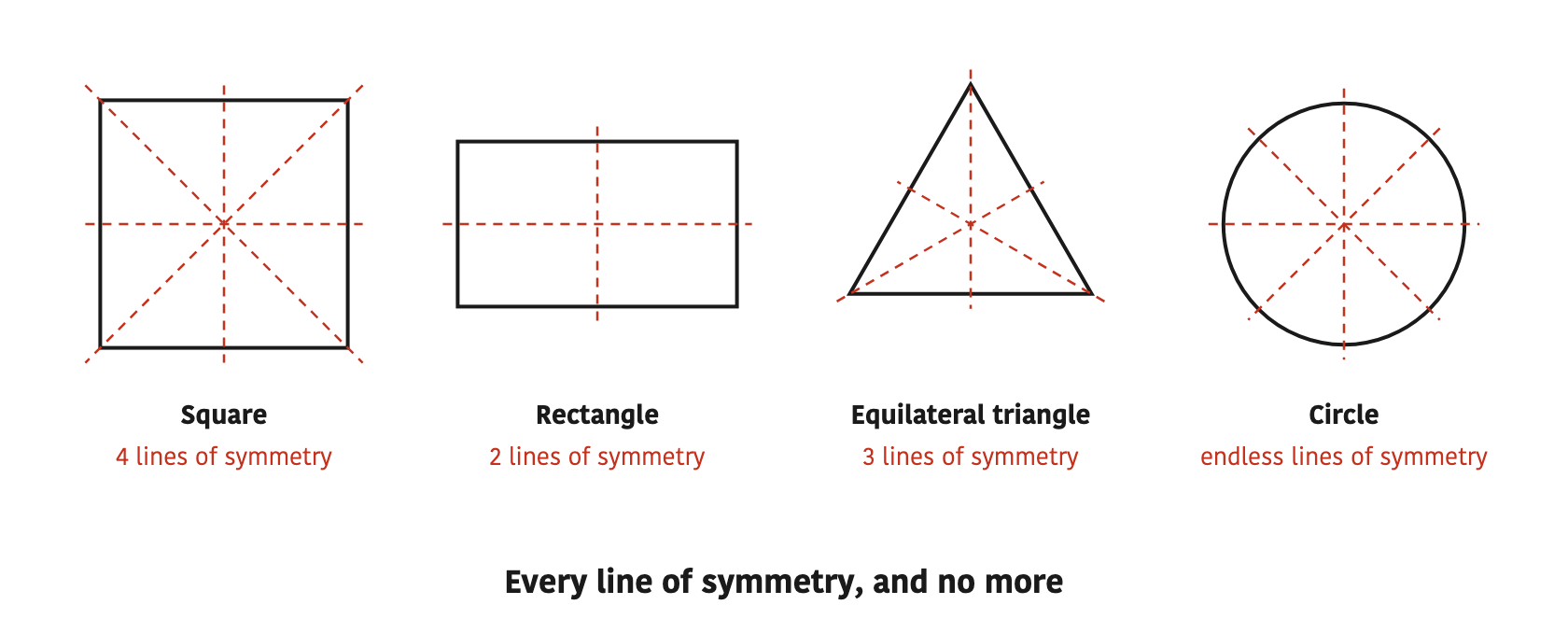
One figure can have more than one axis of symmetry. A square folds along the middle line up and down, along the middle line across, and along both diagonals, and every one of those folds matches, so a square has four axes. A rectangle has only two, because folding a rectangle along a diagonal does not match. Some figures have none at all.
| Plane figure | Number of axes of symmetry | Where the axes lie |
| Square | 4 | The middle line down, the middle line across, and both diagonals |
| Rectangle | 2 | The middle line down and the middle line across |
| Equilateral triangle | 3 | From each vertex to the midpoint of the opposite side |
| Isosceles triangle | 1 | From the apex to the midpoint of the base |
| Scalene triangle | 0 | No fold gives matching parts |
| Circle | Countless | Every diameter through the centre |
Completing a Figure Across the Axis of Symmetry
On squared paper you are given half of a figure and a dotted line. Taking that dotted line as the axis of symmetry, the other half has to be drawn. One idea does all the work here: whatever distance a point sits from the axis, its image sits at the same distance on the other side.
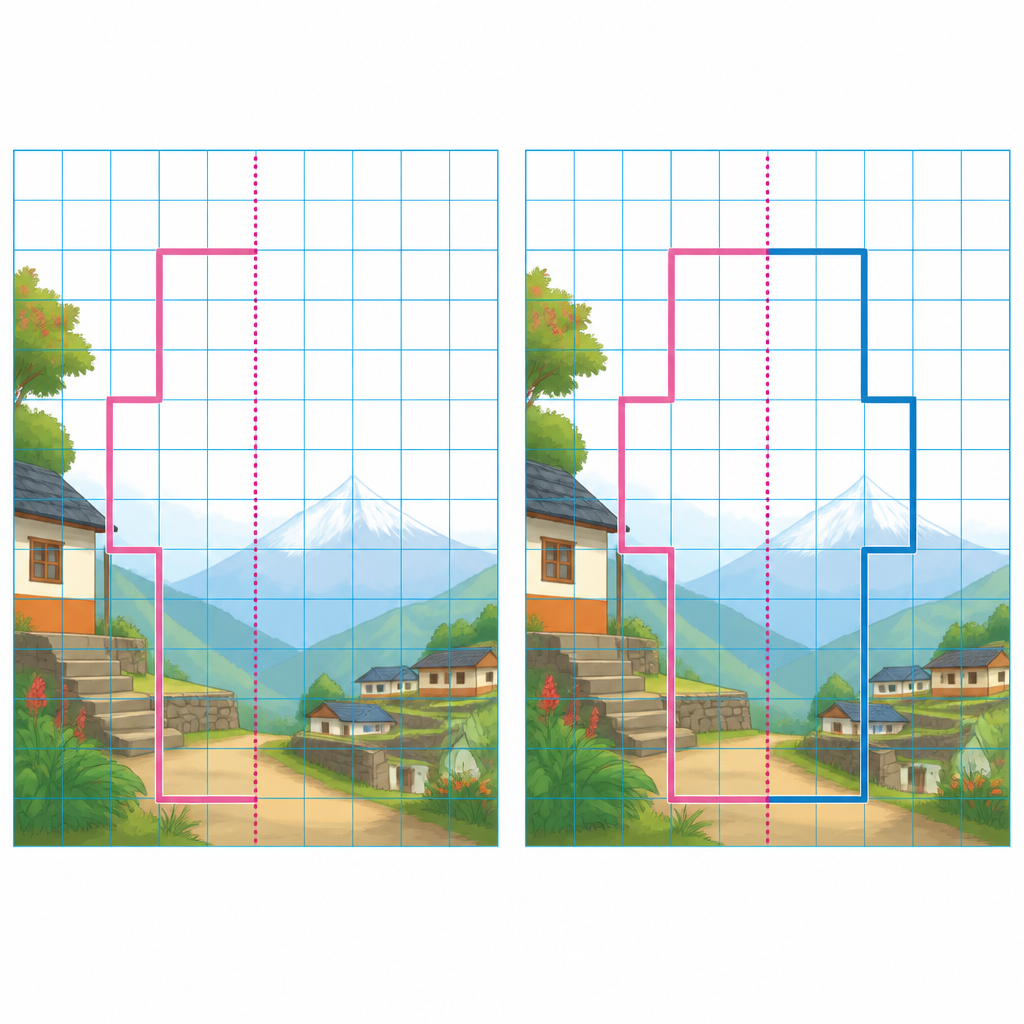
Step 1: Writing \( d \) for the distance of a point from the axis and \( d' \) for the distance of its image, the rule is:
\[ d = d' \]
Step 2: The lowest corner sits 4 squares to the left of the axis, so its image is counted off to the right:
\[ d = 4 \Rightarrow d' = 4 \]
Step 3: The corner where the shape steps in sits 2 squares to the left, so:
\[ d = 2 \Rightarrow d' = 2 \]
Step 4: A corner lying on the axis itself is at distance zero, so it stays exactly where it is:
\[ d = 0 \Rightarrow d' = 0 \]
Step 5: Joining the image points in the same order as the given corners draws the other half and completes the figure.
Step 6: To check the work, count squares. If the given half covers 14 small squares, the whole figure covers:
\[ 14 + 14 = 28 \]
The finished figure must cover exactly twice as many squares as the given half. If it does not, some point was counted at the wrong distance.
Symmetry in English Letters and Everyday Things
Capital English letters can be tested for linear symmetry in the same way.
Some letters fold along a line down the middle, some fold along a line across the middle, a few fold both ways, and several do not fold to match at all.
- Letters with a line of symmetry down the middle: A, M, T, U, V, W, Y
- Letters with a line of symmetry across the middle: B, C, D, E, K
- Letters with both kinds of line: H, I, O, X
- Letters with no line of symmetry: F, G, J, L, N, P, Q, R, S, Z
The same hunt works on things around you. Plates, glasses, the base of a fan, doors, windows, the wings of a butterfly and many flowers all carry symmetry.
A broken stone, a hand torn piece of paper, a winding road and lentils spilled on the floor do not.
Testing a Figure for Symmetry
A figure sometimes has other shapes drawn inside it. Then the outer shape alone cannot settle the answer, because the inner shapes have to match as well. Working through the test in a fixed order makes it easy.
- Draw the line you want to test as a dotted line.
- Pick every corner on one side of that line and measure how far each one is from the line.
- Look for a matching corner at the same distance on the other side.
- Do the same comparison for the corners of the shapes drawn inside.
- If every corner matches, the line is an axis of symmetry. If even one does not, it is not.
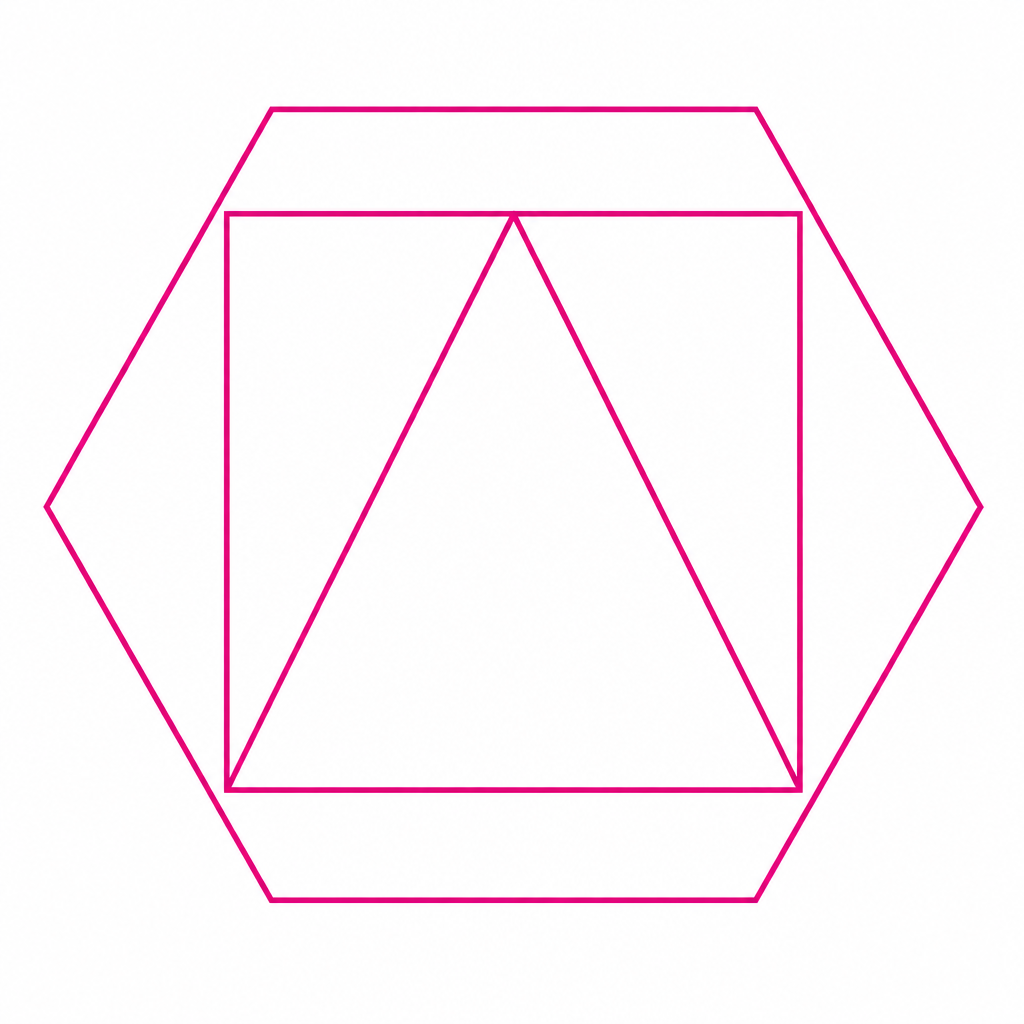
A hexagon on its own has six axes and a square on its own has four. Once a triangle is drawn inside as well, those axes do not all survive. Only the fold along the line down the middle brings the hexagon, the square and the triangle together at the same time, so the combined figure has just one axis of symmetry.
Tessellation
Look at a floor laid with tiles. No tile lies on top of another, and no gap is left between two tiles. One shape repeats in a fixed pattern until the whole surface is covered. In mathematics that covering is called a tessellation.
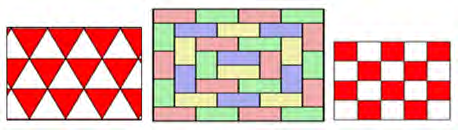
Covering a surface by fitting shapes together in a fixed pattern, with no overlapping and no gaps left between them, is called tessellation.
A tessellation has two conditions and both must hold at once: the shapes must not overlap, and no gap may be left between them.
Shapes That Do Not Tessellate
Not every shape can tessellate. However carefully equal circles are pushed together, curved gaps are left between them. Removing those gaps means sliding the circles over one another, which makes them overlap. Since both conditions cannot hold at the same time, circles do not tessellate.
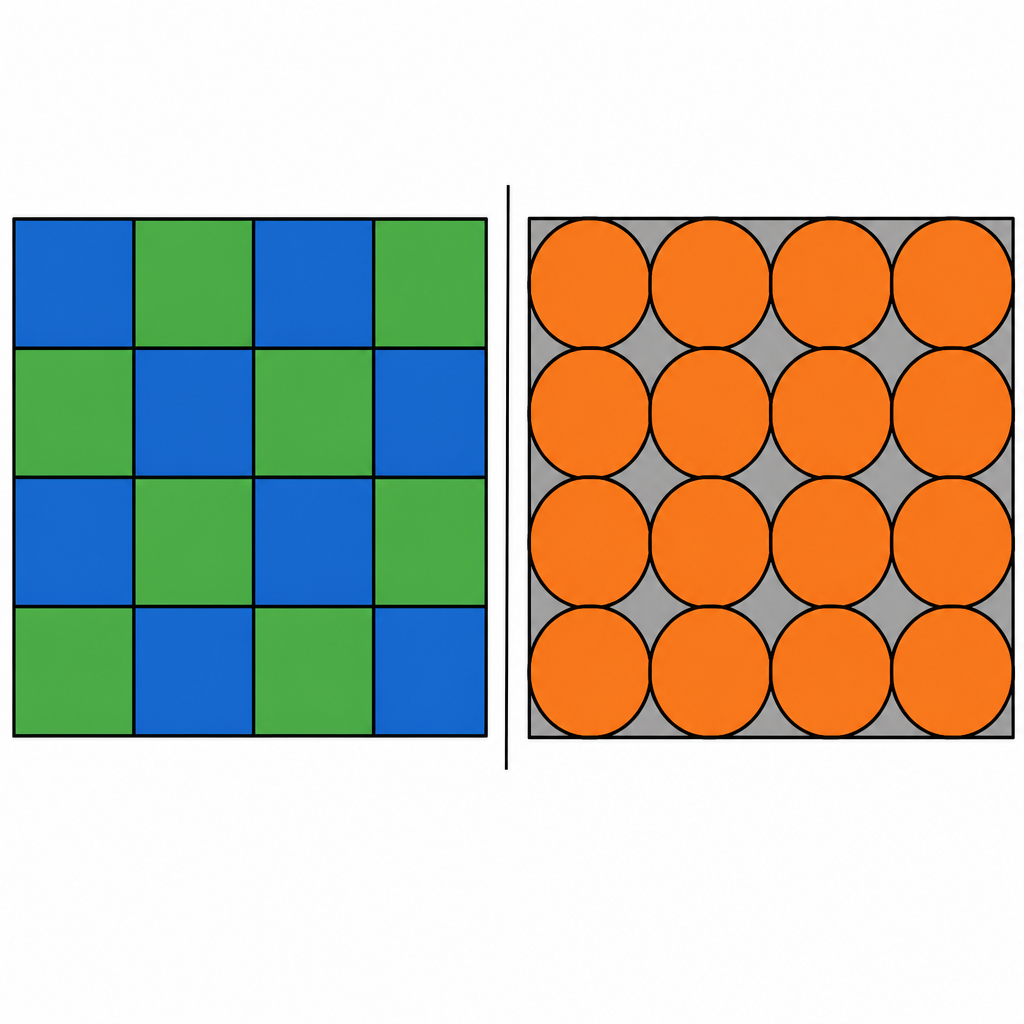
Square: four corners meet at a point and the surface is fully covered.
Rectangle: covers the surface whether laid straight or staggered like bricks.
Triangle: turning one upside down beside another fills the surface.
Regular hexagon: covers with no gaps, the way a honeycomb does.
Circle: leaves gaps in between, so it does not cover.
Tessellation from Rectangles and Squares
On paper marked with evenly spaced dots you can build a tessellation of rectangles and squares yourself. Because the dots are equally spaced, every shape you draw comes out the same size, and that is what stops gaps appearing.
- First decide how many dots long and how many dots wide each rectangle will be.
- Along the top line, draw rectangles of that size side by side until the row is full.
- Draw a second row of the same size directly below, keeping the corners in line with the row above.
- Keep adding rows until the whole surface is covered.
- Finally colour neighbouring shapes differently so the pattern shows clearly.
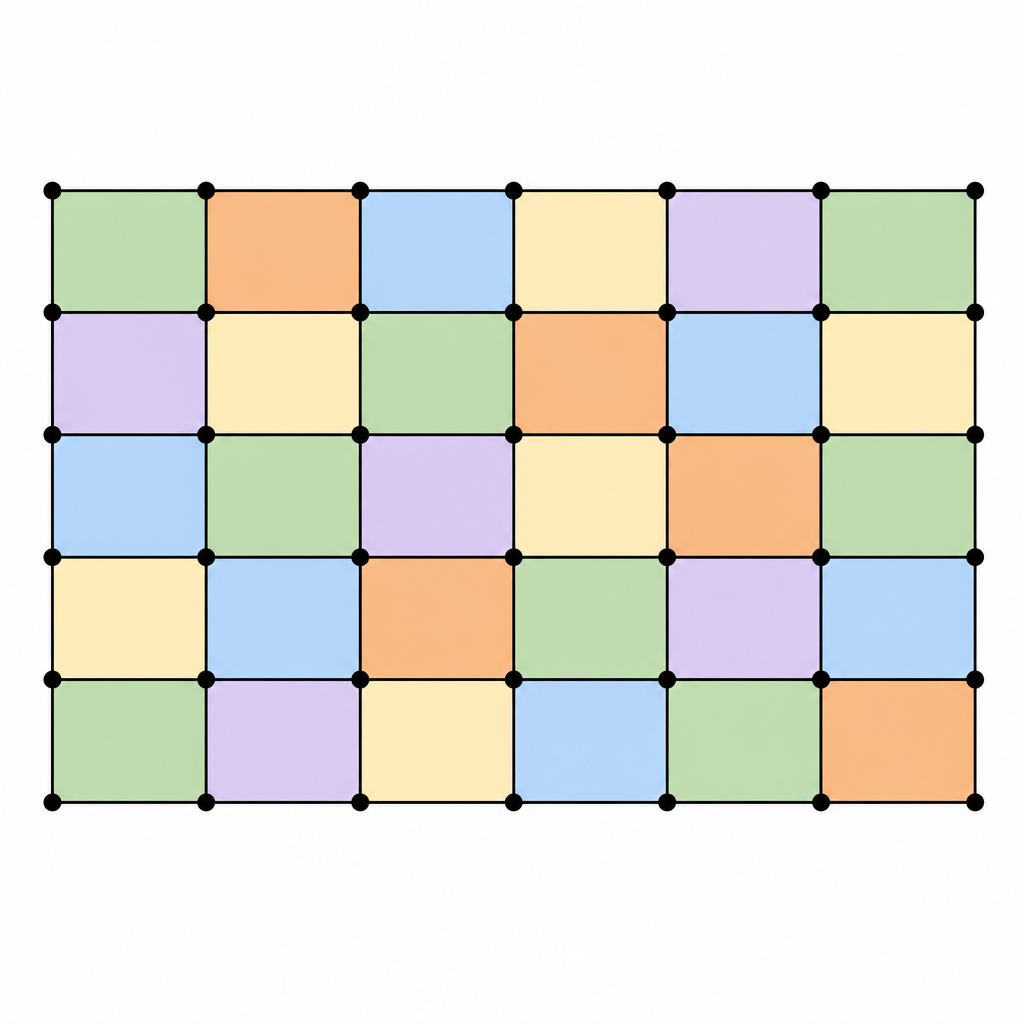
Now work out how many rectangles such a tessellation holds. If one row is 12 squares wide and each rectangle is 2 squares wide, the number of rectangles in one row is:
\[ 12 \div 2 = 6 \]
With 5 such rows, the total number of rectangles is:
\[ 6 \times 5 = 30 \]
Counting the Shapes in a Tessellation
Counting the shapes in a tessellation does not mean counting them one at a time. Because the pattern repeats, you count how many are in one row and multiply by the number of rows.
Step 1: Count the squares in a single row. Here that count is:
\[ 12 \]
Step 2: Count the rows:
\[ 5 \]
Step 3: Multiplying the two gives the total number of squares:
\[ 12 \times 5 = 60 \]
Step 4: Blue and green alternate through the whole pattern, so the count of each colour is:
\[ 60 \div 2 = 30 \]
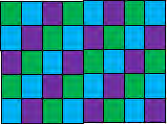
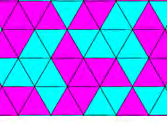
Do not count a shape cut in half at the edge as a whole shape. Count the complete shapes first, then count the part shapes left along the edges separately.
Tessellation Around Us
The floor of a school, the wall of a house, bricks laid in a boundary wall, roof tiles, the weave of a mat, the pattern of woven cloth and a honeycomb are all tessellations. When bricks are laid, each row is shifted half a brick along from the row below, yet no gap is left and no brick sits on another. So that pattern is a tessellation too.
Look at the floors and walls of your school, your home and a public building nearby, and work out which shapes were used. Draw the pattern in your copy and colour it, noting which shape repeats, how many sit in one row, and how the rows are arranged. That is what makes the idea stick.
The full lesson is waiting for you
Create a free account to unlock activities, practice tests, presentations and videos - and to track your progress and confidence score for every subject.
A figure that folds into two equal matching parts is a symmetric figure.
11 more points to remember - sign in to see the rest.
Question 1 of 14