Shapes We Get by Drawing Around Round Things
Many things around us have a round face. A coin, a bangle, a bottle cap, a plate and the dial of a clock all have round faces. Take any one of them, hold it flat on a sheet of paper and run a pencil right along its edge, all the way round. The pencil comes back to the point where it started and leaves a closed round ring on the paper. That ring is the shape this topic is about.
- (a) Draw a ring around a coin with a pencil.
- (b) Draw a ring around a bangle with a pencil.
- (c) Draw a ring around a bottle cap with a pencil.
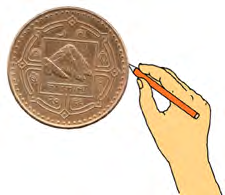
The three rings will be of different sizes, but three things are the same in all of them. First, each ring is closed, so it comes back to where it started. Second, there is no corner anywhere on it, and it bends by the same amount everywhere. Third, there is a place in the middle from which the distance to any part of the ring is the same. This third point matters most, because it is what makes this shape different from every other closed shape.
Making a Circle with a Compass
You can draw a round ring even when there is no coin or bangle to trace. The compass in your geometry box is made for exactly that. One arm of the compass carries a sharp needle and the other arm holds a pencil. Sharpen the pencil, fix it in the compass, and then draw the circle like this.
- Open the two arms of the compass as wide as you want the ring to be.
- Press the needle point down on one spot of your paper and hold it there.
- Keeping the needle in that same spot, let the pencil tip touch the paper.
- Hold the top of the compass and swing the pencil once all the way round the needle.
- When the pencil comes back to where it started the ring is complete, so lift the compass off.
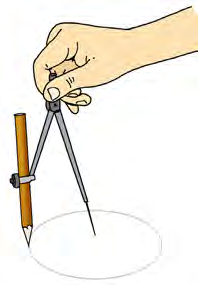
The compass needle is very sharp. Never point it towards yourself or towards a friend, and put the compass back in the box when you finish instead of leaving it open on the desk.
Now look at the shape you have made. The spot where the needle stayed is right in the middle of the ring, and that spot is called the centre of the circle. The distance from the needle to the pencil tip is the radius. While you swing the compass that distance never grows and never shrinks, so the path traced by the pencil comes out round and closed. That path is what we call a circle.
What a Circle Is
Circle: the path traced by a point that moves so that it always stays the same distance from one fixed point is called a circle.
Two phrases in this definition need attention. The first is fixed point, meaning one point that does not move at all. On a compass that is the spot held by the needle. The second is same distance, meaning the moving point must stay just as far from the fixed point the whole way round.
If the arms of the compass close in or open out while you are drawing, the distance changes and the shape comes out egg shaped instead of a circle.
Wherever you put your finger on the ring of a circle, the distance from that place to the centre is the same.
Parts of a Circle: Centre, Radius, Circumference and Chord
The different parts of a circle each have their own name. Talking about circles is hard without those names, so look at four of them first.
Centre: the point inside a circle that is the same distance from every part of the ring is called the centre of the circle. In the picture, O is the centre.
Radius: the line segment that joins the centre of a circle to a point on its ring is called the radius. In the picture, OA is a radius.
Circumference: the ring that runs all the way around a circle is called its circumference.
Chord: the line segment that joins any two points on the circumference is called a chord of the circle. In the picture, CD is a chord.
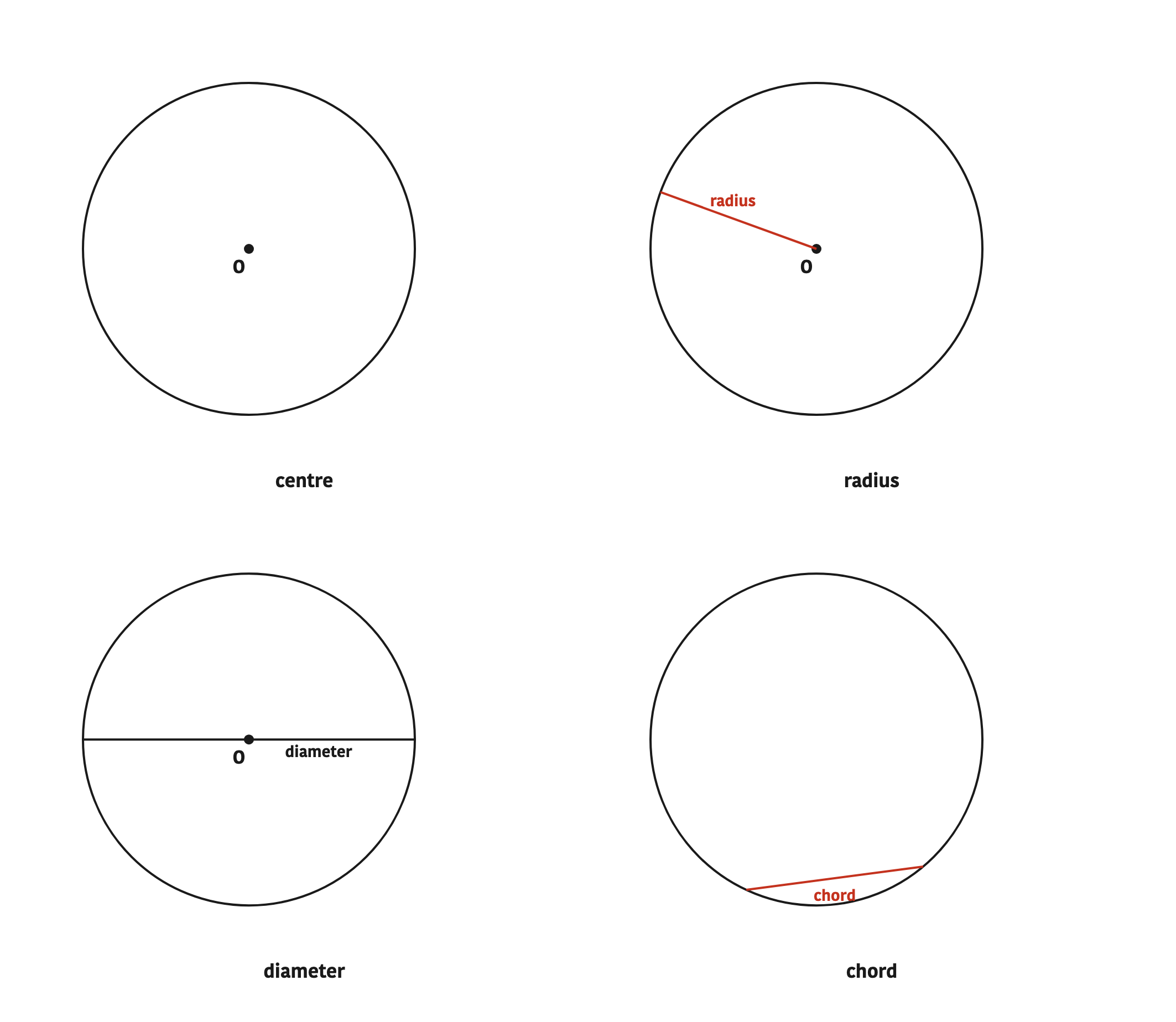
A circle does not have just one radius. Joining the centre to any point on the circumference gives a radius, so countless radii can be drawn, and every one of them has the same length. Countless chords can be drawn too, but chords are not all the same length. A chord that passes near the centre is long, and one drawn near the edge is short.
Parts of a Circle: Diameter, Sector, Semi-circle and Arc
Diameter: a chord that passes through the centre of the circle is called the diameter. In the picture, AB is the diameter. The diameter is the longest chord of a circle.
Sector: the region enclosed between two radii of a circle is called a sector. In the picture, BOF is a sector.
Semi-circle: exactly half of a circle is called a semi-circle.
Arc: any part of the circumference of a circle is called an arc. In the picture, AB is one arc of the circle.
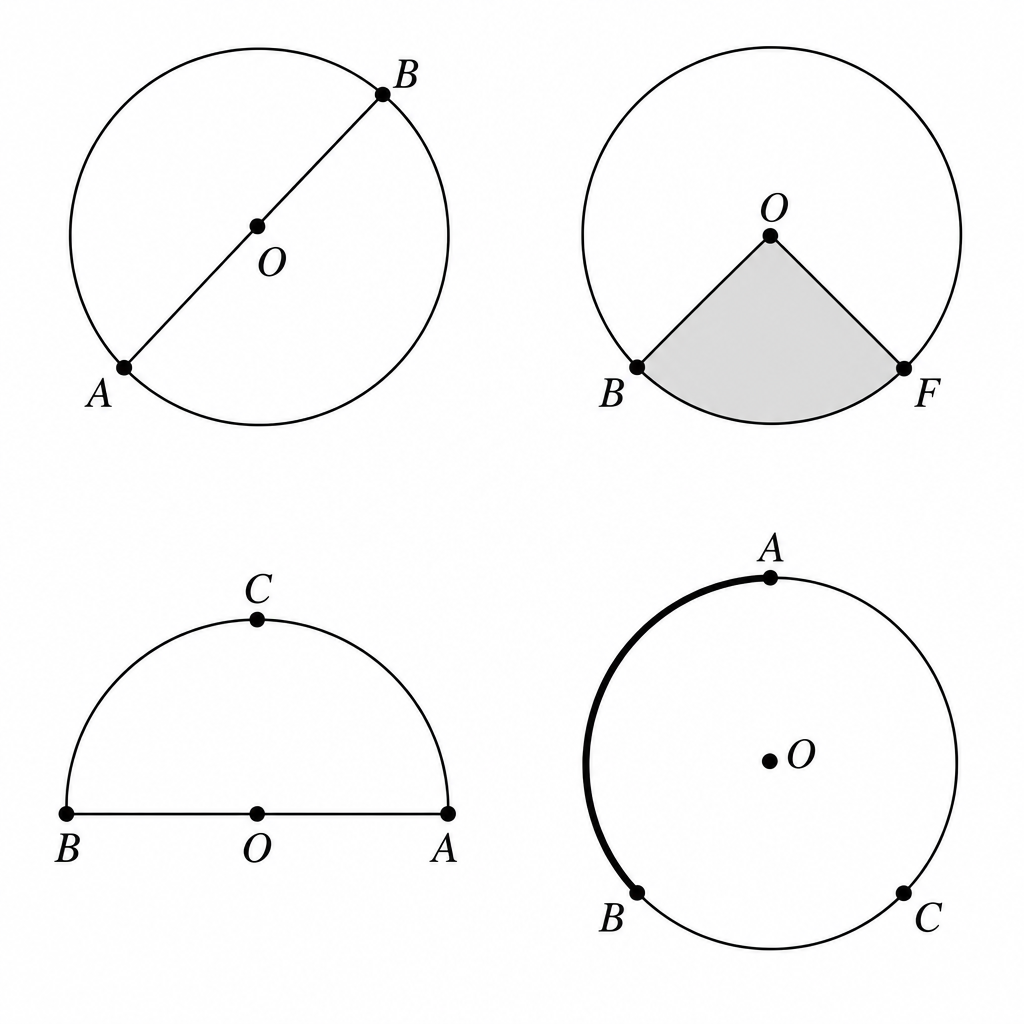
A diameter cuts the circle into two equal halves, and each of those halves is a semi-circle. So drawing one diameter in a circle gives two semi-circles. A sector, on the other hand, is a slice. A wedge cut from the middle of a cake or a roti is a good picture of a sector, because two of its edges are radii and the curved third edge is an arc.
Every diameter is a chord, but not every chord is a diameter. Only a chord that passes through the centre is a diameter.
Students often call any segment joining two points on the circumference a radius. One end of a radius must always sit at the centre. If both ends sit on the circumference, the segment is a chord.
| Part | From where to where | What marks it out |
| Radius | From the centre to the circumference | All radii of one circle are equal |
| Chord | From one point on the circumference to another | Chords can be of different lengths |
| Diameter | From circumference to circumference through the centre | The longest chord, twice the radius |
| Circumference | The whole ring of the circle | Not a straight segment but a closed curved line |
How the Diameter and the Radius Are Related
A diameter goes through the centre. So if you cut a diameter into two pieces at the centre, each piece is a radius. That tells us the diameter is exactly twice the radius. Writing the diameter as \( d \) and the radius as \( r \), the relation is:
\[ d = 2 \times r \]
Turning the same relation the other way gives the radius:
\[ r = \frac{d}{2} \]
Example 1: the radius of a circle is 7 cm. Find its diameter.
Step 1: The relation being used is:
\[ d = 2 \times r \]
Step 2: Putting in the given radius \( r = 7 \):
\[ d = 2 \times 7 \]
Step 3: Doing the multiplication:
\[ d = 14 \]
The radius was given in centimetres, so the diameter comes out in centimetres too. The diameter of the circle is 14 cm.
Example 2: a plate has a diameter of 18 cm. Find its radius.
Step 1: The relation being used is:
\[ r = \frac{d}{2} \]
Step 2: Putting in the given diameter \( d = 18 \):
\[ r = \frac{18}{2} \]
Step 3: Carrying out the division:
\[ r = 9 \]
So the radius of the plate is 9 cm. That also means if you put a compass needle at the centre of the plate, open it to 9 cm and swing it round, you get a circle the size of that plate.
Example 3: a round clock face has a diameter of 25 cm. Find its radius.
Step 1: The relation being used is:
\[ r = \frac{d}{2} \]
Step 2: Putting in the given diameter \( d = 25 \):
\[ r = \frac{25}{2} \]
Step 3: Dividing 25 by 2 does not give a whole number, so writing it as a decimal:
\[ r = 12.5 \]
So the radius of the clock face is 12.5 cm. A radius does not have to be a whole number.
Naming the Parts in a Labelled Circle
Learning the names by heart is not enough. You must also be able to look at a drawing and say which line is which part. In the circle below, O is the centre. C and D are points on the circumference and the line joining them passes through O. E is another point on the circumference and OE has been drawn. A and B are two points on the circumference, but AB does not pass through O.
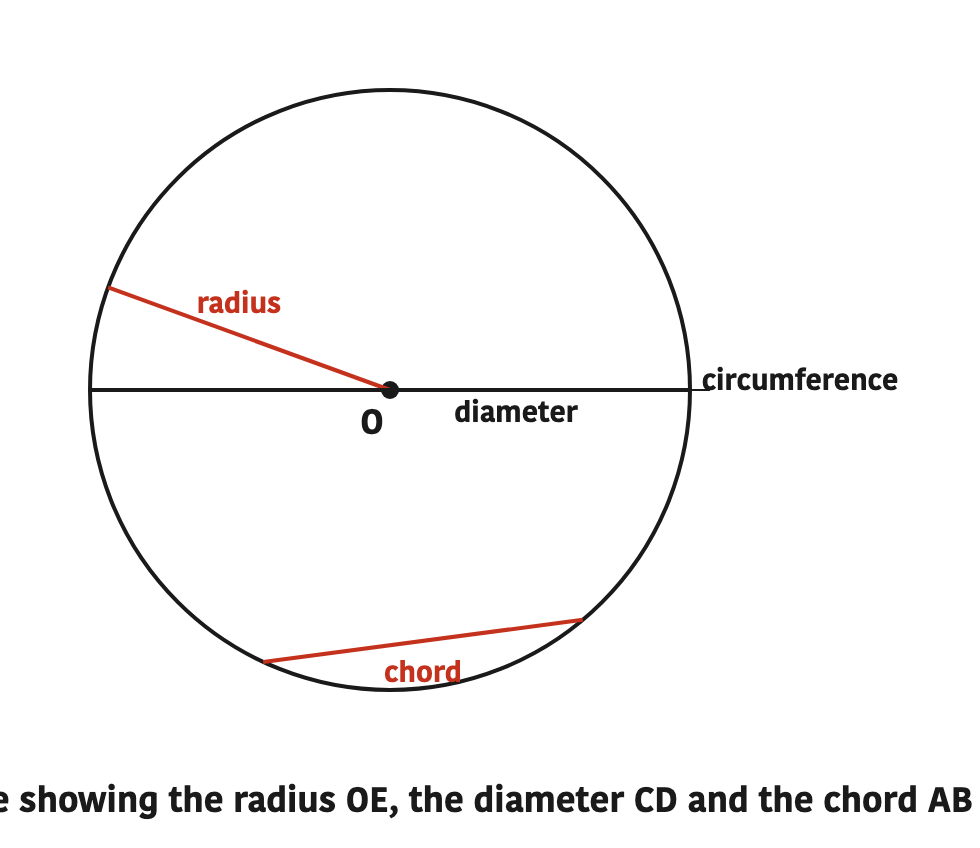
- (a) O is the centre, because it is the same distance from every point on the circumference.
- (b) OE is a radius, because one end is at the centre and the other end is on the circumference.
- (c) CD is a diameter, because it joins two points on the circumference and passes through the centre O.
- (d) AB is a chord, because both its ends are on the circumference but it does not pass through the centre.
- (e) The two equal parts into which CD divides the circle are semi-circles.
Here CD and AB are both chords, but only CD is a diameter. That is why the first habit to build when reading such a drawing is to find the centre. Whether or not a line passes through the centre is what separates a chord from a diameter.
Finding the Centre and Diameter of a Round Plate
You cannot tell just by looking where the centre of a round eating plate lies. But if you trace the plate onto paper, cut the ring out and fold it, the centre is easy to find.
- Put the plate on a sheet of paper and draw a ring around it with a pencil.
- Cut along that ring with scissors so you have a round piece of paper.
- Fold the paper so the two halves lie exactly on each other, then open it out; the crease you get is a diameter.
- Fold it in half again in a different direction and open it out; that second crease is another diameter.
- The point where the two creases cross is the centre of the plate.
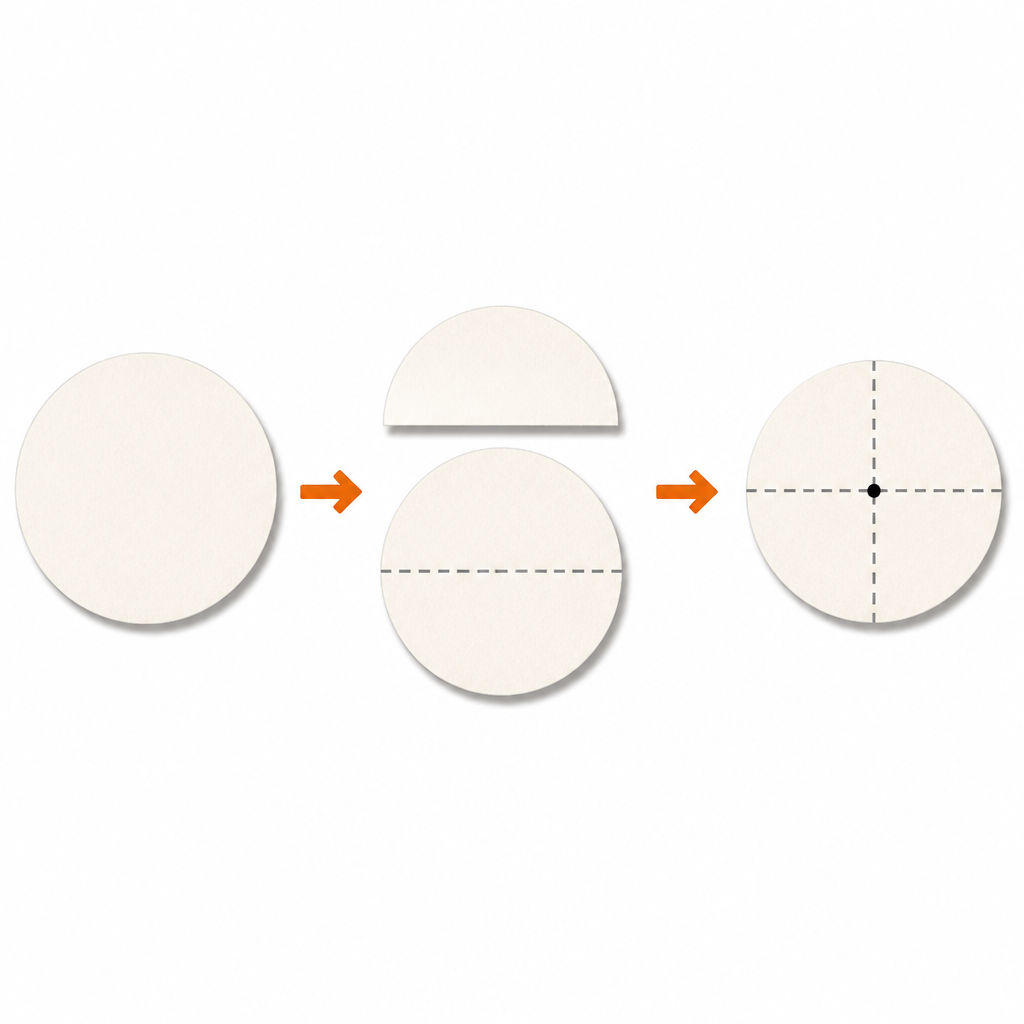
Now measure one of the creases that passes through the centre with a ruler. That measurement is the diameter of the plate. Dividing it by two gives the radius. To check, measure from the centre out to the edge; that distance should come out equal to the radius.
The full lesson is waiting for you
Create a free account to unlock activities, practice tests, presentations and videos - and to track your progress and confidence score for every subject.
A circle is the path traced by a point that always stays the same distance from one fixed point.
11 more points to remember - sign in to see the rest.
Question 1 of 12