Closed Shapes and the Triangle
Take three straws or three thin sticks and try to join their ends. Once the ends meet, the space in the middle is completely enclosed and there is no gap left to walk out of. A figure enclosed in this way is called a closed figure. Three straight sticks always enclose a triangle, because a triangle is the smallest closed figure that straight lines can make. The sticks may be long or short, but the name of the figure is still a triangle. What changes is the kind of triangle you get.
Plane shape: a closed figure that lies flat and fits completely on a level surface such as a sheet of paper or a board. Triangles and quadrilaterals are both plane shapes.
A triangle has three sides, three vertices and three angles. A triangle whose vertices are A, B and C is called triangle ABC. Its sides are AB, BC and CA, and its angles are \( \angle ABC \), \( \angle BCA \) and \( \angle BAC \). There are two separate ways of deciding what kind of triangle you are looking at. The first is to measure the lengths of its sides. The second is to measure the sizes of its angles.
Classifying Triangles by Their Sides
Take a ruler, measure all three sides of a triangle and write the three lengths in your copy. Now compare the three numbers with one another. Only one of the three answers below can be true for any one triangle.
- Are all three sides equal in length?
- Are only two of the sides equal in length?
- Are all three sides of different lengths?
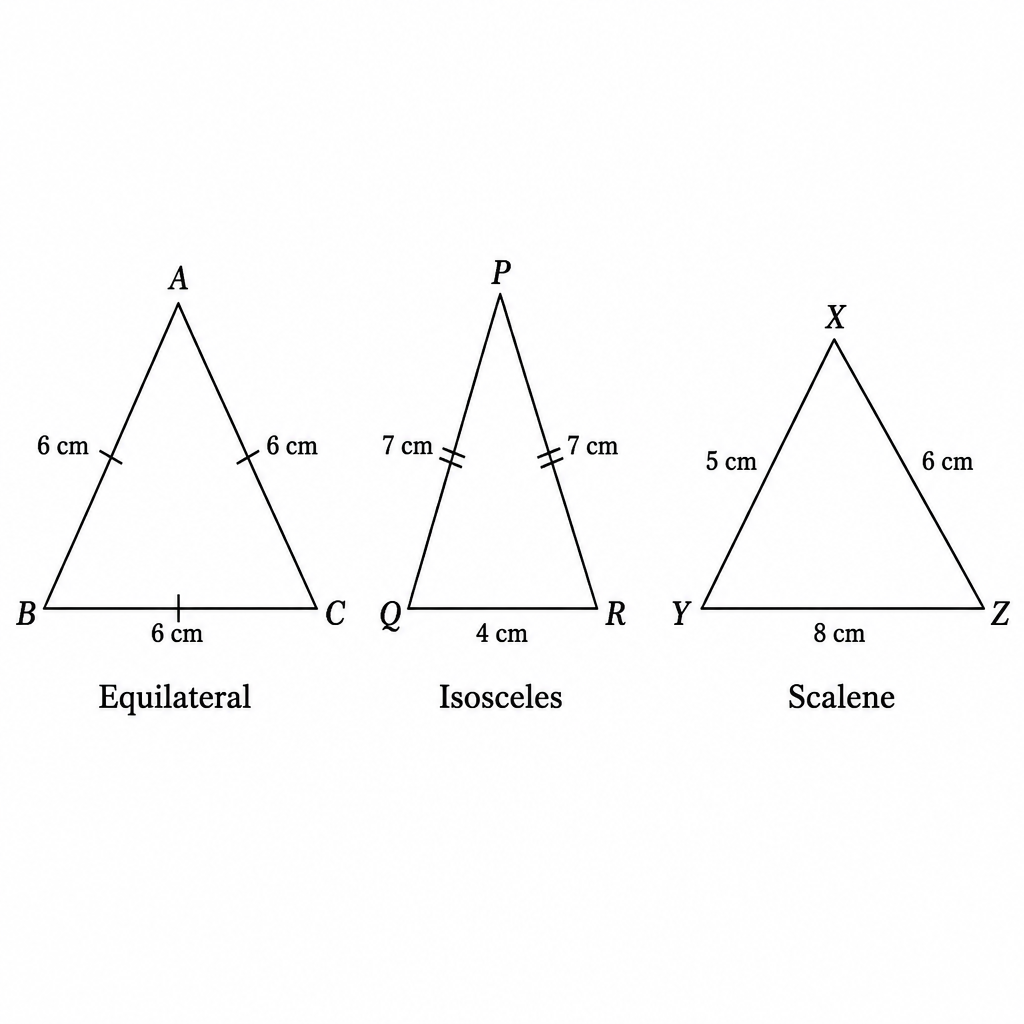
Equilateral triangle: a triangle in which all three sides are equal in length.
Isosceles triangle: a triangle in which two of the sides are equal in length.
Scalene triangle: a triangle in which all three sides are of different lengths.
| Name of triangle | Relation between the sides | Sample measurements |
| Equilateral triangle | All three sides equal | 6 cm, 6 cm, 6 cm |
| Isosceles triangle | Only two sides equal | 7 cm, 7 cm, 4 cm |
| Scalene triangle | All three sides different | 5 cm, 6 cm, 8 cm |
Working Out a Classification by Sides
Let us find out what kind of triangle PQR is when we look at its sides. There are three jobs to do: take the measurements, compare them and then write the conclusion.
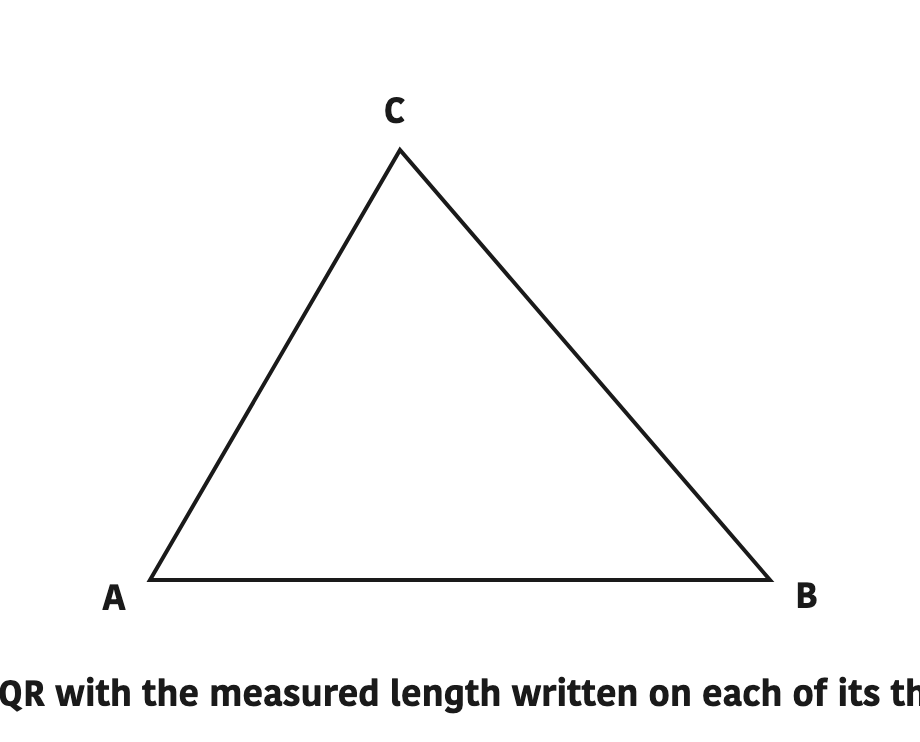
Step 1: Measure the three sides with a ruler and write down each length:
\[ PQ = 2.7 \text{ cm} \]
\[ QR = 5 \text{ cm} \]
\[ PR = 4.6 \text{ cm} \]
Step 2: Compare the three lengths. Since 2.7, 5 and 4.6 are all different numbers, no two sides match:
\[ PQ \neq QR \neq PR \]
Step 3: All three sides are of different lengths, so triangle PQR is a scalene triangle.
Classifying Triangles by Their Angles
Now look at the same triangle in a different way, through its angles. Use a protractor to measure all three angles and compare each reading with \( 90^\circ \). An angle smaller than \( 90^\circ \) is an acute angle, an angle equal to \( 90^\circ \) is a right angle and an angle larger than \( 90^\circ \) is an obtuse angle. The kind of angles you find decides the name of the triangle.
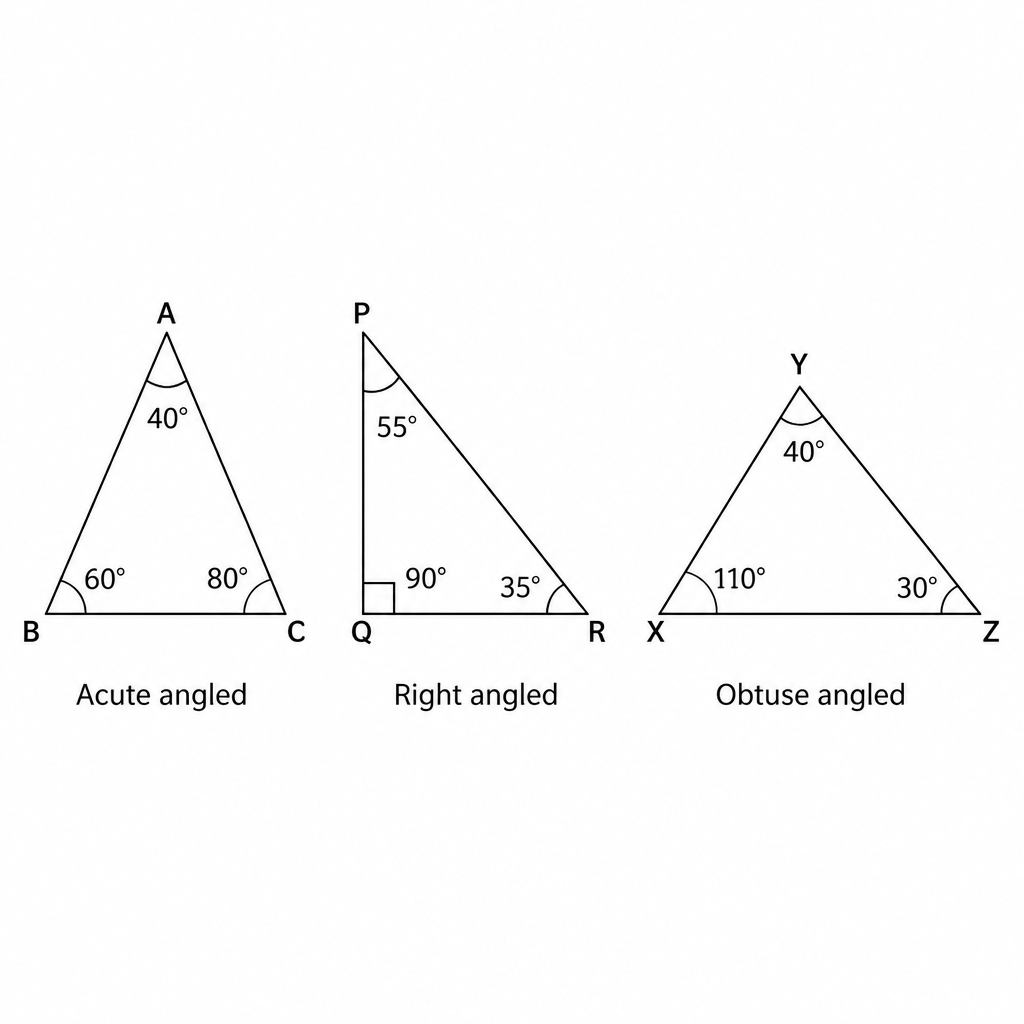
Acute angled triangle: a triangle in which all three angles are acute, that is, each angle is less than \( 90^\circ \).
Right angled triangle: a triangle in which one angle measures exactly \( 90^\circ \).
Obtuse angled triangle: a triangle in which one angle is obtuse, that is, greater than \( 90^\circ \).
| Name of triangle | Condition on the angles | Sample measurements |
| Acute angled triangle | All three angles less than \( 90^\circ \) | \( 40^\circ, 60^\circ, 80^\circ \) |
| Right angled triangle | One angle exactly \( 90^\circ \) | \( 90^\circ, 55^\circ, 35^\circ \) |
| Obtuse angled triangle | One angle greater than \( 90^\circ \) | \( 110^\circ, 40^\circ, 30^\circ \) |
One triangle can never have two right angles or two obtuse angles. A right angled triangle has exactly one right angle, and its other two angles are always acute. An obtuse angled triangle also has only one obtuse angle.
A triangle that is equilateral by its sides is always acute angled by its angles, because each of its three angles measures \( 60^\circ \).
Working Out a Classification by Angles
Let us use a protractor to find out what kind of triangle ABC is when we look at its angles.
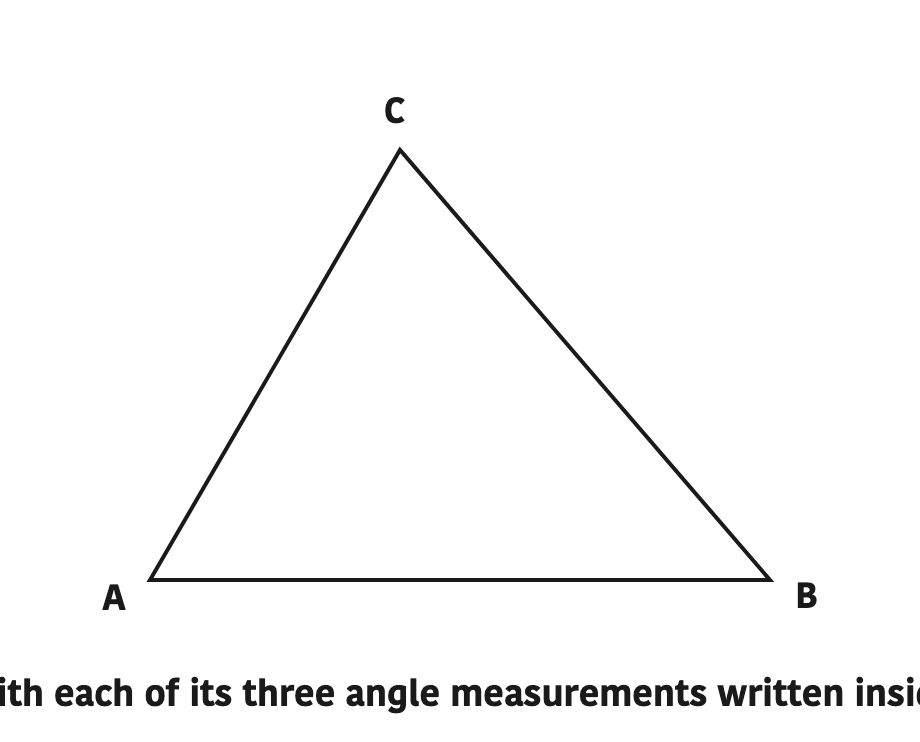
Step 1: Place the protractor at each vertex and read the three angles:
\[ \angle ABC = 75^\circ \]
\[ \angle BCA = 45^\circ \]
\[ \angle BAC = 60^\circ \]
Step 2: Compare each reading with \( 90^\circ \). The first angle is smaller:
\[ 75^\circ < 90^\circ \]
Step 3: Compare the other two readings in the same way:
\[ 45^\circ < 90^\circ \]
\[ 60^\circ < 90^\circ \]
Step 4: All three angles are acute, so triangle ABC is an acute angled triangle.
A protractor carries two scales. Read the scale that begins at zero on the arm you have placed along the base line of the protractor. Reading the wrong scale turns an angle of \( 60^\circ \) into \( 120^\circ \), and then the triangle is given the wrong name altogether.
Finding Triangles Inside a Rectangle
Draw a large rectangle ABCD and then draw both of its diagonals, AC and BD. The two diagonals cross at a point O in the middle. A number of triangles now appear inside the figure, and each of them can be named. Since every corner of a rectangle is a right angle, triangle ABC and triangle BCD are right angled triangles. Triangles AOB and COD face the long sides, and the angle at O in each of them is obtuse, so these two are obtuse angled triangles. Triangles BOC and AOD face the short sides, and all three of their angles are acute, so these two are acute angled triangles.
Quadrilaterals
Look at the windows of your classroom, the frame of the door, the cover of your book, the top of your bench and the surface of the board. Each of them has four edges and four corners. A closed figure enclosed by four sides is called a quadrilateral. In quadrilateral ABCD, the sides AB and DC are opposite sides, and so are AD and BC. Angles that do not meet at the same corner are called opposite angles. Quadrilaterals are given different names according to the lengths of their sides, whether those sides are parallel and how big the angles are.
The Rectangle
Take a piece of paper with torn, uneven edges. Fold it once so that one straight crease is formed along an edge. Fold it a second time so that the new crease meets the first one at a right angle. Carry on until four folds are done, and four straight creases appear on the paper, enclosing a shape.
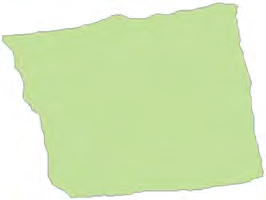
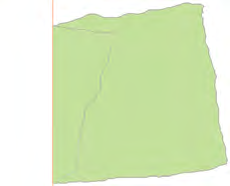
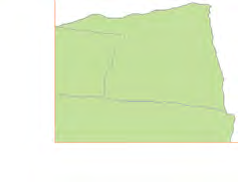
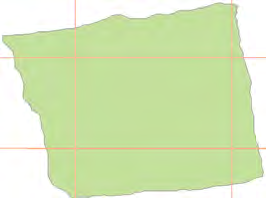
Rectangle: a quadrilateral whose opposite sides are equal in length and whose four angles each measure \( 90^\circ \).
The Square
Now take a rectangular sheet of paper. Fold it so that the shorter side lies exactly along the longer side. Cut off the extra strip that sticks out, then open the paper again. All four sides of what is left are now equal in length, and the four corners are still right angles. This shape is a square.
Square: a quadrilateral whose four sides are all equal in length and whose four angles each measure \( 90^\circ \).
Because a square has equal opposite sides and four right angles, every square is also a rectangle. A rectangle, however, need not be a square, since the two sides meeting at a corner may be of different lengths.
The Parallelogram
Draw a straight line segment AB. Using a ruler, draw a second segment DC that is parallel to AB and equal to it in length. Now join the ends on each side. The quadrilateral you get has both pairs of opposite sides parallel to each other. Folding a rectangular sheet along marks made at equal distances on its two edges produces the same shape.
Parallelogram: a quadrilateral in which the opposite sides are parallel to each other.
Measure the sides and the angles of a parallelogram ABCD and you will find that both the opposite sides and the opposite angles are equal. In one such parallelogram the sides came out as \( AB = 3 \text{ cm} \) and \( CD = 3 \text{ cm} \), with \( AD = 2 \text{ cm} \) and \( BC = 2 \text{ cm} \). The angle readings were these:
\[ \angle ABC = \angle ADC = 60^\circ \]
\[ \angle BCD = \angle DAB = 120^\circ \]
In a parallelogram the opposite sides are equal and the opposite angles are equal.
The Rhombus
Take a parallelogram and make all four of its sides the same length. The opposite sides stay parallel, but now the sides meeting at a corner are equal as well. The shape formed in this way is called a rhombus. Its angles do not have to be right angles.
Rhombus: a quadrilateral in which all four sides are equal in length.
A square and a rhombus are not the same shape. Both have four equal sides, but a square has four angles of \( 90^\circ \), while the angles of a rhombus need not be \( 90^\circ \). Measure the angles before you write the name.
The Trapezium
In a quadrilateral ABCD, drop a perpendicular AX from the point A to the side DC, and a perpendicular BY from the point B to the same side. Measure AX and BY with a ruler. If the two perpendiculars are equal in length, then AB and DC are parallel to each other, because the distance between two parallel lines is the same wherever you measure it.
In such a quadrilateral the other two sides, AD and BC, are not parallel.
Trapezium: a quadrilateral in which only one pair of opposite sides is parallel.
Comparing the Quadrilaterals
All five of these quadrilaterals have four sides, but the conditions on their sides and angles are different. When you meet a quadrilateral, first measure the lengths of its sides, then look at which sides are parallel, and finally measure the angles.
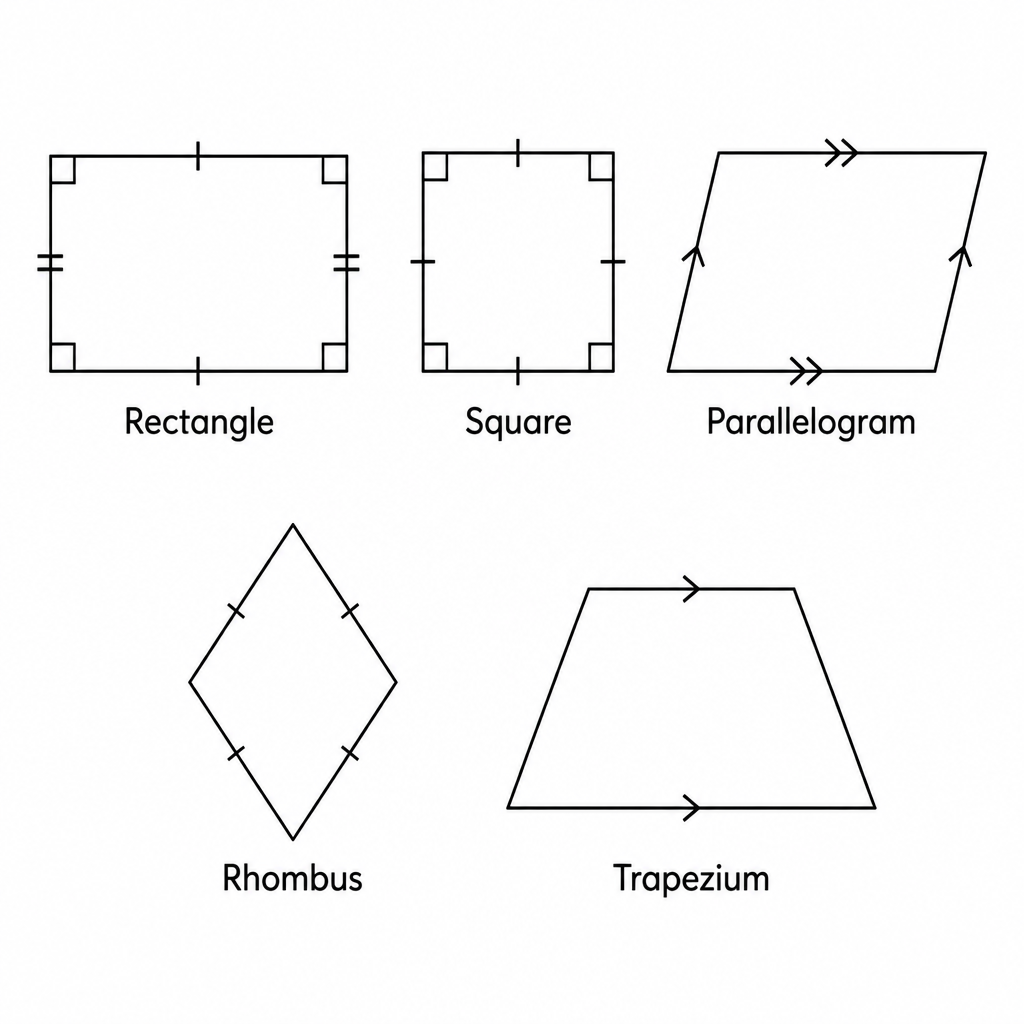
Rectangle: opposite sides equal, all four angles \( 90^\circ \).
Square: all four sides equal, all four angles \( 90^\circ \).
Parallelogram: both pairs of opposite sides parallel.
Rhombus: all four sides equal, angles need not be right angles.
Trapezium: only one pair of opposite sides parallel.
Working Out Which Quadrilateral It Is
Let us take measurements and find out what kind of quadrilateral CDEF is.
Step 1: Measure the two pairs of opposite sides with a ruler:
\[ CF = DE = 4 \text{ cm} \]
\[ DC = EF = 2.5 \text{ cm} \]
Step 2: Measure the four angles with a protractor. The first two read:
\[ \angle CDE = \angle DEF = 90^\circ \]
Step 3: The other two angles read:
\[ \angle EFC = \angle FCD = 90^\circ \]
Step 4: The opposite sides are equal and all four angles are right angles, so quadrilateral CDEF is a rectangle. It is not a square, because the sides meeting at a corner measure 4 cm and 2.5 cm, which are not equal.
Quadrilaterals Made by Two Pairs of Parallel Lines
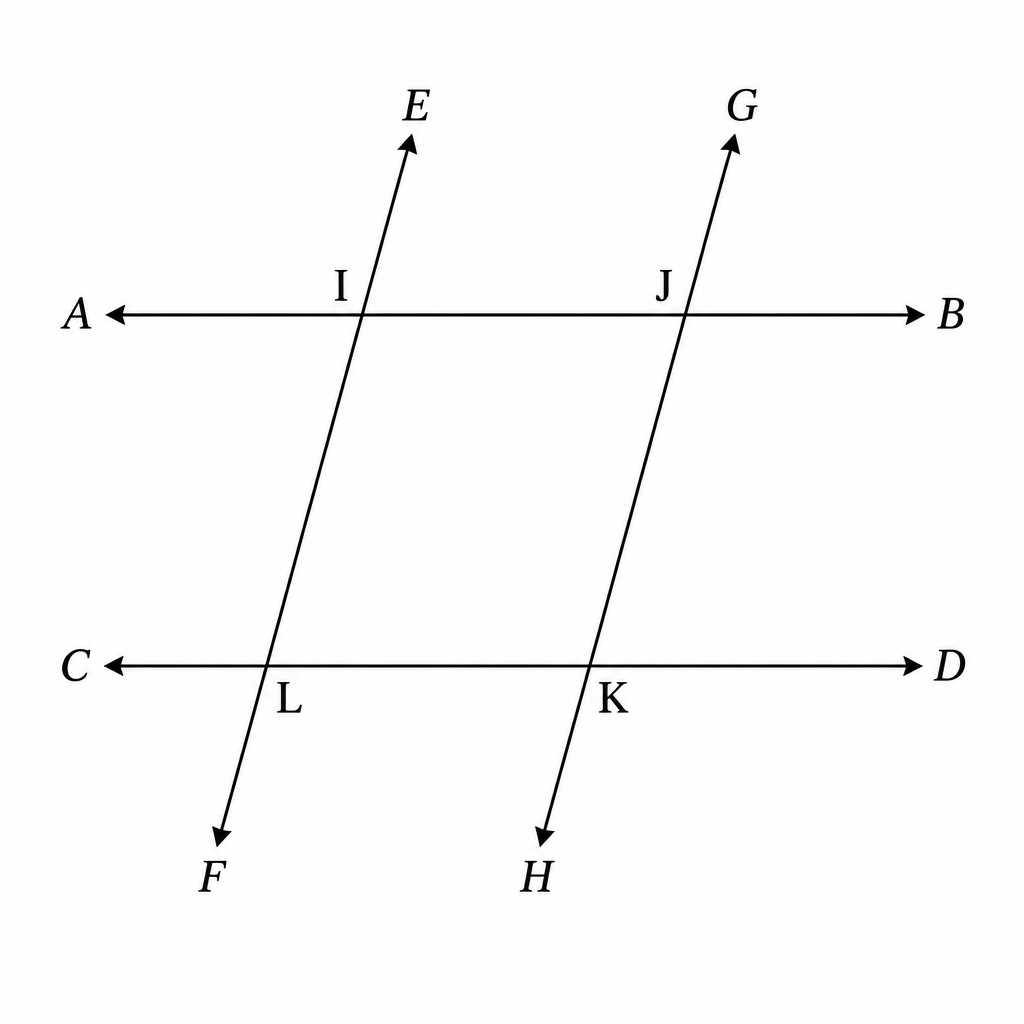
Draw two parallel lines AB and CD. Now draw a second pair of parallel lines EF and GH so that they cut across the first pair. Name the four crossing points I, J, K and L. Both pairs of opposite sides of the quadrilateral IJKL are parallel, so IJKL is a parallelogram. If its angles measure \( 90^\circ \), the shape becomes a rectangle, and if the four sides are equal as well as the angles being \( 90^\circ \), it becomes a square.
Making Quadrilaterals with a Tangram
A tangram is a set of seven flat pieces. By sliding and turning those pieces you can build a rectangle, a square, a parallelogram, a trapezium and a rhombus. Trace round each shape you build, then measure its sides and angles and write down which quadrilateral it is. The same models can be made with bamboo sticks or thin rods laid out on a desk.
The full lesson is waiting for you
Create a free account to unlock activities, practice tests, presentations and videos - and to track your progress and confidence score for every subject.
A triangle is a closed figure enclosed by three straight line segments, and it has three sides, three vertices and three angles.
11 more points to remember - sign in to see the rest.
Question 1 of 13