Starting from Area and Volume
To find the area of a rectangle we multiply its length by its breadth. If a rectangle has length a units and breadth b units, its area is \( A = a \times b \). Here a and b are two different measurements, so there is no shorter way of writing the product.
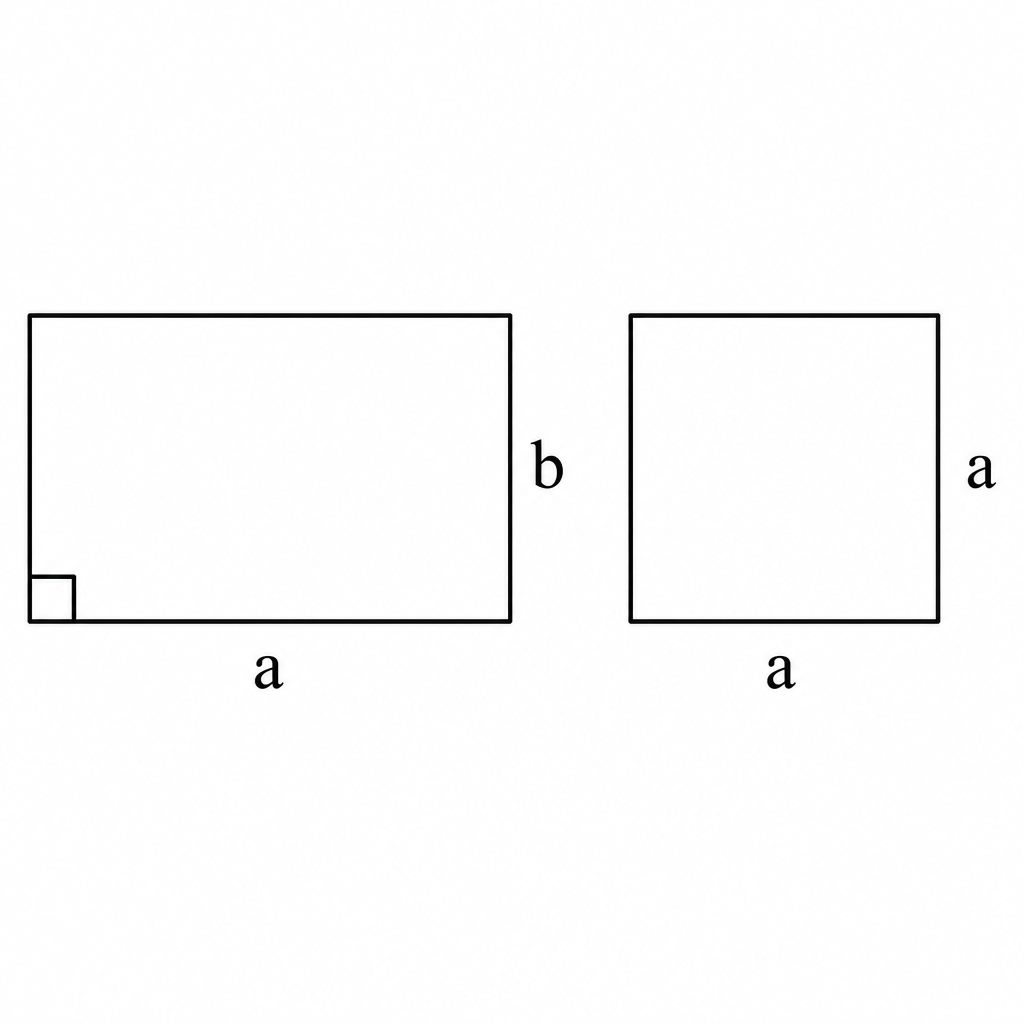
Now suppose the length and the breadth of that same rectangle are both a units. The shape becomes a square, and the area comes out like this.
\[ A = a \times a = a^2 \]
This area is a² square units. Here a has been multiplied 2 times, and that is written as a². The same idea works for solid shapes. A cube has its length, breadth and height all equal to a units, so its volume comes from multiplying three times.
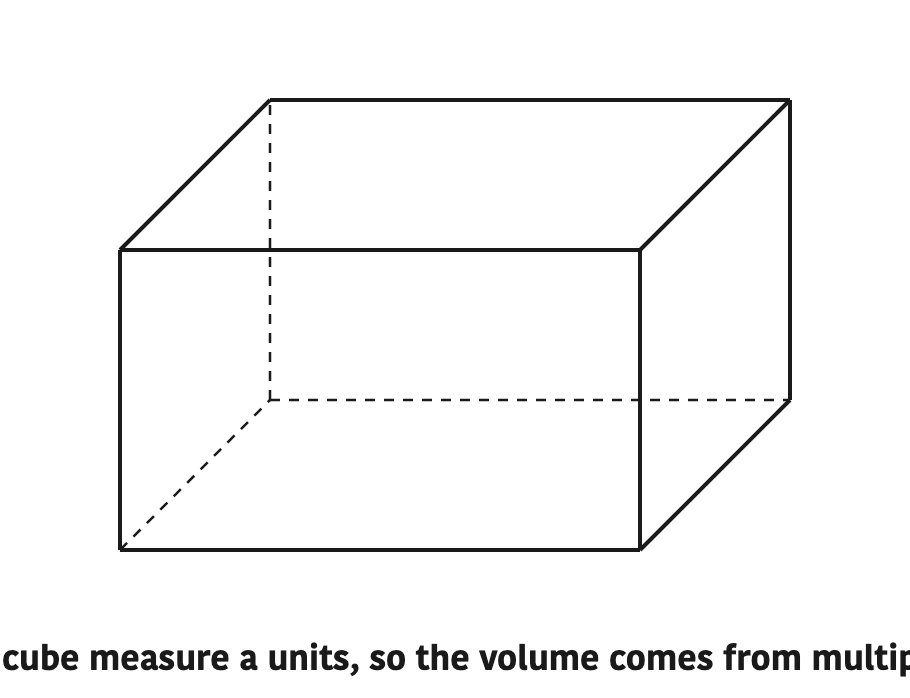
\[ V = a \times a \times a = a^3 \]
When the same number or the same letter has to be multiplied again and again, indices give us a short way of writing it.
Base and Index
If 2 has been multiplied 5 times, that long multiplication can be written in a short form like this.
\[ 2 \times 2 \times 2 \times 2 \times 2 = 2^5 \]
In the same way \( x \times x \times x \times x \) has x multiplied 4 times, so it is written as \( x^4 \). In both of these, the quantity written in full size and the small number written above it do two different jobs.
Base: the number or letter that is being multiplied again and again is called the base. In \( x^4 \) the base is x.
Index: the small number written above the base, which tells how many times the base has been multiplied, is called the index. In \( x^4 \) the index is 4.
| Term | Base | Index | Meaning |
| \( 3^4 \) | 3 | 4 | 3 multiplied 4 times |
| \( a^2 \) | a | 2 | a multiplied 2 times |
| \( y^5 \) | y | 5 | y multiplied 5 times |
| \( b^3 \) | b | 3 | b multiplied 3 times |
When we read them aloud, \( a^2 \) is called a squared and \( a^3 \) is called a cubed, because those two names come from the square and the cube themselves. A term like \( 2^5 \) is read as two to the power five.
\( a^3 \) and \( 3a \) are not the same. \( a^3 \) means \( a \times a \times a \), while \( 3a \) means \( a + a + a \). An index counts multiplication, not addition.
Writing Numbers in Index Form
To turn a long multiplication into index form, these same three jobs are done every time.
- Find which number or letter is repeating. That one is the base.
- Count how many times that base has been written down.
- Write the base, then write the count above it as a small number, and the index form is ready.
Now let us write \( 3 \times 3 \times 3 \times 3 \) in index form.
Step 1: The multiplication that is given is:
\[ 3 \times 3 \times 3 \times 3 \]
Step 2: The repeating number is 3 and it has been written 4 times, so the base is 3 and the index is 4:
\[ 3 \times 3 \times 3 \times 3 = 3^4 \]
Sometimes two different numbers repeat inside one multiplication. To write \( 2 \times 2 \times 2 \times 3 \times 3 \) in index form, each of them has to be counted separately.
Step 1: The multiplication that is given is:
\[ 2 \times 2 \times 2 \times 3 \times 3 \]
Step 2: The number 2 has been multiplied 3 times, so:
\[ 2 \times 2 \times 2 = 2^3 \]
Step 3: The number 3 has been multiplied 2 times, so:
\[ 3 \times 3 = 3^2 \]
Step 4: Writing both parts together gives the complete answer:
\[ 2 \times 2 \times 2 \times 3 \times 3 = 2^3 \times 3^2 \]
Writing Algebraic Terms in Index Form
In algebra a term can carry a number in front of the letter. When that happens, the numbers are handled with the numbers and the letters with the letters. Let us write \( 2x \times x \) in index form.
Step 1: The term that is given is:
\[ 2x \times x \]
Step 2: Here x has been multiplied 2 times, so the x part becomes \( x^2 \):
\[ 2x \times x = 2 \times x^2 \]
Step 3: The number 2 is kept in front and the term is written in short form:
\[ 2x \times x = 2x^2 \]
Take \( a^2 \times a \) as the next example. Since \( a^2 \) means \( a \times a \), and one more a is multiplied with it, a has been multiplied 3 times in all.
\[ a^2 \times a = a \times a \times a = a^3 \]
In \( 2x^2 \) the index belongs to x alone, so it means \( 2 \times x \times x \). In \( (2x)^2 \) the index belongs to both 2 and x, so it means \( 2x \times 2x = 4x^2 \). Look for the bracket before you write anything down.
Writing an Index in Expanded Form
Expanded form: the form in which a term written with an index is opened out fully using multiplication signs. The expanded form of \( y^5 \) is \( y \times y \times y \times y \times y \).
Writing in expanded form is the exact opposite of writing in index form. The base is written down as many times as the index says. Take \( C^2 \) first. Here C has to be multiplied 2 times:
\[ C^2 = C \times C \]
Now take \( y^5 \). Here y has to be multiplied 5 times, so y is written down five times:
\[ y^5 = y \times y \times y \times y \times y \]
Finally take \( x^2 y^2 \). Here x has been multiplied 2 times and y has been multiplied 2 times, so both of them are opened out:
\[ x^2 y^2 = x \times x \times y \times y \]
Multiplying Terms that Share a Base
When two terms have the same base, their product can also be written using an index. The easy way is this: open both of them out, count how many times the base appears altogether, then write it back in index form. Let us do that with \( x^5 \times x^2 \).
Step 1: Writing both terms in expanded form gives:
\[ x^5 \times x^2 = x \times x \times x \times x \times x \times x \times x \]
Step 2: The letter x appears 7 times in all, so in index form:
\[ x^5 \times x^2 = x^7 \]
When numbers stand in front of the letters, those numbers are multiplied together and the letters are handled in the way shown above. Look at \( 3x^3 \times 6x^3 \).
Step 1: Separating the numbers from the letters gives:
\[ 3x^3 \times 6x^3 = 3 \times 6 \times x^3 \times x^3 \]
Step 2: Multiplying the numbers gives \( 3 \times 6 = 18 \), and x appears 6 times in all, so:
\[ 3x^3 \times 6x^3 = 18x^6 \]
Indices can be added up only when the base is the same. In \( x^2 \times y^3 \) the bases are different, so it cannot be written any shorter than \( x^2 y^3 \).
Volume of a Solid Written with Indices
If a solid box shape has length l, breadth b and height h, this is the formula for its volume:
\[ V = l \times b \times h \]
Now if the length, breadth and height of that same solid are all b units, then b goes in all three places, and b is multiplied three times:
\[ V = b \times b \times b = b^3 \]
This volume is b³ cubic units. The method stays the same even when the measurements carry numbers in front of the letters. The solid below has length 8a, breadth 4a and height a units.
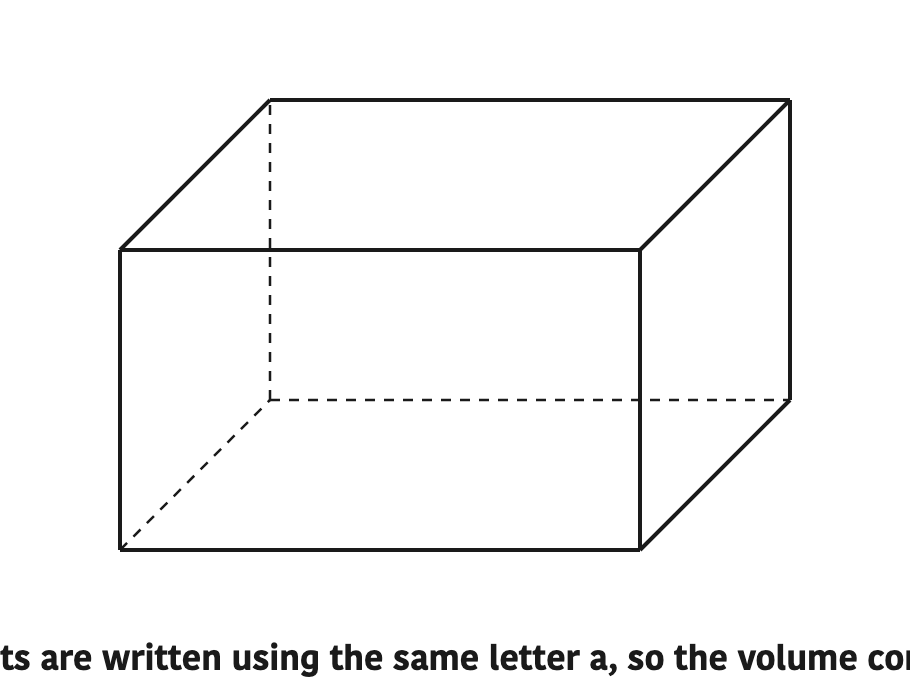
Step 1: Putting the measurements into the formula gives:
\[ V = 8a \times 4a \times a \]
Step 2: Grouping the numbers with the numbers and the letters with the letters gives:
\[ V = 8 \times 4 \times a \times a \times a \]
Step 3: The numbers multiply to give \( 8 \times 4 = 32 \), and a appears three times, so it becomes a³:
\[ V = 32a^3 \]
So the volume of this solid is 32a³ cubic units. This is what indices are for: a long multiplication is packed into one short term that is easy to write and easy to read.
The full lesson is waiting for you
Create a free account to unlock activities, practice tests, presentations and videos - and to track your progress and confidence score for every subject.
Indices are used when the same number or letter is multiplied again and again.
11 more points to remember - sign in to see the rest.
Question 1 of 13