Around the Edge and Across the Surface
Look at a photo frame hanging on a wall. Two different things can be measured on it. The first is how long the wooden strip is all the way round. The second is how much flat space the picture inside covers. These two measurements are not the same, and each one has its own name.
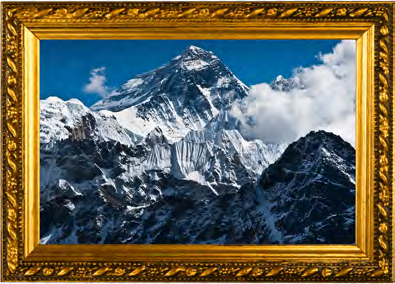
The total length you cover by going once round the outside of a shape is called its perimeter. Perimeter is a length, so it is written in cm, m or ft. The space a surface takes up on a flat surface is called its area, and area is written in square units such as square centimetres or square metres. The space a solid object fills is called its volume, and volume is written in cubic units such as cubic centimetres or cubic metres.
Perimeter can be measured with a string, area is found by counting squares, and volume is found by filling the object with small cubes. Three measurements, three kinds of unit.
Perimeter of a Rectangle and a Square
Measure the top of a classroom table. Suppose the length (l) is 4 ft and the breadth (b) is 3 ft. Going once round the edge of that table gives its perimeter. The table top is a rectangle, so going round it covers the length twice and the breadth twice.
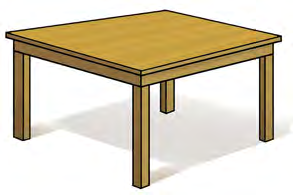
Step 1: Adding the lengths of all four sides of the boundary gives:
\[ P = 4\ \text{ft} + 3\ \text{ft} + 4\ \text{ft} + 3\ \text{ft} \]
Step 2: Each measurement appears twice, so it can be written as a multiplication:
\[ P = 4\ \text{ft} \times 2 + 3\ \text{ft} \times 2 \]
Step 3: Since 2 is common to both terms, taking 2 outside the bracket gives:
\[ P = 2\,(4\ \text{ft} + 3\ \text{ft}) = 2 \times 7\ \text{ft} \]
Step 4: Multiplying gives the perimeter of the table:
\[ P = 14\ \text{ft} \]
Perimeter: the total length of the boundary all the way round an object is called its perimeter.
The opposite sides of a rectangle are equal, so this working does not have to be repeated for every rectangle. Adding the length to the breadth and doubling the answer is enough. In symbols, the perimeter of a rectangular surface is:
\[ P = 2\,(l + b) \]
All four sides of a square are equal, so its breadth is the same as its length. That makes \( P = 2(l + b) = 2(l + l) \), which gives the perimeter of a square as:
\[ P = 4l \]
Adding the length and the breadth alone does not give the perimeter. The sum \( l + b \) covers only half of the boundary, so never forget to double it.
Now find the perimeter of a rectangle ABCD whose length is 6 cm and whose breadth is 4 cm.
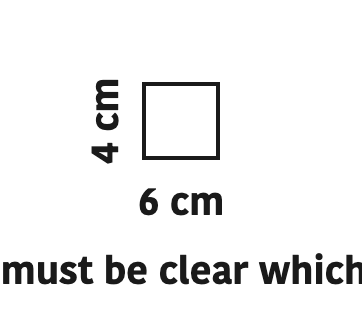
Step 1: Putting the given measurements into the formula gives:
\[ P = 2\,(6 + 4) \]
Step 2: The addition inside the bracket is done first:
\[ P = 2 \times 10 \]
Step 3: Multiplying and writing the unit gives:
\[ P = 20\ \text{cm} \]
Finding a Missing Side from the Perimeter
Sometimes the perimeter is given and a side has to be found. No new formula is needed for that. Put the known numbers into the same formula and get the unknown letter by itself. Suppose a rectangle has a perimeter of 18 cm and a breadth of 4 cm.
Step 1: Putting the given values into the formula gives:
\[ 18 = 2\,(l + 4) \]
Step 2: Opening the bracket, which means multiplying both terms by 2, gives:
\[ 18 = 2l + 8 \]
Step 3: Subtracting 8 from both sides gives:
\[ 2l = 18 - 8 = 10 \]
Step 4: Dividing both sides by 2 gives the length:
\[ l = \frac{10}{2} = 5\ \text{cm} \]
A square is easier still, because it has only one side measurement. Suppose a square handkerchief has a perimeter of 120 cm.
Step 1: Putting the perimeter into the formula for a square gives:
\[ 120 = 4 \times l \]
Step 2: Dividing both sides by 4 gives the length of one side of the handkerchief:
\[ l = \frac{120}{4} = 30\ \text{cm} \]
One formula works both ways. Knowing the sides gives the perimeter, and knowing the perimeter gives back a side.
Area by Counting Squares
Area is measured with squares of equal size. The space covered by one square whose side is 1 unit long is called 1 square unit. When a shape is drawn on squared paper, counting the squares inside it tells how much space that shape covers.
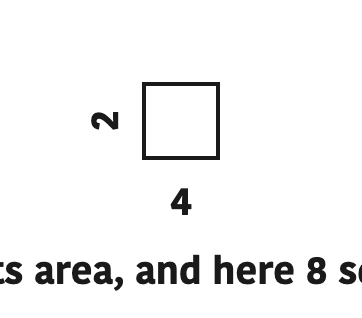
Eight whole squares fit inside the shape above, so its area is 8 square units. Any rectangle or square drawn on squared paper can be compared in the same way. The shape with more squares inside it is the one covering more space.
Area: the amount of space that the surface of an object covers on a flat surface is called its area.
Square unit: the space covered by a square of side 1 unit is 1 square unit. When the sides are measured in centimetres, the unit of area is the square centimetre.
Area of Irregular Objects
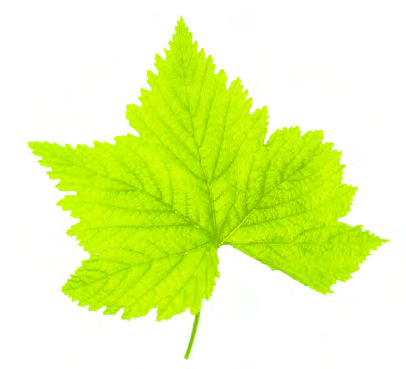
Objects such as a leaf, the palm of a hand or a stone do not have straight edges. There is no formula for the area of such irregular objects, so they are placed on graph paper, traced round, and the squares inside the outline are counted.
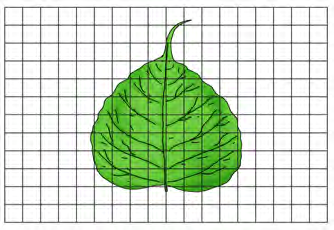
The counting method is simple. First count the whole squares that lie completely inside. Then look at the part squares along the edge, join them up in your mind, and estimate how many whole squares they would make. The leaf above covers 34 whole squares, and the part squares along its edge join up to make about 14 more.
\[ 34 + 14 = 48 \]
So the area of the leaf is about 48 square units. If a parallelogram drawn on the same paper covers 30 whole squares and its part squares join to make 6 more, its area is \( 30 + 6 = 36 \) square units. In the same way, an arrow shape covering 14 whole squares with 4 more made from parts has an area of about \( 14 + 4 = 18 \) square units.
The area of an irregular object is an estimate and not an exact figure. Write the word about in front of the answer instead of stating it as exact.
Area of a Rectangle and a Square
For a rectangle and a square there is no need to count squares every time. Take a rectangle 6 cm long and 4 cm wide and rule it into squares of side 1 cm.
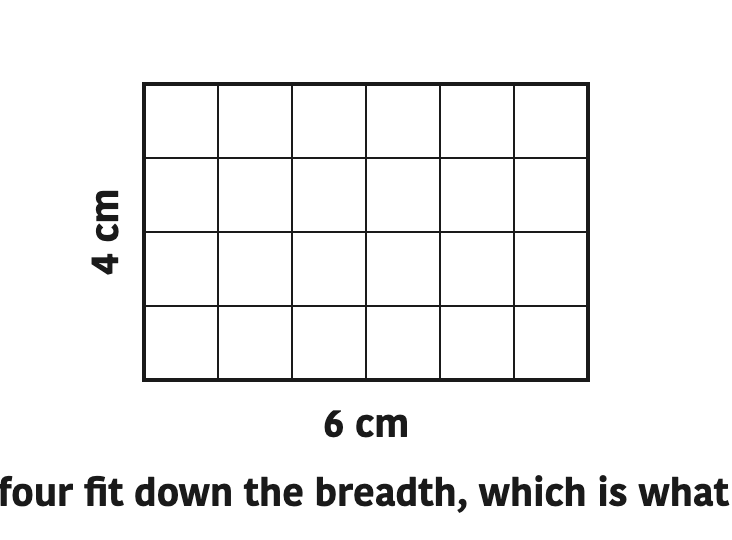
There are 6 squares along the length and 4 squares down the breadth, so the total number of squares is \( 6 \times 4 = 24 \). Each square covers 1 square centimetre, so the area of the rectangle is 24 square centimetres. This shows how area, length and breadth are linked.
\[ A = l \times b \]
In a square the length and the breadth are equal, so the area becomes \( A = l \times l \), which is the side multiplied by itself:
\[ A = l^2 \]
Now find the area of a rectangle 20 cm long and 8 cm wide. Step 1: Putting the values into the formula gives:
\[ A = 20 \times 8 \]
Step 2: Multiplying and writing the answer in square units gives:
\[ A = 160\ \text{cm}^2 \]
Questions also give the area and ask for the sides. Suppose the length of a rectangle is double its breadth and its area is 50 square metres. Step 1: Taking the breadth as \( x \) makes the length \( 2x \), so the formula becomes:
\[ 50 = 2x \times x = 2x^2 \]
Step 2: Dividing both sides by 2 gives:
\[ x^2 = \frac{50}{2} = 25 \]
Step 3: Asking which number multiplied by itself gives 25 leads to \( x = 5 \). So the breadth is 5 m and the length is:
\[ l = 2 \times 5 = 10\ \text{m} \]
If a square field has an area of 100 square feet, put the value into \( A = l^2 \), which gives \( 100 = l^2 \). Asking which number squared gives 100 leads to:
\[ l = \sqrt{100} = 10\ \text{ft} \]
Area of a Shaded Part
Sometimes a small rectangle is left blank inside a bigger one and only the shaded part has to be measured. For this, subtract the area of the small rectangle from the area of the big one. Suppose the big rectangle is 6 cm long and 4 cm wide, and the blank rectangle inside it is 3 cm long and 2 cm wide.
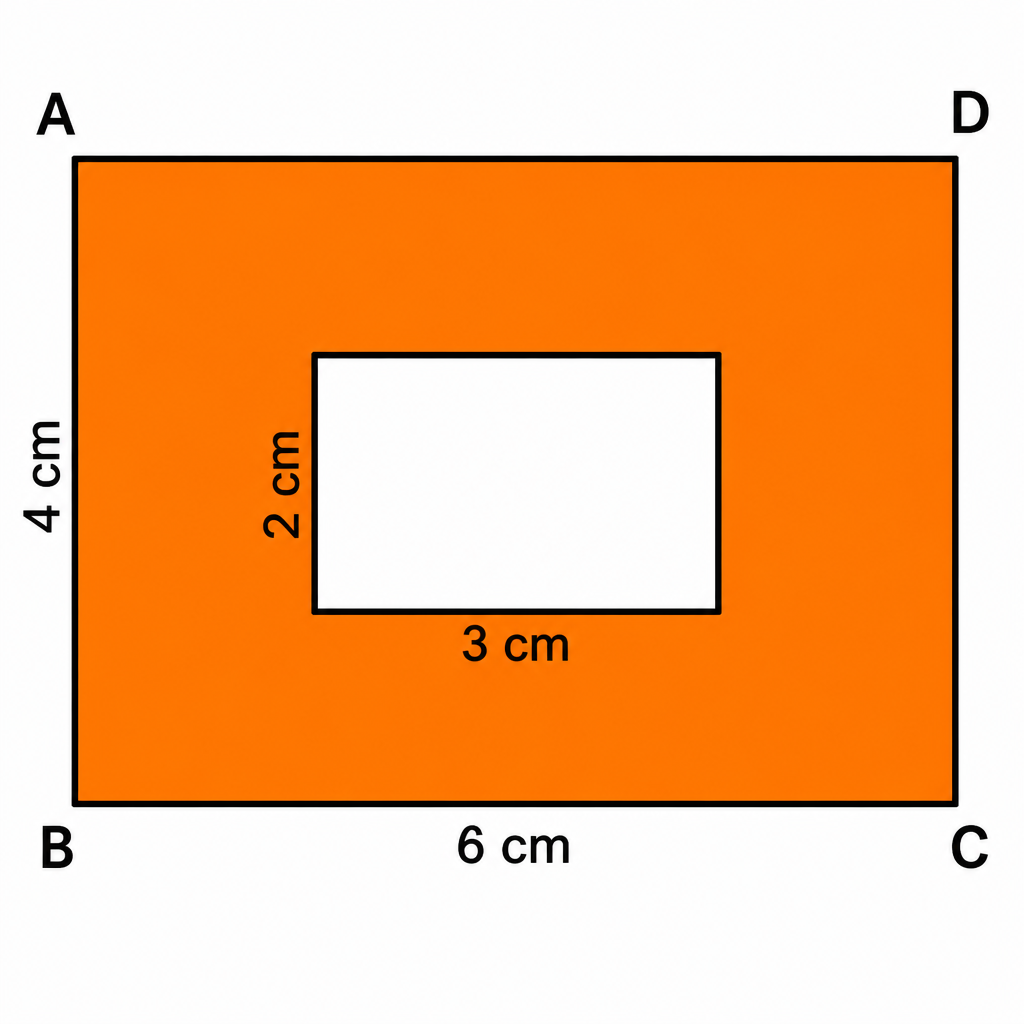
Step 1: Finding the area of the big rectangle gives:
\[ A_1 = 6 \times 4 = 24\ \text{cm}^2 \]
Step 2: Finding the area of the blank rectangle inside gives:
\[ A_2 = 3 \times 2 = 6\ \text{cm}^2 \]
Step 3: Subtracting the smaller area from the bigger one gives the area of the shaded part:
\[ A = 24 - 6 = 18\ \text{cm}^2 \]
Volume of a Cuboid and a Cube
Now move from flat surfaces to solid objects. A unit cube with an edge of 1 cm has a volume of 1 cubic centimetre. Place such cubes 4 along the length and 3 across the width, then add a second layer on top so that the height is 2 cubes.
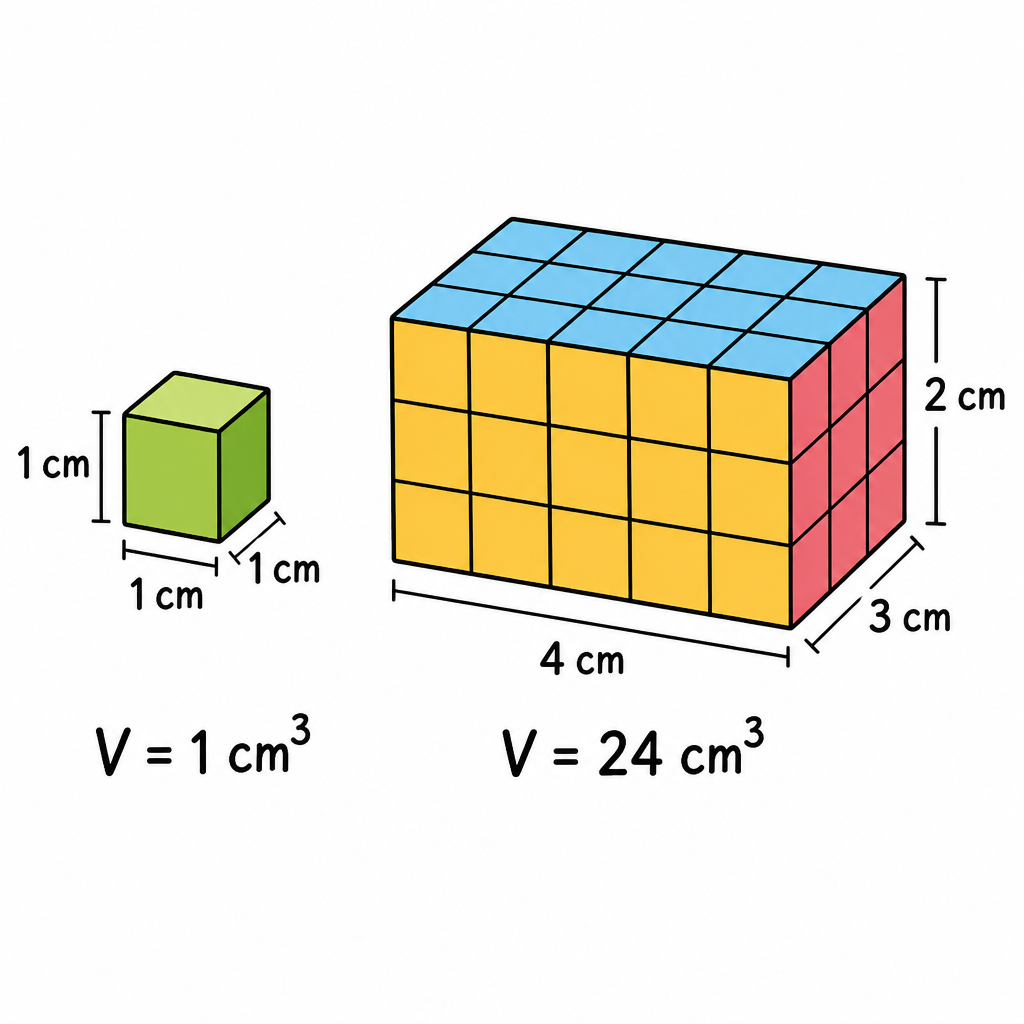
The cubes now form a cuboid, and 24 cubes of 1 cubic centimetre fit inside it, so its volume is 24 cubic centimetres. Comparing this with the measurements shows that \( 24 = 4 \times 3 \times 2 \), so the volume is the length multiplied by the breadth multiplied by the height.
Volume: the total number of unit cubes that fill a cuboid is its volume. The volume of a cuboid is \( V = l \times b \times h \).
Cube: a cuboid whose length, breadth and height are all equal is called a cube. The volume of a cube is \( V = l \times l \times l = l^3 \).
Now find the volume of a box 12 cm long, 8 cm wide and 4 cm high. Step 1: Putting the values into the formula gives:
\[ V = 12 \times 8 \times 4 \]
Step 2: Multiplying the first two numbers gives:
\[ V = 96 \times 4 \]
Step 3: Finishing the multiplication and writing the answer in cubic units gives:
\[ V = 384\ \text{cm}^3 \]
When the volume of a cube is given and the edge is asked for, the same formula is used backwards. Suppose a cube has a volume of 64 cubic metres. Step 1: Putting the value into the formula gives:
\[ l^3 = 64 \]
Step 2: Asking which number multiplied by itself three times gives 64, and since \( 4 \times 4 \times 4 = 64 \), the edge is:
\[ l = 4\ \text{m} \]
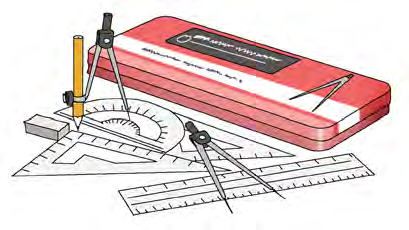
Look at your own geometry box. It is a cuboid too. Measure its length, breadth and height with a ruler, multiply the three measurements together, and that product is its volume.
Telling Perimeter, Area and Volume Apart
All three measurements come from the same rectangular object, so the first job is to work out what the question is asking for. Measuring round the edge needs perimeter, covering a surface needs area, and filling the inside needs volume. Buying string calls for perimeter, painting calls for area, and filling with sand calls for volume.
| Measurement | What it measures | Formula | Unit |
| Perimeter | The length all round the boundary | \( P = 2(l+b) \), \( P = 4l \) | cm, m, ft |
| Area | The space a surface covers | \( A = l \times b \), \( A = l^2 \) | \( \text{cm}^2 \), \( \text{m}^2 \) |
| Volume | The space a solid fills | \( V = l \times b \times h \), \( V = l^3 \) | \( \text{cm}^3 \), \( \text{m}^3 \) |
The unit on the answer shows whether the right work has been done. Perimeter ends in cm, area ends in square centimetres and volume ends in cubic centimetres.
- Change every measurement to the same unit before working, for example write 1 m 20 cm as 120 cm.
- Count squares only for irregular shapes, and use the formulas for rectangles and squares.
- To find a missing side, put the known numbers into the same formula and work from there.
- Never leave the unit off an answer.
The full lesson is waiting for you
Create a free account to unlock activities, practice tests, presentations and videos - and to track your progress and confidence score for every subject.
The perimeter is the total length all the way round the boundary of an object.
11 more points to remember - sign in to see the rest.
Question 1 of 12