Looking at Then and Now
Places do not stay the same. A hill that was thick with trees twenty years ago may be bare today. A quiet corner where people rested may now be a busy road. When we put a picture of the past beside a picture of the present, the changes jump out at us. Look at these two pictures of the same hill.
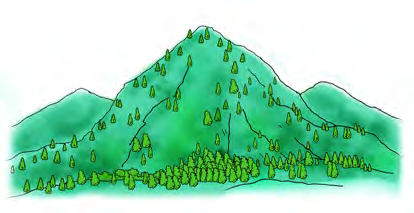
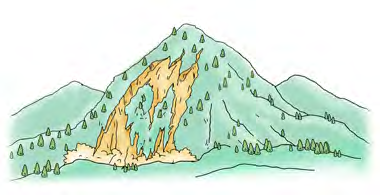
The first hill used to be covered with trees, so the soil held firm. In the second picture many trees have been cut, and a landslide has swept down the slope. Now compare a second pair of pictures. They show the same spot in a village at two different times.
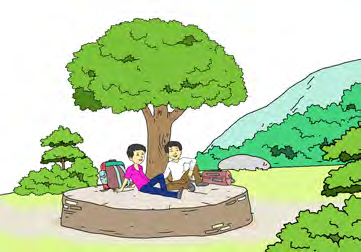
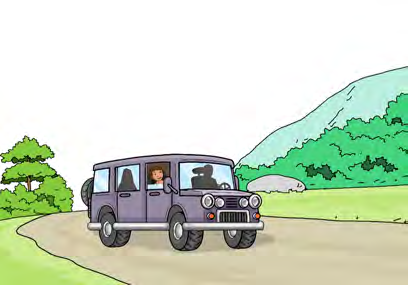
To talk about how things were different in the past, English has a special expression: used to. Everything in this topic, the stories, the song, the conversations and the writing, practises comparing then with now.
A Song About Days Gone By
People often remember their childhood with a smile. This song is sung by someone who dreams about the days when she played with her friends for hours, forgetting food, rain and tiredness. Sing it aloud and notice how many lines talk about things that happened again and again in the past.
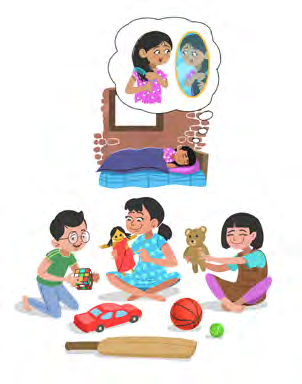
I used to get an amazing dreamThere I got my long hair trim.We were there all three or fourWanted to play there more and more.We cracked jokes and we laughed loudWe used to ignore rain and cloud.Did not feel hungry did not feel tiredEven though whole day played in mire.Where has gone those happy scenesI used to play at least in dreams.Remembering that I get painI wish to have such dream again.
The song says: I used to get an amazing dream, and We used to ignore rain and cloud. Both sentences describe habits from the past that do not happen any more. That is exactly the meaning you will study in the grammar of this topic. The last verse is sad, because the singer knows those days will not come back.
Gairigaun: Then and Now
Mukesh is an eleven year old boy who lives in Gairigaun and studies in class six. One day his English teacher said that the village was very different in the past. Mukesh could not believe it, so he decided to ask his grandfather, who knew many things about the old days. As soon as he reached home, he went to him. His grandfather's story attracted him very much.
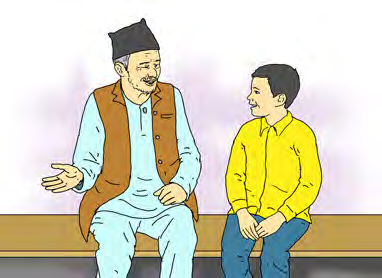
This is what the grandfather said. In the middle of the village there used to be a peaceful travellers' rest. People called it the Bar Pipal Chautaro, because a Bar tree and a Pipal tree grew on it, and the Pipal was the bigger of the two. Many travellers used to stop there. The grandfather himself used to spend a lot of time at the Chautaro, meeting people who came for rest and recreation. Sitting there, they could hear the melodious songs of birds. There were large, plain, smooth stones where people sat and talked about village matters, and a water tap stood nearby.
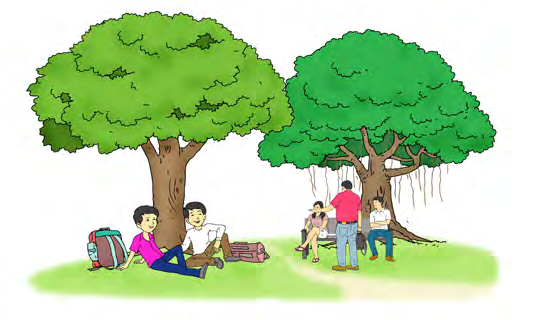
Children loved the place most of all. They used to play different games there, and sometimes they spent the whole day playing without even eating a snack in the afternoon. School children became very happy when they got time to rest at the Chautaro, and while returning home late they used to stay there a long time. The Chautaro belonged to nobody in particular. It was a public property of all the villagers.
But now Mukesh finds the Chautaro is gone. Both the Bar and the Pipal have been cut down, and the beauty of the old place has gone away. A road has been constructed by the Chautaro. The people of Gairigaun have lost their place to rest.
Words from the Story
Learn these words. They carry the story, and they are useful far beyond it.
| Word | Meaning |
| Chautaro | a rest stop along foot trails |
| melodious | sweet and pleasant tune |
| public | of all, not of an individual |
| property | belongings |
| recreation | rest and enjoyment after work |
| peaceful | calm and quiet |
| attracted | pulled someone's interest strongly |
Grammar: used to
The story keeps repeating one small phrase: people used to come, children used to play, travellers used to take rest. This phrase is the heart of the unit's grammar.
used to + base verb describes a habit or a state that was true in the past but is not true now. She used to have long hair, but now it's short. Her long hair belongs to the past only.
didn't use to + base verb is the negative form. It says something was NOT true in the past, though it may be true now. It didn't use to snow a lot in the winter. I speak English now, but I didn't use to speak it when I was in grade one.
Did + subject + use to + base verb? is the question form. Did they use to have a dog? The helping verb did asks the question, so the main phrase stays as use to.
| Form | Pattern | Example |
| Positive | subject + used to + base verb | She used to have long hair. |
| Negative | subject + didn't use to + base verb | It didn't use to snow a lot in the winter. |
| Question | Did + subject + use to + base verb? | Did they use to have a dog? |
After did or didn't, write use to, never used to. The d moves into did. So: Did you use to collect stamps? and I didn't use to like tea. Writing 'didn't used to' is the most common mistake with this structure.
Try turning present facts into sentences about the past. John doesn't like apples now becomes John used to like apples. You don't wear shorts now becomes You used to wear shorts. My brother doesn't throw things away becomes My brother used to throw things away. Going the other way, 200 years ago people used to make their own clothes, they used to walk everywhere, but they didn't use to have mobile phones, didn't use to watch TV and didn't use to drive cars.
used to is only for the past. There is no present form. To talk about a present habit, use the simple present: I play football every day, not I use to play football every day.
Speaking About Past Habits
A conversation about childhood is the most natural place to practise used to. Read this one aloud with a partner, then replace the games with your own.
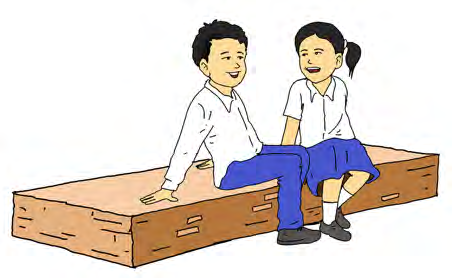
Notice what the conversation tells us without saying it. Rina used to play hide and seek, so she does not play it now. Ronish used to play Dandibiyo, so that too has stopped. The phrase used to always whispers 'not any more'. When you make your own version, ask with Did you use to, and answer with I used to or I didn't use to.
Listening: Village and Town
Before listening to any talk about a place, look at pictures of it and predict what you will hear. Here are two very different places. One is a village with small houses, trees and open space. The other is a town street full of vehicles, smoke and noise, where school children cover their faces with masks.
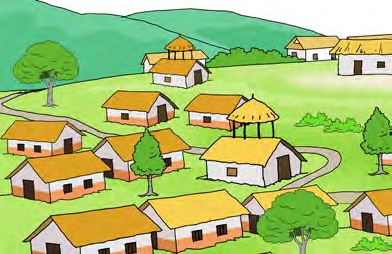
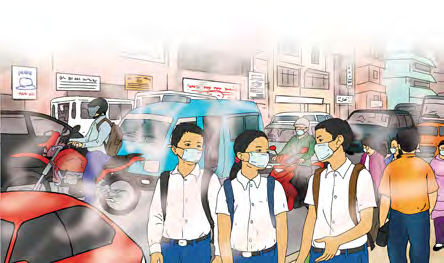
A typical listening text on this topic describes a village such as Dadagaun then and now. Ten years ago it was not a developed village. There was no road, houses were small with thatched roofs, and sick people used to be carried to hospital on a stretcher. Now things have changed. There is electricity, children no longer walk to school because they use a school bus and a van, and new services have arrived. While you listen, catch exactly these small facts: what kind of roof, what carried the patients, how children travel today. Then think about your own answers. Do you live in a village or a town? Which do you like, and why? And what can we do to minimise pollution? We can plant trees, walk or cycle for short trips, manage rubbish properly and keep vehicles well serviced.
Anne Frank: A Short Life
The second reading also compares then and now, but it tells a true and serious story from history. Anne Frank was a Jewish girl whose short life is known all over the world because of the diary she kept. Her story is told as a timeline, year by year.
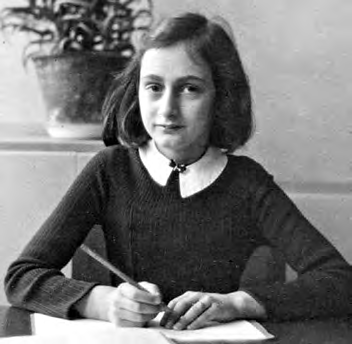
| Year | The events |
| 1929 | Anne Frank was born in Frankfurt, Germany on 12 June. Her family was Jewish, and she was the second daughter. |
| 1933 | Adolf Hitler came to power in Germany as the leader of the Nazis. He blamed the Jews for all of the country's problems, and it became impossible for Jews to live normally in Germany. The Frank family moved to Amsterdam, the Netherlands, where Otto Frank started a new business. |
| 1934 | Anne adapted to her new life quickly. She learnt Dutch, made many friends and enjoyed school. |
| 1939 | Hitler's armies invaded Poland. |
| 1940 | On 10 May, the Germans occupied the Netherlands. The Nazis began imposing restrictive measures against the Jews. |
| 1941 | Anne had to change schools in the autumn because a new law said Jewish children could not go to school with other children. |
| 1942 | Anne's parents gave her a diary for her 13th birthday on 12 June. In July the family went into hiding in 'The Secret Annex', a hidden part of Mr. Frank's office building. |
| 1944 | On 4 August, a police van stopped at 263 Prinsengracht. Everyone hiding in the Secret Annex was arrested. Anne's diary was left scattered on the floor, and one of the family's helpers picked it up and kept it. |
After 1940 the rules against Jewish people grew crueller each year. They had to wear a yellow star that said 'Jew'. They could not own a business, take a tram, bus or car, buy sugar, or even walk on the same street as other people. In 1942 Anne wrote the first words in her new diary: 'I hope I shall be able to confide in you completely and I hope that you will be a great support and comfort to me.' The Van Pels family joined the Franks in hiding on 13 July, and an eighth person came in November. People who worked for Anne's father secretly brought them food and visited them, until the police found the Annex in 1944, after more than two years of hiding.
A timeline tells a life in order: year first, event next. You can make one for your own life too. Start at your birth, mark each year, and write one event beside it.
Writing About Changes
To write about how a place has changed, compare a 'then' picture with a 'now' picture, one idea at a time. Four clue ideas guide the comparison: greenery, less population, pollution, big buildings. Look at these two scenes.
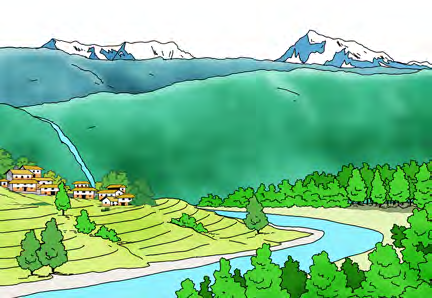
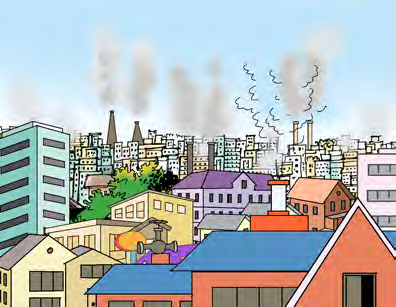
Take one clue at a time and write a full sentence for each side of it.
- Greenery: The place used to be full of greenery, with forests, terraced fields and a clean river. Now most of the greenery has been replaced by concrete.
- Population: There used to be less population, with only a few houses on the hillside. Now thousands of people live crowded together.
- Pollution: The air used to be clean and fresh. Now smoke from factories and vehicles pollutes the air.
- Buildings: People used to live in small houses. Now big buildings stand everywhere, wall to wall.
You can also write about your own habits changing. Ask your parents what you used to do when you were small. Then write two lists: what you used to do, and what you did not use to do. For example: I used to cry when my mother went to work. I used to sleep in the afternoon. I didn't use to eat green vegetables. I didn't use to go to school alone. Join the best sentences into a paragraph, and you have a true story of your own then and now.
Project: Your Own Then and Now
Collect pictures of your own locality, both present and past, with the help of your parents and teachers. Old family photographs work well. Put a past picture beside a present one and find out the changes that have occurred: roads, buildings, trees, shops, the number of people. Then write a couple of paragraphs about the changes, using used to for the past, and present your work to the class.
Alphabetical Order
In the English alphabet, A is the first letter and Z is the last. A dictionary arranges its words in the same order as the letters of the alphabet, so words starting with a sit at the beginning and words starting with z sit at the end.
Alphabetical order means arranging words by the order of the letters of the alphabet, comparing the first letters, then the second letters when the first letters are the same, then the third, and so on.
Study these three lists. Each one is already in correct alphabetical order.
- ash, credit, cricket, epic, episode, manual, publish, pure, sickle, water, wealth
- deaf, dear, debate, decide, decorate, demand, develop, device, dig, dry
- key, keyword, kill, king, knife, knit, know, knowledge
Look closely at the second list. Every word begins with d, so the first letters cannot decide the order. Move to the second letter: deaf, dear, debate and the others with e come before dig with i, and dig comes before dry with r. Inside the e group, the third letter decides: a in deaf and dear comes before b in debate, which comes before c in decide and decorate. A shorter word comes before a longer word that starts with the same letters, which is why key comes before keyword and know comes before knowledge.
The full lesson is waiting for you
Create a free account to unlock activities, practice tests, presentations and videos - and to track your progress and confidence score for every subject.
used to + base verb describes a past habit or state that is not true now: She used to have long hair.
11 more points to remember - sign in to see the rest.
Question 1 of 14