Watching People Talk
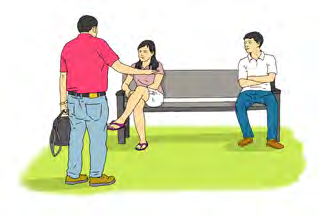
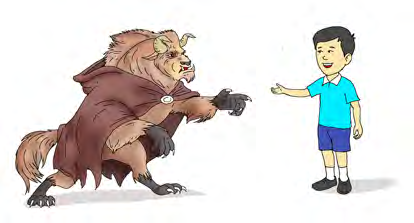
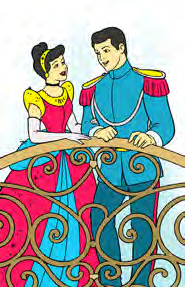
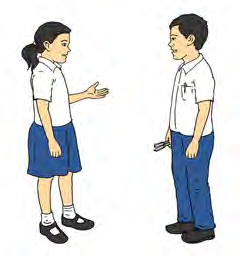
Look at the four pictures below, one after another. In the first, a man stops to greet two people resting on a park bench. In the second, a young boy stands bravely in front of a strange beast and speaks to it. In the third, a prince and a princess talk together on a balcony. In the fourth, a schoolgirl holds out her hand and asks her friend for something. Four very different scenes, yet the same thing is happening in every one of them: one person is speaking to another. People greet each other, ask questions, and request things they need. How we ask matters. A polite request opens doors that a rude demand keeps shut, and that is the skill these pages practise again and again.
A Song That Asks Politely
Here is a short song sung by a child who wants to paint the whole world. Read it aloud, or better, sing it. Notice how every wish in it is asked for, never grabbed.
Will you give me the colour, please?I want to paint all hills and seas.I want to travel the world too.Can I take your lovely shoe?Could you now give me a cup of tea?I want to be all fresh and free.How shall it look my world to be?Could you please explain it to me?

Count the requests in the song. Will you give me the colour, please? Can I take your lovely shoe? Could you please explain it to me? Three different openings, and all three are polite ways of asking. Keep them in mind, because the whole of this topic keeps coming back to them: will, can and could are the small words English uses to ask nicely.
The Story of Beauty and the Beast
Once upon a time, a merchant lived with his three daughters at the edge of a dense forest. One morning, as he was getting ready to leave for work in the town, he asked his daughters if they wanted any presents on his return.
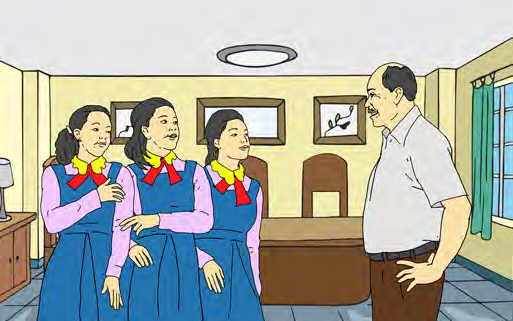
The eldest daughter was excited. She said, "Oh, yes! Will you bring me dresses made of silk?" The merchant replied that silk dresses were expensive, but he would try. The second daughter asked, "Oh father, could you please bring me pearl earrings?" Then the merchant turned to his youngest daughter, Beauty, who was the most beautiful and thoughtful of them all. She said, "You may just bring me some roses, father." Her simple demand pleased the merchant very much. Promising to try his best, he left for the town.
On his way back through the dark, dense forest, the merchant lost his way. Suddenly he reached the gates of an old, ruined castle. Inside the gate he saw a huge bush full of white roses, and he happily decided to pluck a few for his Beauty. Just as he touched the first rose, a roar came from behind him: "How dare you walk inside my castle without my permission?" A dangerous beast stood in front of him, with the head of a lion, the body of a bear and the legs of a wild dog.
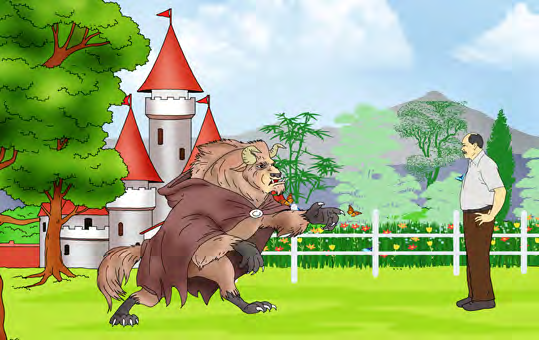
The terrified merchant stammered that he was sorry and had only wanted the roses for his daughter. "You thief! I won't let you get away with this!" snarled the beast. At last the beast said, "Go home. But send your daughter who wanted the roses. Don't lie! If you don't send your daughter by tomorrow evening, I will come to take you all."
That night the merchant told his daughters everything. Beauty's sisters wanted to send Beauty to the beast so that they themselves would be safe, but the loving father refused. Beauty, however, decided on her own to go to the beast and save her family. The following night she left home without telling anyone.
When Beauty reached the castle, the beast welcomed her warmly. She was given a proper room to live in and well cooked food to eat, and the beast treated her as a friend. After a few months they became best friends. Still, Beauty missed her father and sisters, so one night she asked the beast to give her a day to visit them. The beast agreed to let her go for only one day. At home everyone was happy to see her, and the days slipped by so pleasantly that Beauty slowly forgot the beast was waiting for her.
Then one night she had a dream. The beast was very sick and was calling her name. Worried and guilty that she had broken his trust, she ran back to the castle the next day and found that the beast really was ill. "Oh, I am so sorry I left you alone," she said with tears in her eyes. "I feared you would never come back," said the beast. Beauty began to cry, and her tears fell upon the beast's face. Magically, the beast turned into a handsome young man. He explained, "I was a prince. I used to kill the wild animals a lot, so the god punished me and turned me into a beast. When I pleaded to be turned back, the god said that only a true friend's teardrops would help. Now you have helped me become human again." Beauty was overjoyed. Later they invited her father and sisters to live with them in the castle, and they all lived happily together forever. The story leaves us with a quiet lesson: true friendship and kindness can change even a beast.
Words from the Story
Merchant: a person who buys and sells goods to earn money.
Dense: thick, packed closely together, as trees are in a deep forest.
Castle: a large building where a king or another great person resides.
Scare: to make a person or an animal feel frightened.
Roar: to make a loud noise, as of an animal such as a lion.
Punishment: bad treatment given to someone because they have done wrong.
Asking for Things Politely
Notice how often the people in the story make requests. The eldest daughter says, "Will you bring me dresses made of silk?" The second says, "Could you please bring me pearl earrings?" Requests are part of everyday life at school too. Read this short conversation between two friends and act it out with a partner, one of you as Mahesh and the other as Anu.
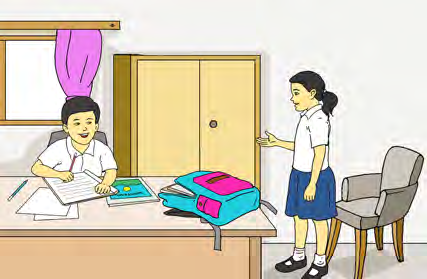
A request has two halves: the asking and the answering. You can agree, or you can refuse politely by giving a reason. These pairs show both.
- Give me your pen, please. / Sure, here you are.
- Pass me my notebook, please. / Sorry, I am writing in it.
- Lend me a pencil, please. / Of course, take this.
- Help me carry this bag, please. / I'm afraid I am feeling weak.
Four openings make almost any request: Will you ..., please? / Please, ... / Can you ...? / Could you ...? Slot in what you need and the request is ready.
Talking About Computers

When two friends stand in front of a computer, there is plenty to talk about, because a computer can do many things for a student. When you listen to people talking about a plan, listen for the key facts: the names of the speakers, what one of them wants to do, where someone lives, and the words that show a decision. A good listener also predicts. Before the talk begins, look at the situation and guess what it will be about. Then listen to check your guesses.
- Watch videos to learn and to enjoy.
- Type letters, stories and homework.
- Play games in your free time.
- Listen to music and songs.
A computer helps you only when you control your time on it. Spending hours on social sites wastes the very time the computer was meant to save.
Reading a Leave Application
Sometimes you have to make a request in writing, to someone you must speak to formally. When a student is ill and cannot come to school, the student writes an application to the head teacher asking for leave. Here is one written by Mukesh Sharma of Grade 6, who is suffering from fever. Study each part and where it sits on the page.
| Part | What Mukesh wrote |
| Date | April 5, 2020 |
| Receiver's address | The Principal, Shree Padmodaya Secondary School, Kathmandu |
| Subject | Application for sick leave |
| Greeting | Dear Madam, |
| Body | With due respect, I would like to inform you that I will not be able to come to school tomorrow as I am suffering from fever. The doctor has suggested that I take medicine and rest for some days. I am visiting the doctor tomorrow. Therefore, I request you to grant me a leave for a day. I shall be very grateful to you. |
| Closing | Your obedient student, |
| Name and class | Mukesh Sharma, Grade 6 |
Application: a written request asking for something, sent to a person in authority.
Inform: to tell someone about something.
Suffer: to feel pain or illness.
Suggest: to advise, to tell someone what would be good to do.
Grant: to give or to allow.
Obedient: dutiful and disciplined, doing what one is told.
Respect: a feeling of deep admiration for someone.
Students often forget the subject line, yet it is the line the head teacher reads first. Always write one clear subject, such as Application for sick leave, in the middle of the page before the greeting.
Will, Would, Can and Could
Look back at Mukesh's letter. He writes I will not be able to come, and I would like to inform you. The song asked Will you give me the colour, please? and Could you please explain it to me? These four small words, will, would, can and could, do most of the polite work in English. Each has its own jobs.
Will: used to talk about the future and to make ordinary requests. I will be there tomorrow. Will you pass me the salt, please?
Would: used for extra polite requests and for imagined situations that are not real. Would you please be quiet? I would meet my aunt if I went to my village.
Can: used for ability, for permission, for possibility and for everyday requests. Nishu is tall, so she can reach the ceiling. Can I use your pencil? It can be very cold here in winter.
Could: used for very polite requests and for things that are possible but not certain. Could I borrow your ruler, please? They could come by car.
See how the same words behave in short exchanges. Could I borrow your ruler, please? Certainly! Here you are. Can I help you? No, thanks, I am just waiting for my friend. Would you like another coffee? No, thanks. Will you pass me the salt, please? Okay. In statements they work just as hard: John will be in his office. We'll be late. I thought we would be late. You can easily get lost in this town.
When you want to sound softer and more polite, step down one word: can becomes could, and will becomes would. Could you lend me a pencil? is gentler than Can you lend me a pencil?
Could and would in a request are not about the past. Could you bring me a notebook? asks about right now. They are simply softer, more polite forms of can and will.
Writing Your Own Application and Dialogue
Now write an application of your own. Suppose you are suffering from diarrhoea and need two days of sick leave from your head teacher. Follow these steps in order.
- Write today's date at the top left.
- Write the receiver's address: The Head Teacher, then the name of your school and its place.
- Write one clear subject line in the middle: Application for sick leave.
- Greet the receiver: Dear Sir or Dear Madam.
- In the body, begin with With due respect, say what is wrong, and request the leave you need, naming the number of days.
- Close with Your obedient student, then your name and class.
Dialogue writing uses the same politeness in speech. When you complete a conversation, read the line before the blank and the line after it. The blank must answer the one and lead into the other. If a friend asks How are you?, the missing line is I am fine. If a friend says But I need to read it tomorrow, the missing line asks Can you bring it back tomorrow? Every gap has exactly one job to do.
Project Work: A List of Our Demands
The three daughters in the story demanded silk dresses, pearl earrings and roses. What do you demand from your parents when they go out of your village or town? Turn that question into a class project.
- Write down what you yourself ask your parents to bring you.
- Ask your friends what they demand from their parents, and collect everyone's answers.
- Find the items that appear again and again, and make a final list of these common items on a chart paper.
- Give the chart the title A List of our Demands and present it to the class.
The full lesson is waiting for you
Create a free account to unlock activities, practice tests, presentations and videos - and to track your progress and confidence score for every subject.
Will you ..., Can you ..., Could you ... and Please ... are the four common openings for a request.
11 more points to remember - sign in to see the rest.
Question 1 of 15