Right and Wrong at School
A school runs on rules, and so does a road, a library and a playground. Before you can talk about rules in English, you need to notice behaviour and judge it. Look at the four pictures below. In each one, ask yourself two questions. What are the people doing? Is it the right thing to do in that place?
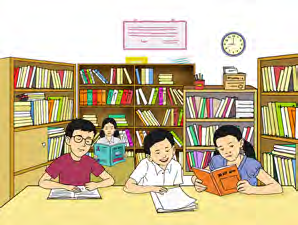
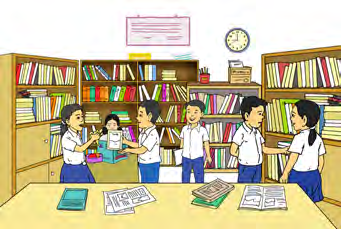
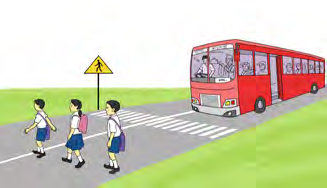
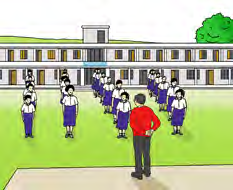
When you speak about the pictures, use full sentences. It is right to read quietly in the library. It is wrong to shout and scatter books there. It is right to cross the road at the zebra crossing. It is right to stand in line at assembly. Saying the reason makes your answer stronger: it is wrong to make noise in the library because other people are reading.
A Song for Asking Permission
Before you do something that involves another person, you ask first. English has special polite phrases for this, and this little song carries almost all of them.
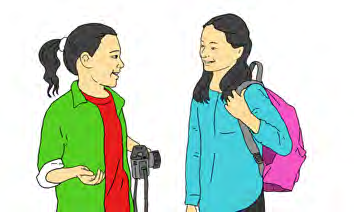
Would it be alright if I took your pen?May I write and recite a poem then?Of course, you can but rather do it soon.I am so restless to wait till noon.Can I take a photo with you somehow?Is it alright if I click it now?Oh, I am afraid, I can't say 'yes' now.Sorry, but I'd rather you not allow.
Read the song again and underline the asking phrases: Would it be alright if, May I, Can I, Is it alright if. Now find the answers. Of course, you can gives permission. I am afraid, I can't say yes and Sorry refuse it politely. Notice that even the refusal is soft and friendly. Nobody in the song simply shouts no.
The Story of Chulong and the Bird
Once there was a rich man named Chulong who lived in a village. Although he already had plenty, he wanted more riches and more money. One day, while walking in his garden, he saw a strange little bird in a bush. Its feathers were beautiful and colourful, and its voice was very sweet. Chulong had never seen such a bird in his life. He crept close to the bush unseen and caught it.
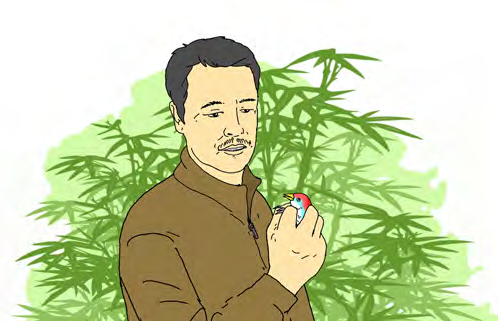
The bird asked why it had been caught. Chulong said he would sell it for a big amount of money. The bird warned him not to dream of making money through it. Nobody would buy it, the bird said, because in imprisonment it would lose its beauty and its sweet voice. As it spoke, the bird slowly turned black, and its lovely feathers looked like the feathers of a crow. Chulong's hopes of making money were shattered. Angry now, he threatened to kill the bird and eat its meat, but the bird replied that it was far too small to fill his hunger. Chulong could not answer.
Then the bird made an offer. Set me free, and in return I shall teach you three simple but useful rules. Chulong was irritated at first. What use are rules to a man who wants only money? But the bird promised the rules could profit him greatly, and it gave its word that it would not cheat him. Chulong decided to take a chance and released it. The bird flew up at once, sat on the branch of a tree, and its colour returned. It became beautiful again.
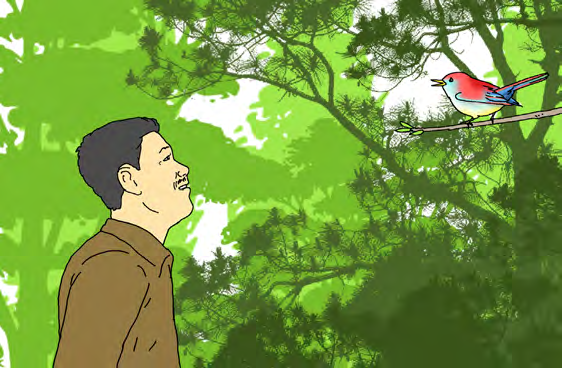
The bird kept its word and taught the rules. Chulong exploded. Silly bird, everyone knows these rules, you have cheated me! But the bird calmly asked him to think about his own actions that day. He had held the bird in his hands and released it. He had believed everything it said. And now he was sad about not having it. The rules were simple, but he had broken every single one. Then the bird flew away and disappeared from his sight.
Three Rules Worth Keeping
The bird's three rules: Never believe everything others say. Never be sad about something you do not have. Never throw away what you have in your hand.
The clever twist of the story is that Chulong breaks all three rules within minutes of learning them. He believes the bird's every word, so he breaks the first. He feels miserable about losing a bird he no longer owns, so he breaks the second. And he let the bird go when it was safely in his hand, so he broke the third before the lesson even began. The story is really about greed. A person who always wants more cannot enjoy what he already has, and he becomes easy to fool.
Words from the Story
These words carry the story, and you should be able to use each one in a sentence of your own.
| Word | Meaning |
| riches | lots of money and valuable things |
| strange | unusual, not seen before |
| unseen | without being seen by anyone |
| amount | a quantity of money |
| imprisonment | being kept locked up, not free |
| shattered | completely broken or destroyed |
| irritated | annoyed, a little angry |
| released | set free, let go |
| silly | foolish, not sensible |
| disappeared | went out of sight |
Rules in the Library and the Classroom
Schools write their rules down and put them on the wall so that everyone can see them. Read these two posters carefully. Notice that the library rules are arranged so that their first letters spell the word LIBRARY.
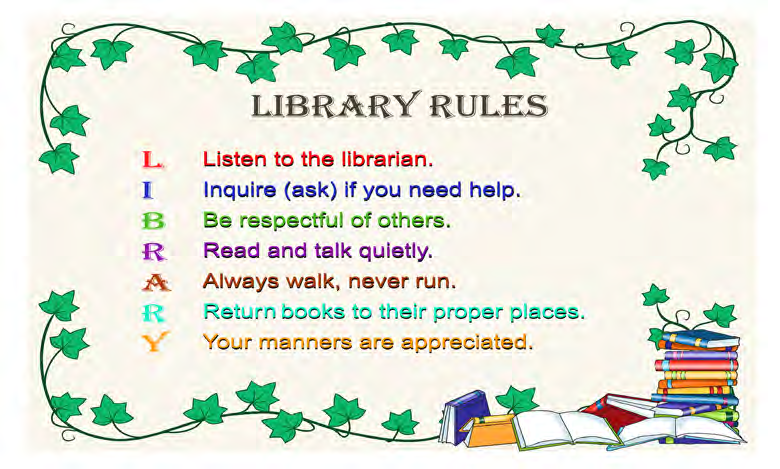
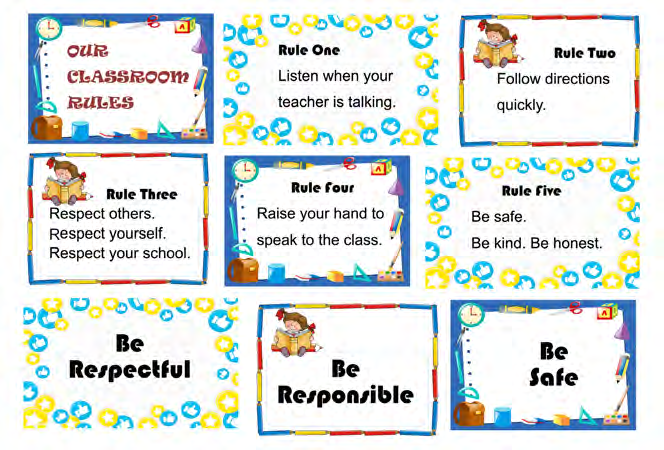
Rules like these are written as commands. Listen when your teacher is talking. Raise your hand to speak to the class. Return books to their proper places. A command starts with the base form of the verb and does not need a subject. When you write your own rules later in this unit, use the same shape: short, clear commands.
Asking, Giving and Refusing Permission
Permission is the freedom someone gives you to do something. You ask for it before you act, and the other person may give it or refuse it.
| Purpose | Expressions |
| Asking for permission | May I ...? Can I ...? Is it okay if I ...? |
| Giving permission | Yes, you may. Of course. Yes, you can. |
| Refusing permission | I'm sorry. You can't. I'm afraid. You can't. |
Here is how these expressions sound in a real conversation between two classmates in the library.
Never refuse with a bare No. It sounds rude in English. Begin your refusal with I'm sorry or I'm afraid, and then say you can't. The softener is not optional, it is part of the answer.
Listening to Announcements
Every school makes announcements, usually at the morning assembly. The head teacher may announce the school's timings, its uniform rules, what students may and may not bring, cleanliness habits such as washing hands frequently, how to use different dustbins for different waste, and when the library is open.
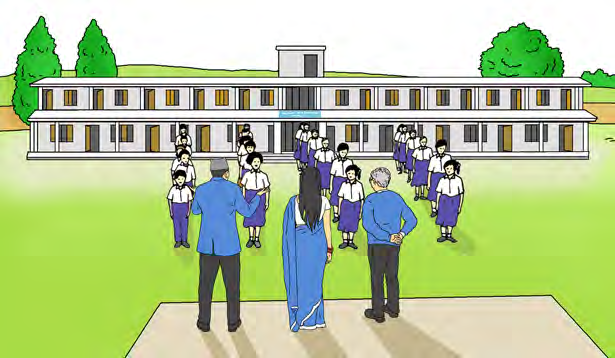
Good listening means listening for specific details, not just the general sound. Before you listen, read the questions so you know what to catch: a name, a time, a thing that is not allowed, a habit you must follow. While you listen, write only the key word, not the whole sentence. Afterwards, compare your notes with a partner and tell each other the rules you heard. Two listeners together catch more than one alone.
Making Yes/No Questions
A Yes/No question is a question that can be answered simply with Yes or No. It begins with a helping verb such as is, are, am, can, may, do, does or did.
There are two situations. If the statement already has a helping verb like is, are, am, can or may, move that verb to the front of the sentence. She is an honest girl becomes Is she an honest girl? They are playing now becomes Are they playing now? I may come inside becomes May I come inside? If the statement has only a main verb, borrow do, does or did. Use does for he, she and it in the present, do for I, we, you and they, and did for the past. After do, does or did, the main verb returns to its base form.
| Statement | Yes/No question |
| She is an honest girl. | Is she an honest girl? |
| They are playing now. | Are they playing now? |
| She dances well. | Does she dance well? |
| He eats an apple everyday. | Does he eat an apple everyday? |
| She gave me a book yesterday. | Did she give me a book yesterday? |
| They have a car. | Do they have a car? |
After does or did, the main verb must go back to its base form. Does she dance well? is correct. Does she dances well? and Did she gave me a book? are wrong, because does and did already carry the tense.
Writing Your Own Rules and a Letter
Now put the unit to work in your own writing. First, a set of class rules. Work with your group and follow these steps.
- Think of the problems your class actually faces, such as noise, latecomers or lost books.
- Write one short command for each problem, for example, Raise your hand before speaking.
- Keep the list small. Five or six rules that everyone remembers beat twenty that nobody reads.
- Write the final rules neatly on cardboard paper and paste them on the classroom wall or bulletin board.
Second, a friendly letter explaining the rules of your school to a friend. A friendly letter has a fixed shape: your address and the date at the top, a greeting such as Dear Anita, a body of two or three short paragraphs telling your friend what the rules are and what you think of them, and a closing such as Your friend, followed by your name. In the body, use the language of this unit: We must wear our uniform every day. We are not allowed to eat in the classroom. We may visit the library during snack time.
The Poem: Where Go the Boats
This poem is by Robert Louis Stevenson. A child stands beside a river, floating little boats on the water and wondering where the current will carry them.
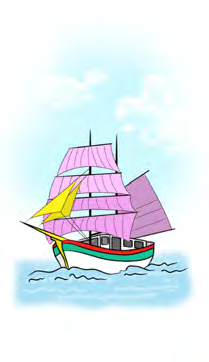
Dark brown is the river,Golden is the sand.It flows along for ever,With trees on either hand.Green leaves a-floating,Castles of the foam,Boats of mine a-boating,Where will all come home?On goes the riverAnd out past the mill,Away down the valley,Away down the hill.Away down the river,A hundred miles or more,Other little childrenShall bring my boats ashore.
The river is dark brown and the sand beside it is golden. Trees stand on both banks, which is what on either hand means. Green leaves float on the water, and the white foam piles up into shapes like little castles. The child's boats sail on past the mill, down the valley and down the hill, a hundred miles or more. The child knows the boats will never come back. Far away, other little children will find them and bring them to the shore. The poem turns a small game into a picture of how the things we let go travel on to delight someone else.
| Word | Rhyming word from the poem |
| band | sand, hand |
| drill | mill, hill |
| fever | river, ever |
| dome | foam, home |
| bore | more, ashore |
| Word | Meaning |
| castle | a large old-fashioned building |
| boat | a lightweight form of rubber, plastic or wood used for travelling on water |
| valley | a low area of land between hills or mountains |
| a-floating | floating on the water (an old poetic form) |
| mill | a building where grain is ground into flour |
| ashore | onto the land from the water |
The Full Stop
The full stop (.), also known as a period, is the simplest punctuation mark. It cuts sentences to the required length, like a knife.
The full stop has four jobs, and you should recognise each one when you see it.
- To mark the end of a statement. Kathmandu is the capital of Nepal. My sister studies in Grade 8.
- To indicate an abbreviation. Dr. Karki is a physician. The bus leaves between 6 a.m. and 7 a.m.
- To separate the whole number from the decimal in numbers. 14.17 is read as fourteen point one seven.
- After a single word which can form a sentence on its own. Goodbye. Stop.
Project: Learning About Nelson Mandela
Finish the unit with a small research task. Visit your school library, or take help from your English teacher, and note down the details of Nelson Mandela's life. Collect his important dates of birth and death, his place of birth, and his works. Arrange your notes under clear headings so that you can present them to your class. This is your first practice at gathering facts about a real person and reporting them in English, a skill you will use again and again.
The full lesson is waiting for you
Create a free account to unlock activities, practice tests, presentations and videos - and to track your progress and confidence score for every subject.
Ask for permission with May I, Can I, Is it okay if I, or Would it be alright if.
11 more points to remember - sign in to see the rest.
Question 1 of 14