Questions Are How We Learn
A shopper at a vegetable stall asks how much the tomatoes cost. A referee lifts a red card and a player asks why. Two visitors point at a tall tower and ask when it was built. A crowd gathers in a lane and a passer-by asks what everyone is watching. Every one of these moments begins with a question. When you want information, you ask. When someone asks you, you answer clearly. That is the skill this whole topic builds.
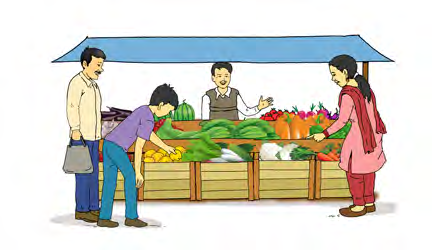
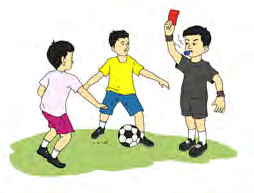
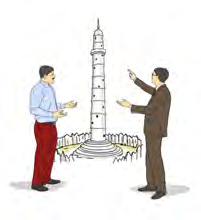
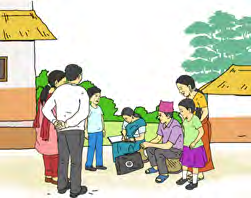
Here is a song made almost entirely of questions. Sing it, and as you sing, count how many different question words you can hear.
Silly fox! Silly fox! Where do you live?What are your foods and when do you sleep?What does your daughter do, what does your son?Always here always there, why do you run?Where are your parents and where are your friends?How do you help them, when there is rain?You always look lonely, always in tense.Are tigers, monkeys, ducks, hens, not your friends?
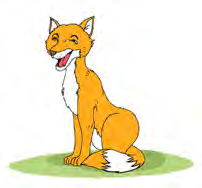
The song asks where the fox lives, what it eats, when it sleeps, why it runs and how it helps. Five question words in one short song. Each one asks for a different kind of information, and that is the idea to hold on to as you go through this topic.
Reading a Bar Chart
A bar chart is a picture that shows numbers as bars. The taller the bar, the bigger the number. The labels along the bottom tell you what each bar stands for, and the scale on the side tells you how much each bar is worth.
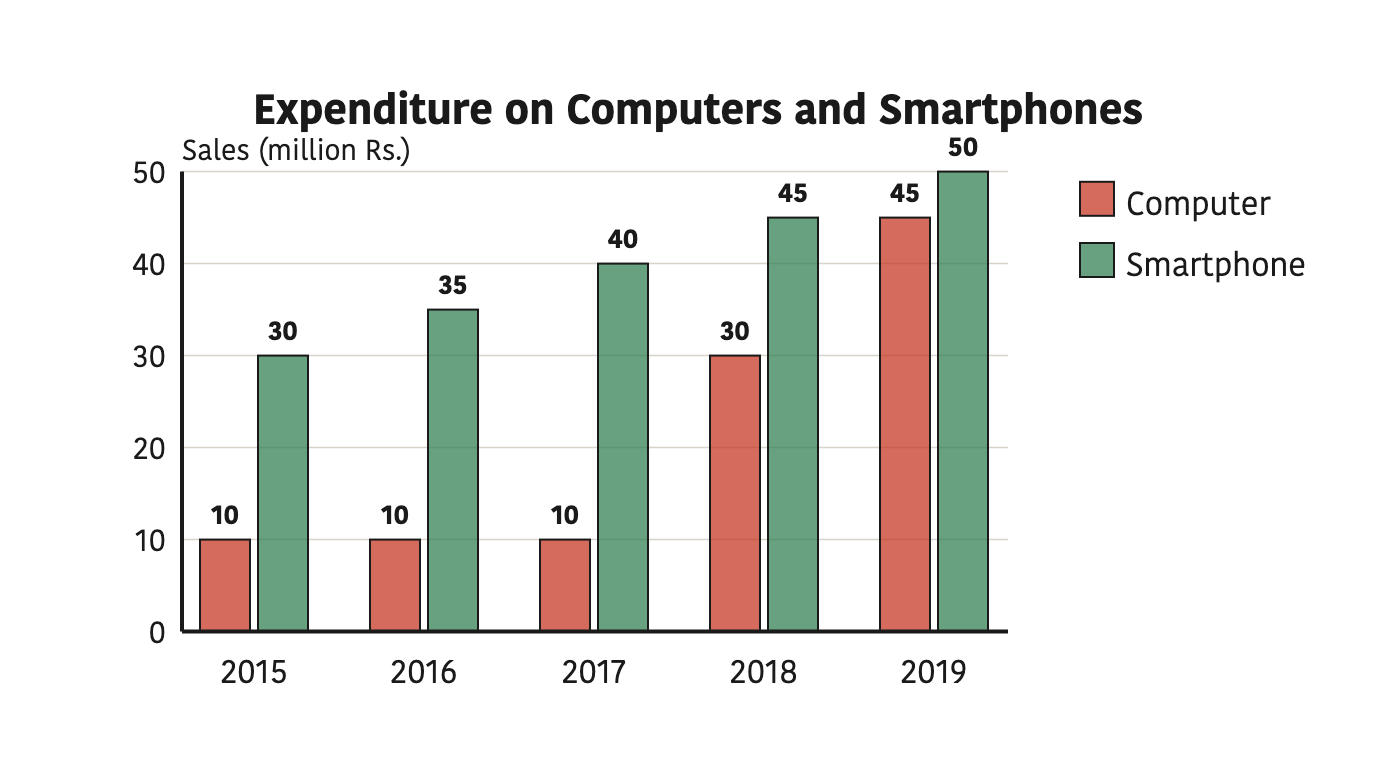
This chart shows the amount of money people in Kathmandu spent on computers and smartphones between 2015 and 2019. Read it bar by bar. Smartphone sales increased steadily, going up by the same small amount every year, from 30 million rupees in 2015 to 50 million rupees in 2019. Computer sales tell a different story. They remained constant at 10 million rupees until 2017, then increased dramatically, jumping to 30 million in 2018 and reaching 45 million rupees in 2019.
Now add the two together. The total expenditure on these electronic devices was 40 million rupees in 2015 and it rose to 95 million rupees in 2019. Overall, sales of both items grew, but computer sales grew more quickly at the end. If these trends continue, we can expect computer sales to overtake smartphone sales in 2020 or soon after.
A trend is the general direction in which numbers are moving over time. Numbers can trend upward, trend downward, or stay level.
Expenditure means the money spent on something. Total expenditure is all the money spent added together.
| Phrase | What it means |
| increased steadily | went up by about the same amount each time |
| increased dramatically | went up by a very large amount, suddenly |
| remained constant | stayed the same, did not change |
| grew | became bigger over time |
| overtake | become bigger than something that used to be bigger |
| in this period | during this stretch of time |
The Question Words
A question word is a word placed at the front of a question to say what kind of information you want. Most begin with wh, so these questions are called wh-questions: What do you eat? Where do you live?
Each question word asks for one kind of answer. If you want a place, only where will get it. If you want a reason, only why will. Learn this table well, because choosing the right question word is the first step in every question you will ever ask.
| Question word | It asks for | Example |
| What | a thing or an action | What did you do yesterday? |
| When | a time | When is your birthday? |
| Where | a place | Where do you live? |
| Why | a reason | Why are you learning English? |
| Who | a person | Who do you live with? |
| Which | a choice between things | Which do you prefer, ice-cream or cake? |
| Whose | an owner | Whose bag is this? |
| What kind | a type | What kind of music do you like? |
| What time | an exact time | What time do you usually go to bed? |
| How much | an amount of something you cannot count | How much coffee do you drink a day? |
| How many | a number of things you can count | How many brothers and sisters do you have? |
| How often | how frequently something happens | How often do you exercise? |
Use how many with things you can count one by one: books, sisters, goals. Use how much with things you cannot count one by one: water, coffee, money, time. How many money is always wrong, because money is measured, not counted.
Asking For and Giving Directions
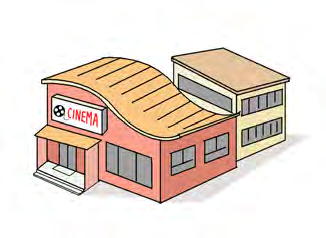
Imagine a girl standing in a new town. She needs the clinic, the post office, an ATM and a cinema, and she has never been here before. She has to ask, and someone has to answer her clearly. Direction words are what make those answers clear.



| Direction phrase | What it tells you | Example |
| next to | it is right beside another building | The clinic is next to the cinema. |
| opposite | it faces another building across the road | The museum is opposite the cinema. |
| past | go beyond that place and keep walking | Walk past the post office and you will see it. |
| in | it is inside another place | The ATM is in the bank. |
| on the corner | it stands where two roads meet | It is right on the corner. |
Practise this with a partner. One of you asks, Where is the post office? The other answers with a full direction: Go past the cinema, and it is next to the clinic, right on the corner. Then swap. A very good exercise is to give your partner directions from your school gate all the way to your own home, step by step, using these phrases.
Making Questions from Statements
Every statement hides a question inside it. Look at these three pairs. The statement gives the information, and the question is what someone would ask to get that information.
- She lost her yellow pen. The which question: Which pen did she lose?
- They play volleyball. The what question: What do they play?
- Supriya lives in Janakpur. The where question: Where does Supriya live?
Here is the method. Follow it with any statement.
- Step 1: Find the piece of information the question should ask about. In Supriya lives in Janakpur, that piece is Janakpur, a place.
- Step 2: Choose the question word that matches it. A place needs where.
- Step 3: Bring in a helping verb: do for I, you, we and they, does for he, she and it, and did for the past. If the sentence already has is, are, was, has or can, use that instead.
- Step 4: Put the words in this order: question word, helping verb, subject, main verb. Where does Supriya live?
- Step 5: Drop the piece of information you asked about. Janakpur disappears, because that is the answer, not the question.
Question word first, helping verb next, then the subject, then the main verb. That one order builds almost every question in English: Where does Supriya live? Why did your father go to the bank?
Do not leave out the helping verb. Where you live? and Where Supriya lives? are wrong. The helping verb must come before the subject: Where do you live? Also notice that once does or did arrives, the main verb goes back to its plain form. Supriya lives becomes does Supriya live, not does Supriya lives.
You can test yourself with jumbled questions. Take the scrambled words, find the question word, find the helping verb, and rebuild the order. So what doing are they? becomes What are they doing? and stay Kevin long in Paris did how? becomes How long did Kevin stay in Paris?
Writing About a Chart
Reading a chart and writing about one use the same skill in opposite directions. When you write a description of a chart, follow this plan.
- Step 1: Say what the chart shows: the subject, the place if there is one, and the time or the categories.
- Step 2: Describe the main pattern using trend language: increased steadily, remained constant, increased dramatically.
- Step 3: Pick out the biggest and the smallest numbers, because they are what a reader wants to know first.
- Step 4: Finish with one overall sentence, and a prediction if the trend makes one possible.
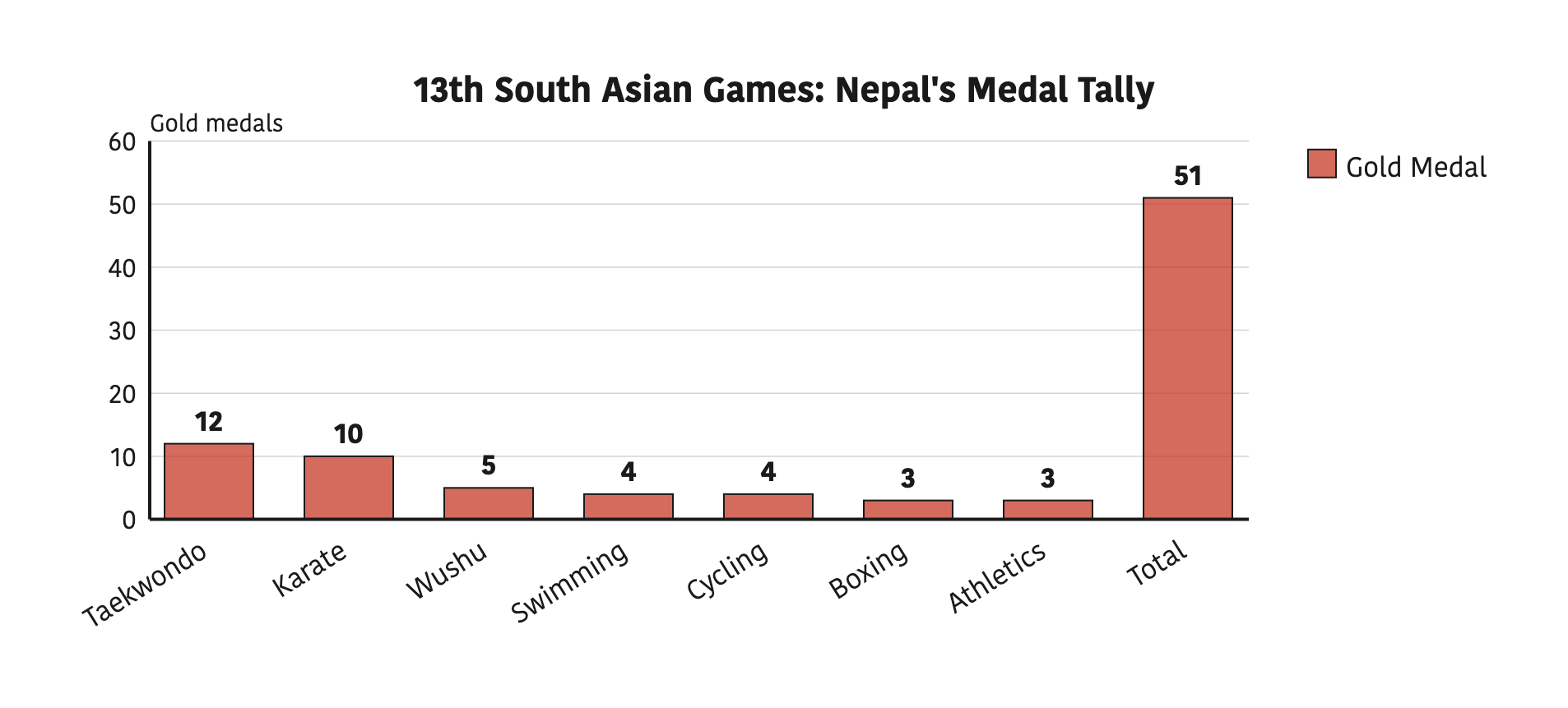
Here is a model description of this chart. The chart shows the gold medals Nepal won at the 13th South Asian Games, sport by sport. Taekwondo brought the most golds, 12, followed by karate with 10. Wushu won 5, swimming and cycling won 4 each, and boxing and athletics won 3 each. Altogether Nepal won 51 gold medals, its best performance in the Games. Notice how the description moves from the largest bar down to the smallest, and ends on the total.
Now make a chart of your own. Find out the number of boys and girls in each class at your school. Draw one bar for the boys and one for the girls of every class, label the classes along the bottom and the numbers up the side, and display your chart in class. Then write four sentences about it using the plan above.
Writing a Simple Poem
A poem does not need difficult words. It needs true lines and, if you like, a little rhyme at the ends: tall and all, free and me, read and need. Here is a short poem about a friend, built from ten plain lines.
My Good FriendI have a friend very tallWho is kind to allS/he loves and helps meI also help when freeWe play and readS/he helps me in needI feel like a family memberI cannot forget, I always rememberI am lucky to have this friend with meI take him as my own family.
Try one yourself about something you love: football, drawing, momo, the rain. Keep the lines short, say one true thing per line, and let the last words rhyme in pairs where they want to. A poem about your own interest is always easier to write than one about somebody else's.
Reading a News Report
A news report is a piece of writing that tells readers about a real event. It has a headline in big letters, a dateline giving the place and date, the most important fact in the first paragraph, and the details after that.
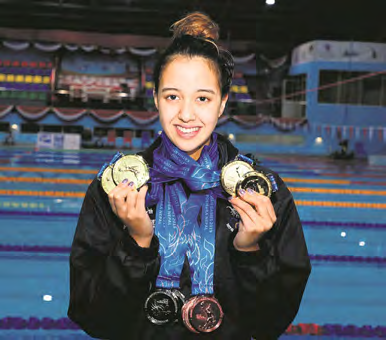
Read this report of a proud moment for Nepali sport. Under the headline Gaurika Bags Record Fourth Gold, the dateline reads Kathmandu, Dec 10. The swimmer Gaurika Singh added another gold to take her tally at the 13th South Asian Games to four, on the last day of the swimming competition in Lalitpur on Monday. With this she became the only Nepali athlete to win four golds in a single Games. Taekwondo's Deepak Bista had also won four SAG golds, but no athlete had achieved the feat in a single tournament before her.
The details come next, exactly where a news report puts them. Gaurika won her fourth gold in the women's 100 metres freestyle with a brilliant timing of 53.13 seconds, defeating her closest competitor, India's Shivangi Sarma, who clocked 58.15 to take the silver. Over the previous four days Gaurika had already won gold in the 200 metres freestyle, the 200 metres backstroke and the 400 metres freestyle, and a bronze in the 400 metres freestyle team event. Words worth learning from this report: a tally is a running count, an athlete is a person who competes in sport, a feat is a difficult achievement, and a tournament is one organised competition.
Now write news of your own. In a group, pick a real event at your school, a sports day, a quiz, a cleaning campaign, and report it: a short headline, a dateline with your town and the date, the most important fact first, and two or three details after it.
Reflexive Pronouns
A reflexive pronoun is a pronoun ending in self or selves, used when the action of a sentence comes back to the person who does it. In I cut myself, the person cutting and the person cut are the same, so myself is needed.
| Subject | Reflexive pronoun |
| I | myself |
| you (one person) | yourself |
| you (more than one person) | yourselves |
| he | himself |
| she | herself |
| it | itself |
| we | ourselves |
| they | themselves |
See how each one follows its subject.
- I cut myself while I was cutting grass.
- My father cut himself while he was shaving.
- The old lady sat in a corner talking to herself.
- Don't get angry. Control yourself! This is said to one person.
- If you want more to eat, help yourselves. This is said to more than one person.
- The picnic was great. We enjoyed ourselves very much.
Yourself is for one person and yourselves is for two or more. If a teacher tells the whole class to behave, it is Behave yourselves. Also, there is no such word as ourself or theirselves. The correct forms are ourselves and themselves.
The full lesson is waiting for you
Create a free account to unlock activities, practice tests, presentations and videos - and to track your progress and confidence score for every subject.
A question word at the front tells the listener what kind of information you want: what for things, when for time, where for place, why for reason, who for people, whose for owners.
11 more points to remember - sign in to see the rest.
Question 1 of 15