Remembering Things That Happened
Every day something happens that is worth telling. You win a trophy at a sports meet. A new factory opens near your town. Speakers argue in a debate competition. A climber finally stands on the top of a snowy mountain. When we tell someone about events like these, we are talking about the past, and English has special verb forms for exactly that job. This whole unit trains you to ask about the past, to read about the past, to listen to the order in which past things happened, and to write about them yourself.
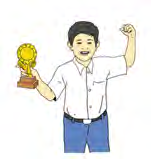

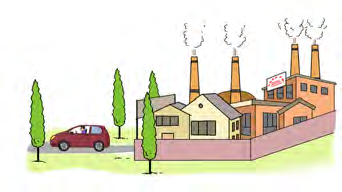
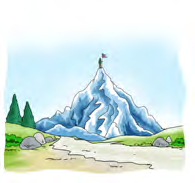
Before you read the unit's stories, think of one memorable event from your own life. It may be a festival, a journey, a prize, or even a day when something went wrong. Practise telling it aloud in two or three sentences. Notice that every verb you use will point backwards in time: went, saw, won, felt.
The Song of the Old Mother
This short poem by the Irish poet W. B. Yeats is sung in the voice of an old mother. She gets up before sunrise, kneels at the fireplace and blows on the embers until the fire glows. Then she scrubs, bakes and sweeps until the stars come out at night. While she works, the young people of the house lie long in bed, dreaming about ribbons for their hair and dresses, and their days pass in idleness.
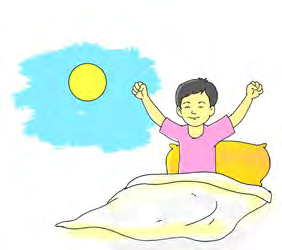
I rise in the dawn, and I kneel and blowTill the seed of the fire flicker and glow;And then I must scrub and bake and sweepTill stars are beginning to blink and peep;And the young lie long and dream in their bedOf the matching of ribbons for bosom and head,And their youth goes over in idleness,And they sigh if the wind but lift a tress:While I must work because I am old,And the seed of the fire gets feeble and cold.W. B. Yeats
The seed of the fire means the small glowing ember that starts the fire each morning. At the end of the poem it also stands for the old mother's own strength, which is slowly growing feeble and cold, just like an ember at night. The poem asks us to notice, and to respect, the quiet hard work of old people in our homes.
Umar in Disguise
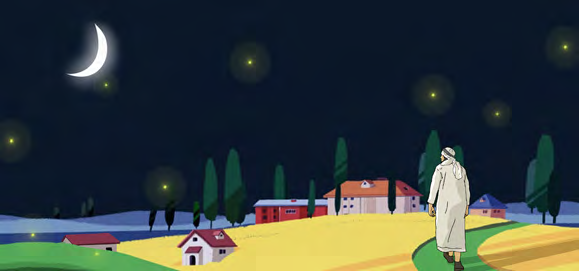
When Abu Bakr died, Umar was elected as the second Khalifah, the ruler of the vast Muslim Empire. He was a tall, well built man with a fair complexion. He was a good speaker, a just ruler and very strict in discipline, yet a man of simple habits. As ruler he handled vast treasures of gold, silver and jewels, and he was the first ruler to establish an administrative system in the country. He would visit the families of men who were away from home serving in the cause of Allah, supply their daily needs, write letters for them and even deliver their letters with his own hands. He was always anxious to know the real condition of his people, so at night he would walk about unattended and in disguise to find out their plight.
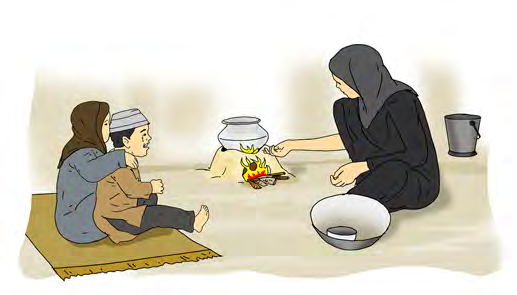
One night, while he was walking in the dark, he heard children crying. He followed the sound to a hut. Inside, a woman sat before a fire with a pot on it, and her small children sat crying beside her. It was very late for the children to have eaten. Umar stepped up and asked, "What is in the pot on the fire?" The woman explained that she had no food at all. She had filled the pot with water and stones and put it on the fire only to give her children the impression that food would soon be ready, hoping they would fall asleep while waiting.
Umar was distressed to hear this. He hurried back to the State Store and picked up a bag of flour, meat and cooking oil, and rushed back towards the hut. His servant begged to be allowed to carry the load, but Umar refused, saying, "It is my responsibility. You would not carry my burden." He meant that the servant could not answer for him on the Day of Judgment; a leader must carry the weight of his own duty.
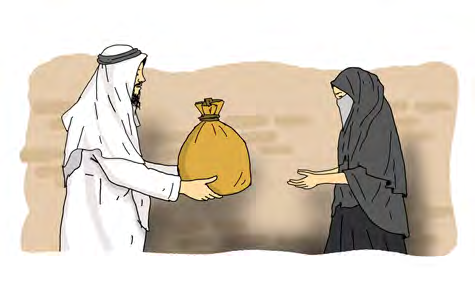
At the hut he gave everything to the woman and told her to prepare a meal. By then the tired children had fallen asleep, so Umar waited until the meal was ready and the children were woken and fed. The grateful woman, not knowing who he was, said, "It would be far better if you were the Khalifah of the Muslims, rather than that wretched Umar who is not aware of the condition of his people." Umar only smiled and said, "Well mother, Umar may not be so bad after all," and departed into the night.
A true leader does not wait for reports from others. Umar went out himself, saw the suffering with his own eyes, carried the relief with his own hands, and stayed until the children were fed.
Disguise: clothes or an appearance that hides who you really are. Umar walked in disguise so that nobody would recognise him as the ruler.
Khalifah: the title of the ruler of the Muslim Empire in early Islam. Umar was the second Khalifah, after Abu Bakr.
Words from the Story
Learn these words with their meanings. They come from both reading passages of this unit and you are expected to be able to use them in your own sentences.
- complexion: the natural colour and appearance of the skin of the face
- treasures: stores of gold, silver, jewels and other valuable things
- anxious: worried and eager to know about something
- unattended: alone, without any guard or servant
- plight: a sad and difficult condition
- distressed: very upset and troubled
- shrine: a holy structure built for worship
- ritual: a fixed religious ceremony done in a set way
- sacred: holy, treated with religious respect
- ancestors: family members who lived long before us
- imitating: copying the way something moves or looks
- excited: full of happy and eager feelings
Talking About Yesterday
To ask a friend about the past, use did with the base form of the verb: What did you do yesterday? Who did you go there with? The answer uses the past form of the verb: I visited a park. I went with my parents. Read this conversation aloud with a partner, then swap roles.

Now practise in pairs. One of you asks, "What did you do yesterday?" and the other answers using one of these ideas, adding who they were with. For example, the first clue becomes: "I went to a stationery shop with my brother and bought some balloons and chart paper."
- went to a stationery shop and bought some balloons and chart paper, with brother
- completed project work, alone
- played football, with friends
- drew a picture of a mountain, with sister
- went to the theatre, with friends
- worked in the field, with father
- did a painting, alone
- drew a picture, alone
- went to the cinema, with my sister
How Black Tea Is Prepared
Tea grows on green bushes on hill slopes, and women pluck the fresh leaves into baskets carried on their backs. In Nepal, Ilam is famous for its tea gardens. Many families drink tea every morning, so describing how it is made is a process everyone knows from home.
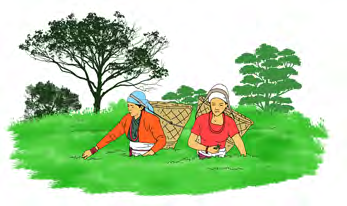
A process has a fixed order, and when you listen to one you must catch which step comes first, which comes next and which comes last. Words like first, then, after that and finally are the signposts. Here is the order for preparing black tea.
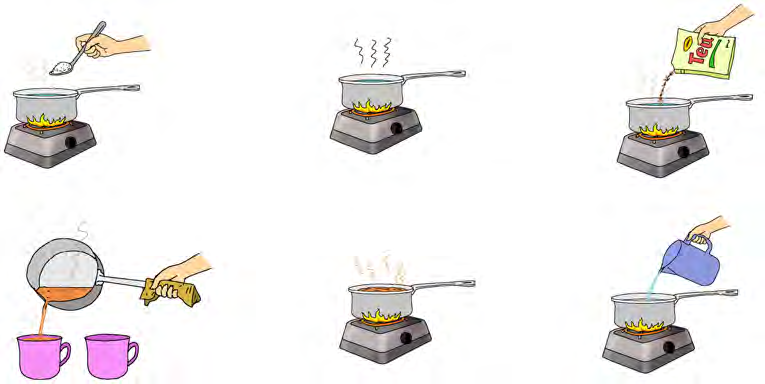
- First, pour water into a pan and put it on the stove.
- Then, let the water come to a boil.
- After that, add the tea leaves to the boiling water.
- Next, add sugar with a spoon.
- Then, let the tea boil for a short while until it turns brown.
- Finally, pour the tea into cups and serve it.
You can retell the same process about someone else in the past tense. Yesterday my brother prepared tea. First he poured water into a pan and boiled it. Then he added tea leaves and sugar. He let it boil until it turned brown, and finally he poured it into cups. Notice how every verb changed to its past form because the making already happened.
Grammar: Three Ways to Talk About the Past
Study these sentences. Each one talks about the past, but the verbs are shaped differently because each sentence looks at past time in a different way. I bought a story book last week. She was drawing a picture when I met her. She had gone home before I reached there. They played well and won the match yesterday. The children had gone to sleep tired before the meal.
Simple past: the past form of the verb, used for an action that started and finished at a definite past time. Example: They played well and won the match yesterday.
Past continuous: was or were followed by the ing form of the verb, used for an action that was in progress at a moment in the past. Example: She was drawing a picture when I met her.
Past perfect: had followed by the past participle of the verb, used for the earlier of two past actions. Example: She had gone home before I reached there.
| Tense | Form | Example | Use |
| Simple past | verb + ed, or past form | I bought a story book last week. | A finished action at a definite past time |
| Past continuous | was/were + verb-ing | They were dancing when we arrived there. | An action going on at a past moment |
| Past perfect | had + past participle | The children had gone to sleep before the meal. | The earlier of two past actions |
When two actions meet in one sentence, the longer background action takes the past continuous and the shorter interrupting action takes the simple past. Manju was watching a movie when I reached her house. The watching was already going on; the reaching happened in a moment. When one action was fully finished before another past action began, the earlier one takes the past perfect. She had gone home before I reached there.
After did, always use the base form of the verb, never the past form. Ask "Did you go?" and never "Did you went?" Also never mix the two past forms in one verb: "I was went" is wrong. Choose one: I went, or I was going.
Sakela Sili at Tundikhel
This passage is a recount: a writer named Shital tells about a real experience in the order it happened. Very early one morning in the month of Mangsir, her friend Binda called her on the phone and they agreed to go together. Shital was very excited, because she was attending the Sakela Sili festival at Tundikhel for the first time. Exactly at 9:30 the two friends reached Tundikhel. The place was beautifully decorated. Though Ubhauli is the festival of the Kirant community, people from many different communities had come to watch the celebration. At the centre stood a shrine decorated with cultural props.
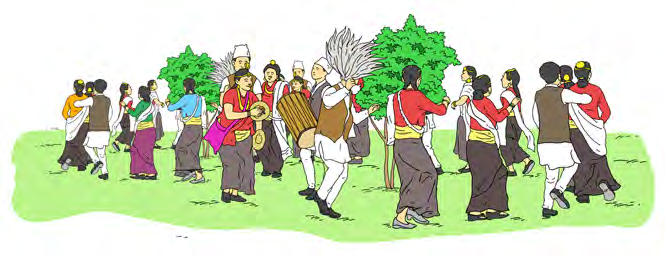
After some time the main priest, called the Nakso, performed a ritual in which a hen was sacrificed at a sacred place called Sakela Than, which is usually built under a sacred tree. When the Pooja was complete, the Nakso gave the signal for the dance and began dancing himself, calling others to join. A large mass of people of different ages, all in traditional dress, danced together in a circle. The male leader, called the Silimangpa, and the female leader, called the Silimangma, controlled and guided the dance, accompanied by two musical instruments, the Dhol and the Jhyamta. The Nakso narrated verses from the holy book, the Mundhum, and through the dance told the stories of how their ancestors travelled along the Dudh Koshi, the Sun Koshi and the Tama Koshi, and finally settled on the bank of the Bhote Koshi river. The dancers beautifully imitated the steps of a duck, a river bird, a black bird, a deer and a musk deer. Shital danced almost the whole day, because Sakela represents the history, culture and identity of the Kirant people, and she felt happy to be part of that culture.
Ubhauli: a festival of the Kirant community
Nakso: the main priest
Silimangpa: the male leader of the dance
Silimangma: the female leader of the dance
Dhol: a musical instrument
Jhyamta: a musical instrument played with the Dhol
Mundhum: the holy book of the Kirant people
Sakela Than: the sacred place, usually built under a sacred tree
A recount tells a real personal experience in the past tense, in the order it happened, and ends with the writer's feeling about it. Notice how this passage does all three.
Writing About Real and Imagined Events
Your first writing task is a recount paragraph about your last birthday. Before you write, recall the real details: when it was, where you were, who came, what you did first, next and last, and how you felt. Then write the events in that order, keeping every verb in the past tense.
- Begin by saying when and where the day happened.
- Tell the events in the order they happened, using first, then, after that and finally.
- Keep every verb in a past form: celebrated, came, cut, sang, gave.
- End with how you felt about the day.
Your second task is to build a complete short story from a bare outline, and to give it a suitable title of your own. Here is the outline. Each point is a bone; your sentences are the flesh.
- An old man had three sons.
- He was about to die, so he called his sons to give them advice.
- He asked them to bring sticks, and gave them the sticks tied in a bundle.
- He asked the eldest son to break the bundle, but he was unable to break it.
- He asked another son to break it, and then another, but each was unable to break it.
- The old man then asked them to work together and try once with one stick each, and they easily broke the sticks.
The story must end with its moral: Unity is strength. A single stick breaks easily, but sticks bound together cannot be broken, and the sons understand that they must stay united after their father is gone. A good title says this in a few words, such as The Bundle of Sticks or Together We Are Strong.
Project: Tell the Story in Pictures
Draw a set of pictures for the story of Umar in disguise: the ruler walking alone at night, the hut with the crying children and the pot of stones, Umar carrying the heavy bag himself, and the woman thanking the stranger. Then retell the whole story to your class using only your pictures as reminders. Retelling from pictures forces you to speak in your own words, in the past tense, in the right order, which is exactly the skill this unit builds.
Consonant Sounds of English
There are 24 consonant sounds in most English accents, conveyed by 21 letters of the regular English alphabet, sometimes in combination, for example ch and th. Sounds and letters are not the same thing: the single sound at the start of shoes is written with two letters, and the letter c makes different sounds in car and in city. In the table, each symbol between slashes is one sound, and the example words show that sound at the beginning, in the middle and at the end of words.
Consonant sound: a speech sound made by blocking or squeezing the flow of air with the lips, teeth or tongue. English has 24 consonant sounds but only 21 consonant letters, so some letters team up to spell one sound.
| Sound | Examples | Sound | Examples |
| /p/ | pair, appear, stop | /ʃ/ | shoes, machine, cash |
| /b/ | black, about, cab | /ʒ/ | genre, pleasure, garage |
| /t/ | tea, stale, rent | /h/ | horse, behind |
| /d/ | drink, reading, need | /tʃ/ | church, teacher, speech |
| /k/ | car, ranks, pack | /dʒ/ | job, wages, page |
| /g/ | game, agree, bag | /m/ | mat, camera, rum |
| /f/ | phone, afford, stuff | /n/ | nose, honey, cone |
| /v/ | van, fever, pave | /ŋ/ | think, sing |
| /θ/ | throne, anything, moth | /l/ | lanky, selfish, school |
| /ð/ | this, mother, breath | /r/ | rat, carrot |
| /s/ | state, mistake, yes | /w/ | water, underwear |
| /z/ | zoo, easy, choose | /j/ | yellow, kayak |
The two th sounds are different: /θ/ in moth is made with no voice, while /ð/ in mother is made with voice. Put your fingers on your throat while saying them; only /ð/ makes it buzz.
The full lesson is waiting for you
Create a free account to unlock activities, practice tests, presentations and videos - and to track your progress and confidence score for every subject.
Simple past is for a finished action at a definite past time: They played well and won the match yesterday.
11 more points to remember - sign in to see the rest.
Question 1 of 16