Guessing What May Happen
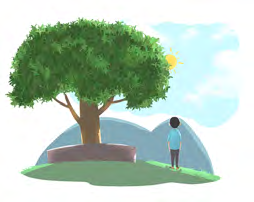
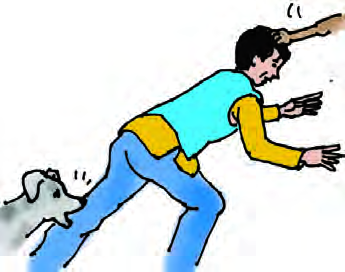
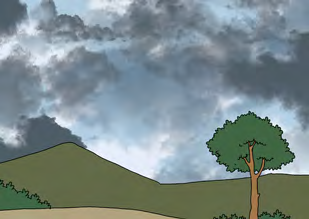
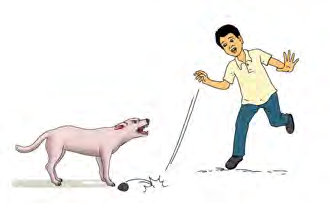
Look carefully at the world around you and you can often guess what will come next. Dark clouds gather over the hills, so rain is probably on its way. A dog barks angrily at a passing man, so the man could be in danger. You are never completely certain about such things. That is exactly why English has special words for guessing: may and might. When you see the four situations below, try saying aloud what may happen next in each one.
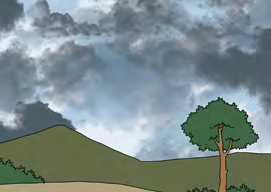
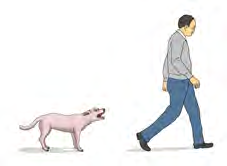
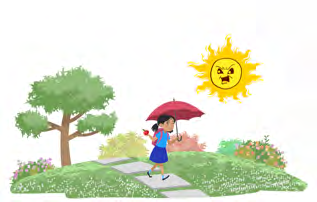
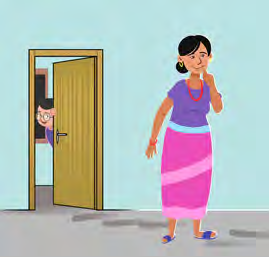
Notice how every guess uses may or might. Nobody knows for certain that the rain will fall or that the dog will bite. A guess is honest about not being sure, and may and might carry that honesty inside them. There is also a short song in this unit about staying calm while everything outside keeps changing. The poet says that the world may be full of chaos, but his own heart is a quiet paradise where his dreams live safely.
There may be chaos still around the world,This little world that in my thinking lies;For mine own bosom is the paradiseWhere all my life's fair visions are unfurled.Within my nature's shell I slumber curled,Unmindful of the changing outer skies,Where now, perchance, some new-born Eros flies,Or some old Cronos from his throne is hurled.
The song is by George Santayana. Even its first line uses the word may, because nobody can be sure what the world outside is doing. Here is a real practice you can do today: go outside and look at the sky. What does it look like? Is it likely to rain, or will there be sunshine? Say your guess in a full sentence and share it with your class.
The Musicians of Ilam
A man had a donkey that had worked hard for him for many years. Now the donkey was old and weak. The man shouted at him and said he would not feed a useless old donkey any more. The donkey thought about his life and made a plan. He liked music, so he decided to walk to Ilam, join a band, and become a musician.
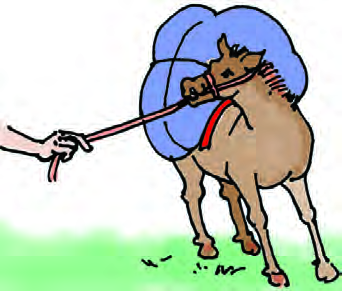
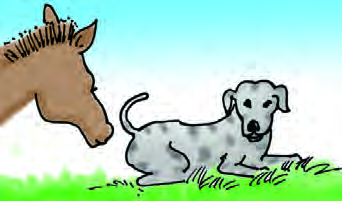
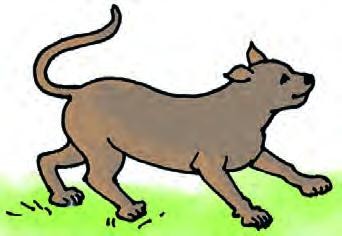
On the road the donkey met an old, tired dog. The dog said his master was going to kill him because he was too old to be useful. The donkey invited him to come along to Ilam. Further on the way they met a cat. She was too old to catch mice, and her mistress would not feed her. The donkey and the dog told her they were going to be musicians in Ilam, so the cat joined them too.
Soon they saw a cock. He crowed sadly that his mistress was going to eat him the very next day. The donkey, the dog and the cat told him not to worry and asked him to come with them to Ilam. So now there were four friends on the road.
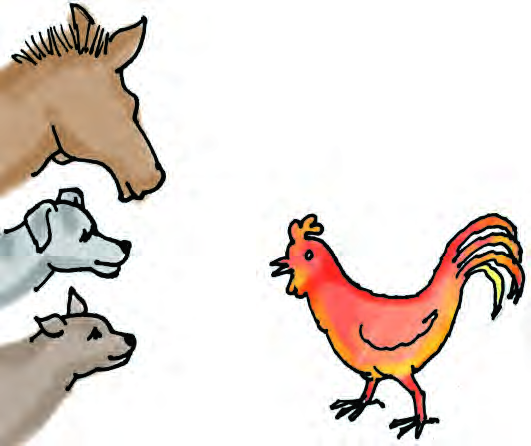
The four friends walked on until it grew dark, and they found themselves in a big forest. They saw a small light, walked towards it, and came to a small house. When they looked inside, they saw a gang of thieves sitting round a table, eating a big meal, laughing and talking. The hungry animals wanted a meal like that, so they made a plan. Silently they climbed on each other's backs. Then all four began to make their loudest noises at once. The donkey brayed, the dog barked, the cat miaowed and the cock crowed, and they all jumped through the window. The thieves were terrified. They ran away into the forest, and the four friends sat down at the table and ate the wonderful meal.
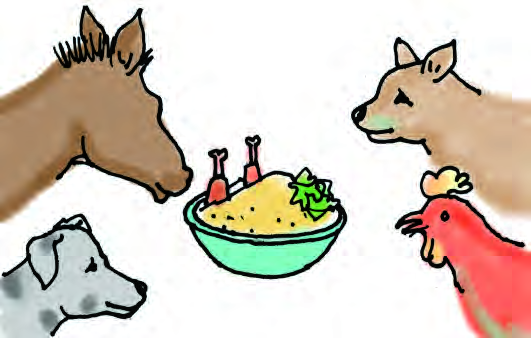
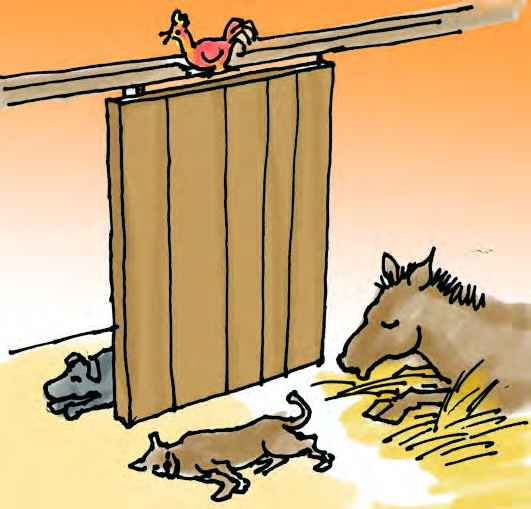
After eating, the friends put out the light and went to sleep. Each one chose a place. The cock sat on the beam over the door. The cat lay near the fire. The dog lay behind the door. The donkey lay on the straw in the front yard.
Out in the forest, the thieves saw the light go out. Everything was quiet, and they began to feel ashamed of running away. One thief offered to go back and look at the house. He crept inside and saw the cat's bright eyes shining in the dark. He thought they were burning coals of a fire, so he poked his candle at them to light it. The cat jumped up and scratched him with her claws. The thief ran for the door and stepped on the dog in the dark, and the dog bit his leg. As he stumbled across the yard, the donkey kicked him hard. And the cock flew down at his head, screeching cock-a-doodle-dooo!
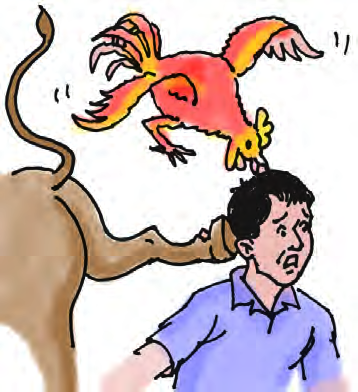
The poor thief limped back to his friends in the forest. His story was much bigger than the truth. He said there was a witch in the house who scratched his face, a man with a knife behind the door who stabbed his leg, a big monster in the yard who hit him with a stick, and a judge who shouted, Bring the thief to me! After that the thieves went far away and never came back. And the four friends? They never went to Ilam at all. They lived happily together in that same house in the forest forever.
Words from the Story
A musician is a member of a music band, a person who plays or makes music. The donkey dreamed of becoming a musician in Ilam.
A beam is a big and long piece of wood that holds a roof up. The cock slept on the beam over the door.
| Word | Meaning | Sentence from the story |
| band | a group of people who play music together | I can join a band. |
| crowed | made the loud cry of a cock | Tomorrow, my mistress is going to eat me, he crowed sadly. |
| brayed | made the loud, harsh cry of a donkey | The donkey brayed, the dog barked. |
| gang | a group of people, often doing something bad together | There was a gang of thieves sitting round a table. |
| frightened | very scared | Why were we so frightened? |
| poked | pushed somebody or something with a stick or finger | He poked his candle in the cat's eyes. |
| scratched | made marks with something sharp | The cat scratched him with her claws. |
| stumbled | nearly fell over | The thief stumbled across the yard. |
| stabbed | pushed a knife into somebody | He stabbed me in the leg. |
Speaking: Saying What May or Might Happen
When you look at a situation and make a guess about it, you can build your sentence in three moves. Look at what is happening. Think about what could come next. Then say it with may or might, often starting with the words I think. Study these two model sentences first.
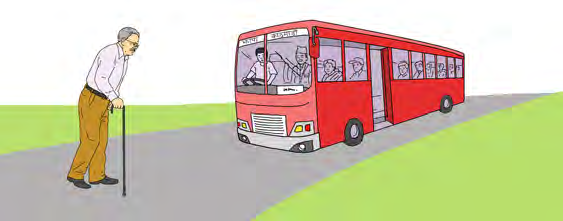
Now practise with these six situations. For each picture, say your own sentence with may or might. One good sentence is given under each picture, but yours can be different, as long as it is a sensible guess about what could happen next.
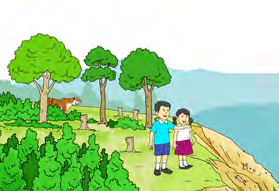
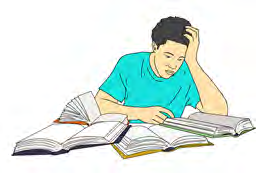
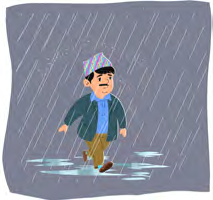
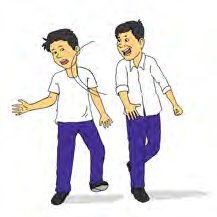
Listening for the Weather
Weather reports are full of guessing language, because nobody can be completely sure what tomorrow's sky will do. A reporter says the weather will improve, or that there is a possibility of rainfall in the hills. Scientists do not only guess, though. They also measure, and one of their simplest instruments is shown below.

A rain gauge is a piece of equipment that collects rain in a marked container and measures how much rain has fallen in a place.
When you listen to a weather report, listen for four things: the name of the person speaking, the names of places, the days being talked about, and the weather words such as improve, rainfall, sunny and fine. Here is a real task for this evening. Listen to the weather report on the radio or television. What might the weather in your province be like tomorrow? Note it down, and check the next day whether the forecast came true.
Grammar: may, might and must
Study these three sentences carefully. I am not sure, but I may come to meet you tomorrow. It's cloudy. It might rain today. He is in school uniform. So, he must be a student. All three talk about things the speaker cannot see directly, but they are not equally sure. The first two are guesses. The third is almost a certainty, because the uniform is strong evidence.
May and might are used when we are not sure about something in the present or the future. She is not here yet. She might be stuck in traffic. Jack may be coming to see us tomorrow.
Must is used when we feel sure that something is true, or it is the only realistic possibility. This must be her house. I can see her car in the garage. He must live near here because he always walks to work.
May, might and must all measure how sure you are. May and might mean perhaps. Must means almost certainly, because the evidence points one way only.
Do not use must for an ordinary guess. If you only think something is possible, use may or might. Keep must for the moment when the evidence leaves you feeling sure, as in: Come inside and get warm. You must be freezing out there.
This unit also practises will. We use will with a verb to say what we expect or promise to happen in the future. They will come back home soon. He will win the race. Don't worry. I will help you. Notice that will is stronger than may or might. Saying I will come is a promise, while I may come is only a possibility.
Will is used with the base form of a verb to talk about future actions we expect or promise to happen. He will win the race.
Writing Correctly
A paragraph can contain all the right words and still be wrong, if its capital letters and punctuation are missing. When you rewrite a faulty paragraph, check it against this short list.
- Begin every sentence with a capital letter.
- Give a capital letter to every name of a person, place or school, such as Saroj, Nepal Secondary School and Pokhara.
- End every sentence with a full stop.
- Put commas between names in a list, such as Sonu, Muna, Sujal and Bibhan.
- Put quotation marks around the exact words somebody speaks, with a comma before them: He replied, "Sure, I will be in time."
See how the rules change a broken sentence. The line my friend rita lives in butwal she has a dog is really two sentences and three missing capitals. Corrected, it becomes: My friend Rita lives in Butwal. She has a dog. Read your own writing aloud. Every place your voice stops is a place that probably needs a full stop.
Students remember the capital letter at the start of a sentence but forget the ones inside it. Names of people, places and schools take capital letters wherever they appear in the sentence.
The unit also asks for a paragraph of your own about the growing population of the world. Think about the problems it will create in the near future and use these clues: cost of living, diseases, deforestation, pollution and other problems. Write one clear sentence for each clue, then join them into a single paragraph. This is a good place to use will, because you are describing what you expect the future to bring.
The Arrow and the Song
The second reading is a famous short poem by Henry W. Longfellow. In it, a man shoots an arrow into the air and sings a song into the air, and both seem to vanish. Read the poem first, then its meaning below.
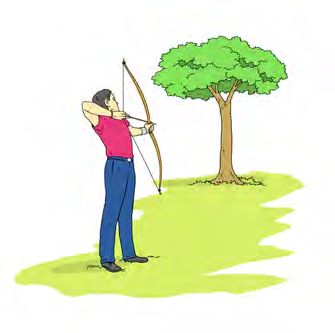
I shot an arrow into the air,It fell to earth, I knew not where;For, so swiftly it flew, the sightCould not follow it in its flight.I breathed a song into the air,It fell to earth, I knew not where;For who has sight so keen and strongThat it can follow the flight of song?Long, long afterward, in an oakI found the arrow, still unbroke;And the song, from beginning to end,I found again in the heart of a friend.
In the first stanza the poet shoots an arrow. It flies so swiftly that his eyes cannot follow it, and he does not know where it lands. In the second stanza he breathes a song into the air, and the song disappears the same way, because no eye is keen and strong enough to follow a song. The last stanza gives the surprise. Long afterwards he finds the arrow stuck in an oak tree, still unbroken. And he finds the song again too, complete from beginning to end, kept safely in the heart of a friend.
Nothing we send into the world is truly lost. A song, like a kind word, travels farther than we can see, and it is kept alive in the hearts of friends.
| Word | Meaning |
| shot | fired, sent flying from a bow |
| swiftly | very quickly |
| keen | sharp, able to notice things |
| oak | a kind of large, strong tree |
| unbroke | not broken (a poetic form of unbroken) |
Project: An Instrument Chart
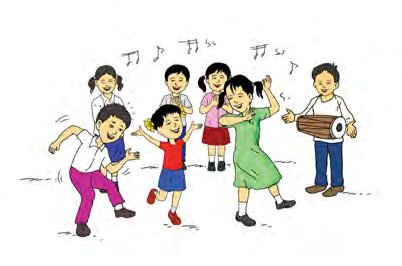
The four friends of the story wanted to be musicians, and your project brings music into the classroom too. Collect pictures of musical instruments from newspapers, magazines or printouts. Paste them onto a sheet of cardboard paper and write the name of each instrument neatly under its picture. Good instruments to look for are the madal, the flute, the sarangi, the guitar, the harmonium and the cymbals. When your chart is ready, present it to the class, pointing to each instrument and saying its name aloud.
The full lesson is waiting for you
Create a free account to unlock activities, practice tests, presentations and videos - and to track your progress and confidence score for every subject.
Use may and might when you are not sure about something in the present or the future: It might rain today.
11 more points to remember - sign in to see the rest.
Question 1 of 14