Powers, Bases and Indices
When one number is multiplied by itself several times, the product is written in a short form called a power. For example, \( 2 \times 2 \times 2 \times 2 \times 2 \) is written \( 2^5 \) and equals 32. The number being multiplied, 2, is the base. The small raised number, 5, is the index. It counts how many times the base is used as a factor. The index is also called the exponent.
In the power \( a^n \), \( a \) is the base and \( n \) is the index (exponent). It is read as 'a to the power n'.
Every method for solving equations in this lesson rests on the laws of indices. For a non-zero base \( a \) and indices \( m \) and \( n \), these laws hold:
- \( a^m \times a^n = a^{m+n} \): when powers of the same base are multiplied, the indices are added.
- \( a^m \div a^n = a^{m-n} \): when they are divided, the indices are subtracted.
- \( (a^m)^n = a^{mn} \): a power of a power multiplies the indices.
- \( a^0 = 1 \): any non-zero base with index 0 equals 1.
- \( a^{-n} = \frac{1}{a^n} \): a negative index means the reciprocal.
- \( a^{\frac{1}{n}} = \sqrt[n]{a} \): a fractional index means a root.
- \( (ab)^n = a^n b^n \): a product raised to a power passes the index to each factor.
A negative index does not make the answer negative. It turns the power upside down: \( 3^{-2} = \frac{1}{3^2} = \frac{1}{9} \), and \( \left(\frac{1}{2}\right)^{-3} = 2^3 = 8 \).
Finding x from a Table of Powers
Suppose we want the value of x that makes \( 2^x = 2 \) true. One way is to work out \( 2^x \) for x from \( -3 \) up to 3 and look for the value that gives 2. The same can be done for \( 5^{x+1} = 125 \) and for \( 3^x = \frac{1}{9} \). In each table the first entry is worked out to show how: \( 2^{-3} = \frac{1}{8} \), \( 5^{-3+1} = 5^{-2} = \frac{1}{25} \) and \( 3^{-3} = \frac{1}{27} \).
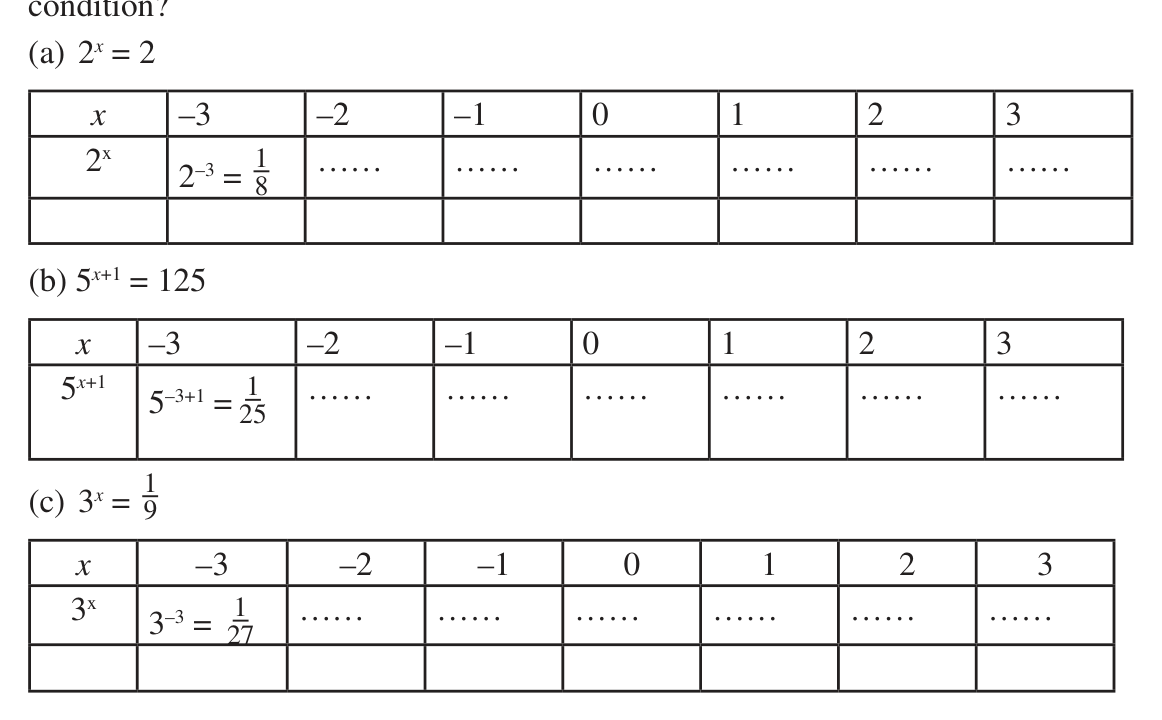
Working out every entry gives these values:
| \( x \) | \( 2^x \) | \( 5^{x+1} \) | \( 3^x \) |
| \( -3 \) | \( \frac{1}{8} \) | \( \frac{1}{25} \) | \( \frac{1}{27} \) |
| \( -2 \) | \( \frac{1}{4} \) | \( \frac{1}{5} \) | \( \frac{1}{9} \) |
| \( -1 \) | \( \frac{1}{2} \) | 1 | \( \frac{1}{3} \) |
| 0 | 1 | 5 | 1 |
| 1 | 2 | 25 | 3 |
| 2 | 4 | 125 | 9 |
| 3 | 8 | 625 | 27 |
Reading down each column for the required value:
- (a) \( 2^x = 2 \) when \( x = 1 \).
- (b) \( 5^{x+1} = 125 \) when \( x = 2 \), because \( 5^{2+1} = 5^3 = 125 \).
- (c) \( 3^x = \frac{1}{9} \) when \( x = -2 \).
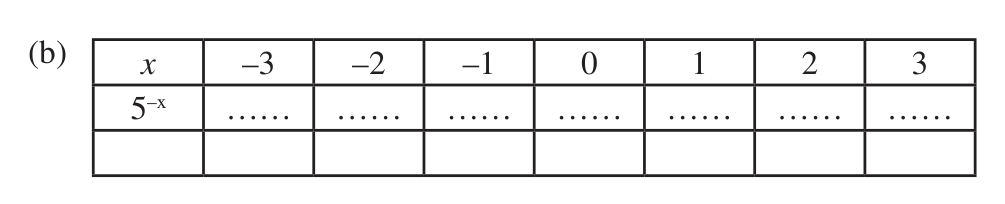
A minus sign in the index turns the table round. For \( 5^{-x} \), putting \( x = 2 \) gives \( 5^{-2} = \frac{1}{25} \), but putting \( x = -2 \) gives \( 5^{2} = 25 \). So the values of \( 5^{-x} \) get smaller as x gets larger. Complete the table below in the same way.
What Is an Exponential Equation?
Look again at \( 2^x = 2 \), \( 5^{x+1} = 125 \) and \( 3^x = \frac{1}{9} \). In every one the base is a known number and the unknown x sits up in the index. That is what makes them a new kind of equation.
An exponential equation is an equation in which the unknown appears in the index. For example, \( 2^x = 32 \), \( 3^{x-1} = 81 \) and \( 4^{x+1} - 4^x = 48 \) are exponential equations.
\( x^2 = 9 \) is not an exponential equation. There the unknown is the base and the index is the fixed number 2, so it is a quadratic equation. In \( 2^x = 8 \) the base is fixed and the index is unknown, so that one is exponential.
Method 1: Trying Values of x
The first idea is simple. Put \( x = 0, \pm 1, \pm 2, \pm 3, \ldots \) into the equation one after another. The value that makes the left side equal to the right side is the solution.
Take \( 2^x = 4 \). Putting \( x = 0 \) gives \( 2^0 = 1 \), not 4. Putting \( x = 1 \) gives \( 2^1 = 2 \), still not 4. Putting \( x = 2 \) gives \( 2^2 = 4 \), which matches the right side. So \( x = 2 \).
Trying values works only when the answer is a small whole number. The equation \( 3^{5x} = 81 \) has the answer \( x = \frac{4}{5} \), and no amount of trying 0, 1, 2 and so on will ever reach it. We need a method that works every time.
Method 2: Making the Bases Equal
Instead of guessing, we can rewrite both sides as powers of the same base. Once the bases match, the indices can be compared directly.
Equal bases, equal indices: if \( a^x = a^y \), where \( a > 0 \) and \( a \neq 1 \), then \( x = y \).
The rule fails for base 1, because \( 1^5 = 1^9 = 1 \) even though 5 and 9 are different. Base 0 fails for the same reason. So the rule is used only with a positive base other than 1.
So the method has three moves: write both sides as powers of the same base, equate the indices, then solve the ordinary equation that is left. Here is \( 3^{x-1} = 81 \) worked this way.
Step 1: Since \( 3 \times 3 \times 3 \times 3 = 81 \), writing 81 as a power of 3:
\[ 3^{x-1} = 3^4 \]
Step 2: The bases are equal, so equating the indices:
\[ x - 1 = 4 \]
Step 3: Adding 1 to both sides:
\[ x = 5 \]
Verification: putting \( x = 5 \) in the left-hand side:
\[ 3^{5-1} = 3^4 = 81 \]
The left-hand side equals the right-hand side, so \( x = 5 \) is correct.
'Solve and examine' means find x, then put it back into the original equation and show that the left-hand side (LHS) equals the right-hand side (RHS).
The same three moves solve \( 7^x = 49 \) in two lines: \( 7^x = 7^2 \), so \( x = 2 \). When the right side is a decimal or a fraction, change it to a fraction first and then to a power. Here is \( 4^{x-2} = 0.25 \).
Step 1: Changing 0.25 to a fraction:
\[ 4^{x-2} = \frac{1}{4} \]
Step 2: Writing \( \frac{1}{4} \) as a power of 4, using a negative index:
\[ 4^{x-2} = 4^{-1} \]
Step 3: Equating the indices:
\[ x - 2 = -1 \]
Step 4: Adding 2 to both sides:
\[ x = 1 \]
The same equation can be solved with base 2 instead, because \( 4 = 2^2 \) and \( \frac{1}{4} = 2^{-2} \). Then \( 2^{2(x-2)} = 2^{-2} \), so \( 2(x - 2) = -2 \), which gives \( x - 2 = -1 \) and again \( x = 1 \). Any common base gives the same answer.
Make the bases the same before comparing indices. From \( 4^x = 2^6 \) you cannot write \( x = 6 \). First change \( 4^x \) to \( 2^{2x} \); then \( 2x = 6 \) and \( x = 3 \).
Method 3: Taking Out a Common Power
Sometimes the unknown appears in two or more terms joined by plus or minus signs, as in \( 3^{x+1} + 3^x = \frac{4}{81} \). The indices cannot be compared while the left side is a sum. Instead, use \( a^{m+n} = a^m \times a^n \) to split each term so that the same power, here \( 3^x \), appears in every term. That power is taken out as a common factor, and the equation shrinks to a single power on each side.
\( 3^{x+1} + 3^x \) is not \( 3^{2x+1} \). The law \( a^m \times a^n = a^{m+n} \) is for multiplying powers. There is no law that adds the indices of a sum.
Step 1: Splitting \( 3^{x+1} \) as \( 3^x \times 3 \):
\[ 3^x \times 3 + 3^x = \frac{4}{81} \]
Step 2: Taking out the common factor \( 3^x \):
\[ 3^x (3 + 1) = \frac{4}{81} \]
Step 3: Adding inside the bracket:
\[ 3^x \times 4 = \frac{4}{81} \]
Step 4: Dividing both sides by 4:
\[ 3^x = \frac{1}{81} \]
Step 5: Since \( \frac{1}{81} = \frac{1}{3^4} \), writing it as a negative power of 3:
\[ 3^x = 3^{-4} \]
Step 6: Equating the indices:
\[ x = -4 \]
Verification: putting \( x = -4 \) in the left-hand side:
\[ 3^{-3} + 3^{-4} = \frac{1}{27} + \frac{1}{81} \]
Adding over the common denominator 81:
\[ \frac{3}{81} + \frac{1}{81} = \frac{4}{81} \]
This equals the right-hand side, so \( x = -4 \) is correct.
The power taken out need not be \( 3^x \) itself. In \( 3^{5x-4} + 3^{5x} = 82 \) the common power is \( 3^{5x} \).
Step 1: Splitting \( 3^{5x-4} \) as \( 3^{5x} \times 3^{-4} \), where \( 3^{-4} = \frac{1}{81} \):
\[ 3^{5x} \times \frac{1}{81} + 3^{5x} = 82 \]
Step 2: Taking out the common power \( 3^{5x} \):
\[ 3^{5x} \left( \frac{1}{81} + 1 \right) = 82 \]
Step 3: Adding inside the bracket:
\[ 3^{5x} \times \frac{82}{81} = 82 \]
Step 4: Multiplying both sides by \( \frac{81}{82} \):
\[ 3^{5x} = 81 \]
Step 5: Writing 81 as a power of 3:
\[ 3^{5x} = 3^4 \]
Step 6: Equating the indices:
\[ 5x = 4 \]
Step 7: Dividing both sides by 5:
\[ x = \frac{4}{5} \]
This is the answer that trying whole numbers could never find. With three terms the method is the same. Here is \( 3^{x-1} + 3^{x-2} + 3^{x-3} = 13 \).
Step 1: Splitting each term, since \( 3^{x-1} = 3^x \times 3^{-1} = \frac{3^x}{3} \) and so on:
\[ \frac{3^x}{3} + \frac{3^x}{9} + \frac{3^x}{27} = 13 \]
Step 2: Taking out \( 3^x \):
\[ 3^x \left( \frac{1}{3} + \frac{1}{9} + \frac{1}{27} \right) = 13 \]
Step 3: Adding the fractions over the common denominator 27:
\[ 3^x \times \frac{9 + 3 + 1}{27} = 13 \]
Step 4: Adding the numerator:
\[ 3^x \times \frac{13}{27} = 13 \]
Step 5: Multiplying both sides by \( \frac{27}{13} \) and writing 27 as a power of 3:
\[ 3^x = 27 = 3^3 \]
Step 6: Equating the indices:
\[ x = 3 \]
Method 4: Substituting to Get a Quadratic
Some equations contain \( 3^x \) together with its square \( (3^x)^2 = 3^{2x} \), or together with its reciprocal \( \frac{1}{3^x} \). Taking out a common power does not help here. Instead, the repeated power is given a new letter, for example \( 3^x = a \). Here a is not a base; it is just a letter standing in for \( 3^x \). The equation then becomes a quadratic equation in a, which is solved by factorisation. Finally each value of a is turned back into a value of x.
Substitution means replacing a repeated expression, such as \( 3^x \), by a single new letter, such as \( a \), so that the equation takes a form we already know how to solve.
Look for these signals: \( 3^{2x} \) or \( 9^x \) beside \( 3^x \), because both equal \( (3^x)^2 \); or \( \frac{1}{3^x} \), which is \( 3^{-x} \), beside \( 3^x \). Either one means the equation becomes a quadratic once \( 3^x \) is replaced by a letter.
Example: solve \( 3^x + \frac{1}{3^x} = 3\frac{1}{3} \).
Step 1: Changing the mixed number to an improper fraction:
\[ 3^x + \frac{1}{3^x} = \frac{10}{3} \]
Step 2: Letting \( 3^x = a \), which we call equation (i):
\[ a + \frac{1}{a} = \frac{10}{3} \]
Step 3: Adding the fractions on the left:
\[ \frac{a^2 + 1}{a} = \frac{10}{3} \]
Step 4: Cross-multiplying:
\[ 3a^2 + 3 = 10a \]
Step 5: Bringing every term to the left:
\[ 3a^2 - 10a + 3 = 0 \]
Step 6: Splitting the middle term, since \( 3 \times 3 = 9 \) and \( 9 + 1 = 10 \):
\[ 3a^2 - 9a - a + 3 = 0 \]
Step 7: Taking out common factors in pairs:
\[ 3a(a - 3) - 1(a - 3) = 0 \]
Step 8: Taking out the common factor \( (a - 3) \):
\[ (a - 3)(3a - 1) = 0 \]
Step 9: A product is zero only when one of its factors is zero. Either \( a - 3 = 0 \), so \( a = 3 \); or \( 3a - 1 = 0 \), so \( a = \frac{1}{3} \).
Step 10: Putting each value of a back into (i). If \( a = 3 \), then \( 3^x = 3^1 \), so \( x = 1 \). If \( a = \frac{1}{3} \), then \( 3^x = 3^{-1} \), so \( x = -1 \).
So the equation has two solutions, \( x = 1 \) and \( x = -1 \). Both check: \( 3 + \frac{1}{3} = 3\frac{1}{3} \) and \( \frac{1}{3} + 3 = 3\frac{1}{3} \).
The numbers 3 and \( \frac{1}{3} \) are values of a, not of x. The answer is finished only after each value of a has been turned back into a value of x.
Another example: solve \( 5 \times 4^{x+1} - 16^x = 64 \). Here \( 16^x = (4^2)^x = (4^x)^2 \), so \( 4^x \) and its square appear together.
Step 1: Splitting \( 4^{x+1} = 4^x \times 4 \) and writing \( 16^x = (4^x)^2 \):
\[ 5 \times 4 \times 4^x - (4^x)^2 = 64 \]
Step 2: Letting \( 4^x = a \), equation (i):
\[ 20a - a^2 = 64 \]
Step 3: Bringing every term to one side:
\[ a^2 - 20a + 64 = 0 \]
Step 4: Splitting the middle term as \( -16a - 4a \):
\[ a^2 - 16a - 4a + 64 = 0 \]
Step 5: Taking out common factors in pairs:
\[ a(a - 16) - 4(a - 16) = 0 \]
Step 6: Taking out the common factor \( (a - 16) \):
\[ (a - 4)(a - 16) = 0 \]
Step 7: So \( a = 4 \) or \( a = 16 \). Putting these into (i): \( 4^x = 4 = 4^1 \) gives \( x = 1 \), and \( 4^x = 16 = 4^2 \) gives \( x = 2 \). The values of x are 1 and 2.
A positive base raised to any power is always positive, so \( 3^x \) can never be 0 or negative. If the substituted letter comes out as 0 or a negative number, reject that value. A value of 1 is allowed, though: \( 3^x = 1 = 3^0 \) gives \( x = 0 \).
Choosing the Right Method
Before starting, look at the shape of the equation. The shape tells you which method to use. Some equations need two methods together: split the terms first, then substitute.
| What the equation looks like | Method | Example |
| One power on each side | Make the bases equal | \( 3^{x-1} = 81 \) |
| Several terms of one base joined by + or - | Take out the common power | \( 3^{x+1} + 3^x = \frac{4}{81} \) |
| \( 3^x \) with \( 9^x \) or \( \frac{1}{3^x} \) | Substitute and solve a quadratic | \( 3^x + \frac{1}{3^x} = \frac{10}{3} \) |
| Answer likely a small whole number | Try values of x | \( 2^x = 4 \) |
Proving Relations with Fractional Indices
Some questions give x as a sum or difference of fractional powers such as \( 3^{\frac{1}{3}} - 3^{-\frac{1}{3}} \) and ask you to prove a relation between x and its powers. The key is to cube both sides. Cubing turns the index \( \frac{1}{3} \) into a whole 1, and the product of the two terms becomes a simple number. These identities are needed:
\[ (p + q)^3 = p^3 + q^3 + 3pq(p + q) \]
\[ (p - q)^3 = p^3 - q^3 - 3pq(p - q) \]
Two facts make the cube easy: \( \left(3^{\frac{1}{3}}\right)^3 = 3 \), and \( 3^{\frac{1}{3}} \times 3^{-\frac{1}{3}} = 3^0 = 1 \).
Example: if \( x^2 + 2 = 3^{\frac{2}{3}} + 3^{-\frac{2}{3}} \), prove that \( 3x(x^2 + 3) = 8 \).
Step 1: Subtracting 2 from both sides:
\[ x^2 = 3^{\frac{2}{3}} + 3^{-\frac{2}{3}} - 2 \]
Step 2: Writing each power as a square, and writing 2 as \( 2 \times 3^{\frac{1}{3}} \times 3^{-\frac{1}{3}} \) because that product is \( 2 \times 1 \):
\[ \begin{aligned} x^2 &= \left(3^{\frac{1}{3}}\right)^2 + \left(3^{-\frac{1}{3}}\right)^2 \\ &\quad - 2 \times 3^{\frac{1}{3}} \times 3^{-\frac{1}{3}} \end{aligned} \]
Step 3: Using \( p^2 + q^2 - 2pq = (p - q)^2 \):
\[ x^2 = \left(3^{\frac{1}{3}} - 3^{-\frac{1}{3}}\right)^2 \]
Step 4: Taking the square root of both sides, and calling this equation (i):
\[ x = 3^{\frac{1}{3}} - 3^{-\frac{1}{3}} \]
Step 5: Cubing both sides of (i) with \( (p - q)^3 = p^3 - q^3 - 3pq(p - q) \):
\[ \begin{aligned} x^3 &= \left(3^{\frac{1}{3}}\right)^3 - \left(3^{-\frac{1}{3}}\right)^3 \\ &\quad - 3 \times 3^{\frac{1}{3}} \times 3^{-\frac{1}{3}} \\ &\quad \times \left(3^{\frac{1}{3}} - 3^{-\frac{1}{3}}\right) \end{aligned} \]
Step 6: Simplifying: the first cube is 3, the second is \( 3^{-1} = \frac{1}{3} \), the product \( 3^{\frac{1}{3}} \times 3^{-\frac{1}{3}} \) is 1, and by (i) the bracket is x:
\[ x^3 = 3 - \frac{1}{3} - 3x \]
Step 7: Multiplying both sides by 3, since \( 9 - 1 = 8 \):
\[ 3x^3 = 8 - 9x \]
Step 8: Adding \( 9x \) to both sides:
\[ 3x^3 + 9x = 8 \]
Step 9: Taking out the common factor \( 3x \):
\[ 3x(x^2 + 3) = 8 \]
This is what had to be proved.
When cubing \( p + q \) or \( p - q \), the middle part \( 3pq(p + q) \) is the one most often forgotten. It is also the part that brings x back into the equation.
When a whole number is added to the fractional powers, move it to the other side before cubing. Example: if \( x = 2 + 2^{\frac{1}{3}} + 2^{\frac{2}{3}} \), prove that \( x(x^2 - 6x + 6) = 2 \).
Step 1: Subtracting 2 from both sides, equation (i):
\[ x - 2 = 2^{\frac{1}{3}} + 2^{\frac{2}{3}} \]
Step 2: Cubing both sides with \( (p + q)^3 = p^3 + q^3 + 3pq(p + q) \):
\[ \begin{aligned} (x - 2)^3 &= \left(2^{\frac{1}{3}}\right)^3 + \left(2^{\frac{2}{3}}\right)^3 \\ &\quad + 3 \times 2^{\frac{1}{3}} \times 2^{\frac{2}{3}} \\ &\quad \times \left(2^{\frac{1}{3}} + 2^{\frac{2}{3}}\right) \end{aligned} \]
Step 3: Simplifying: the cubes are 2 and 4, the product \( 2^{\frac{1}{3}} \times 2^{\frac{2}{3}} = 2^1 = 2 \), and by (i) the bracket is \( x - 2 \):
\[ (x - 2)^3 = 6 + 6(x - 2) \]
Step 4: Expanding both sides:
\[ x^3 - 6x^2 + 12x - 8 = 6x - 6 \]
Step 5: Subtracting \( 6x \) and adding 8 on both sides:
\[ x^3 - 6x^2 + 6x = 2 \]
Step 6: Taking out the common factor x:
\[ x(x^2 - 6x + 6) = 2 \]
Mixed Practice Across Algebra
Exponential equations are practised together with the rest of this year's algebra: sequences, quadratic equations and algebraic fractions. Three of those mixed problems can only be understood with a picture, so they are set out here. Their full working is given with the questions.
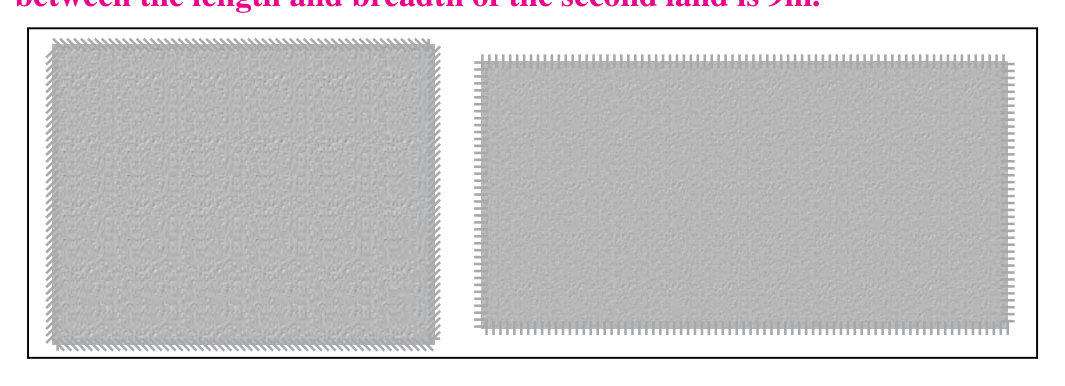
Harisaran has two rectangular fields, and each has an area of 360 m². In the first field the length is 2 m more than the breadth; in the second it is 9 m more. He needs to find how much barbed wire will fence each field.
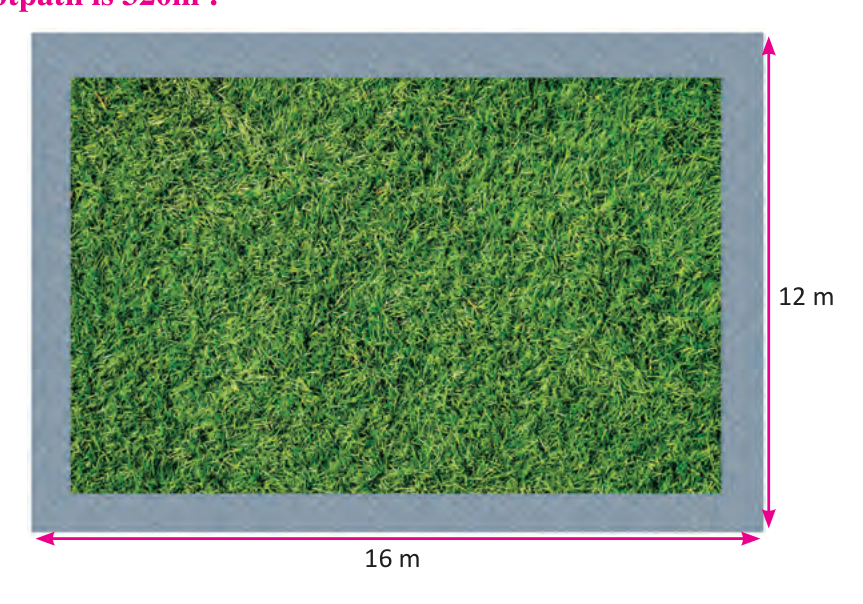
A footpath of equal width runs all round a grassland 16 m long and 12 m wide. The grassland and footpath together cover 320 m². Taking the path's width as x, the outer rectangle is \( (16 + 2x) \) m long and \( (12 + 2x) \) m wide, because the path lies on both sides.
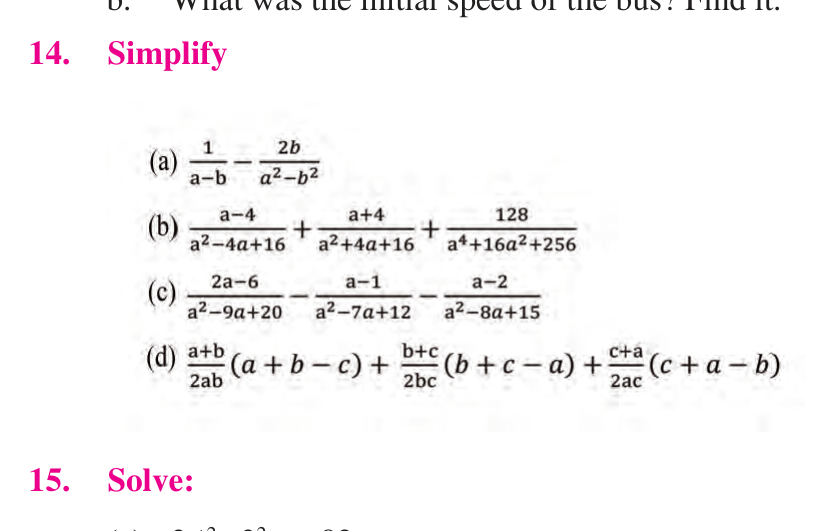
The last problem sets four algebraic fractions. Each is simplified by factorising the denominators and combining over a common denominator.
The full lesson is waiting for you
The notes are free to read in full. A free account opens the rest of the practice, and tracks your progress and confidence score for every subject. Presentations and videos need approval from Learn Yeti.